Full-Spectrum Does Not Equal Healthy, and Color Temperature Is Not a Cure-All
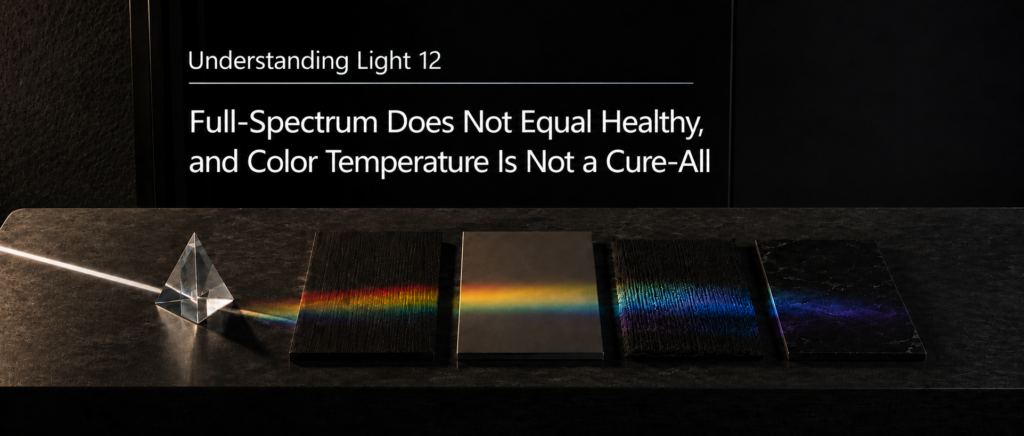
Bringing the spectrum back to measurable characteristics instead of asking it to carry promises beyond the evidence
Author | Lawrence Lin
Chairman, GLGA | Board Member, GLG | IWBI WELL Light Concept Advisor | Founder & CEO, LRS
“We use a full-spectrum light source, so it’s better for your eyes, helps you sleep, and is closer to natural daylight.” This kind of marketing language is common. “Full spectrum” sounds complete and natural, which makes it particularly easy to attach claims that go beyond the available evidence.
At present, “full spectrum” is not a standardized prescription that automatically corresponds to specific health outcomes in market communications. To evaluate a light spectrum, we should return to specific measurable metrics: color rendering, gamut, distribution across specific wavelength bands, mel-DER, and overall performance under different operating conditions.
Continuous Does Not Mean Suitable for Every Time of Day
A seemingly continuous and smooth spectrum may provide a pleasant color experience, but whether it is appropriate for a morning office, an evening residence, or museum display still depends on quantity, direction, timing, and the people exposed to it.
Daylight itself is not a fixed spectral curve. It changes with weather, time of day, orientation, and sky conditions.
Without specifying the conditions of comparison, saying that a light source is “like daylight” is difficult to turn into a rigorous conclusion. Moreover, the goal before bedtime is not to reproduce midday sunlight, but to reduce unnecessary light exposure.
CCT Cannot Replace the Spectrum
Two 3000 K light sources can have different levels of color fidelity, gamut, and mel-DER.
Conversely, a 4000 K product that has been appropriately dimmed may result in lower mel-EDI at the eyes than an undimmed 2700 K product.
Color temperature affects color appearance and atmosphere, but it is not a physiological dose.
Color quality should also not be evaluated solely through the general color rendering index Ra. CIE has recommended that, during the transition period, CIE Rf and Ra be reported together. If a project is concerned with color preference and colorfulness, more complete gamut and hue information is also needed.
What Should You Ask When Comparing Products?
Request machine-readable spectral data, rather than just images or marketing graphics.
Confirm that the data correspond to the specified power level, color temperature, and dimming setting.
Check whether color fidelity, gamut, mel-DER, efficiency, and temporal light modulation are all acceptable at the same time.
If a supplier claims that a product improves sleep or cognition, ask about the population studied, the exposure scenario, and the duration of the human study.
A truly professional product is not afraid to clearly state its boundaries.
What We Can Say Today / What We Cannot Yet Say
What we can say today: The shape of the spectrum affects color appearance and α-opic stimulation; complete spectral data have greater engineering value than a “full-spectrum” label.
What we cannot say: A continuous spectrum, a CCT close to daylight, or a high Ra value automatically means that a product is better for the eyes, improves sleep, or is suitable for all-day use.
Three Things You Can Do Today
- Replace the term “full spectrum” with verifiable spectral, color, and α-opic metrics.
- When comparing dimmable and tunable products, evaluate every critical scenario, rather than only the rated operating condition.
- When communicating with consumers, clearly distinguish between “natural appearance / accurate color” and “medical or health outcomes.”
Evidence label: Established consensus / Open question.
The spectrum can be accurately measured; there is no automatic equivalence between a single market label and long-term health outcomes.
References
- CIE PS 002:2025 :https://www.cie.co.at/publications/cie-ps-0022025-cie-position-statement-colour-quality-metrics-2nd-edition
- CIE S 026:2018 :https://www.cie.co.at/publications/cie-system-metrology-optical-radiation-iprgc-influenced-responses-light-0
- CIE 253:2024 — Technical Reports :https://cie.co.at/publications/technical-reports
In the next article, we continue unpacking another term that easily triggers anxiety: Is blue light actually a risk, a circadian signal, or simply a marketing buzzword?

 English
  Chinese (Taiwan)
  Chinese (China)
  German