“Blue Light”: Risk, Circadian Signal, or Marketing Buzzword?
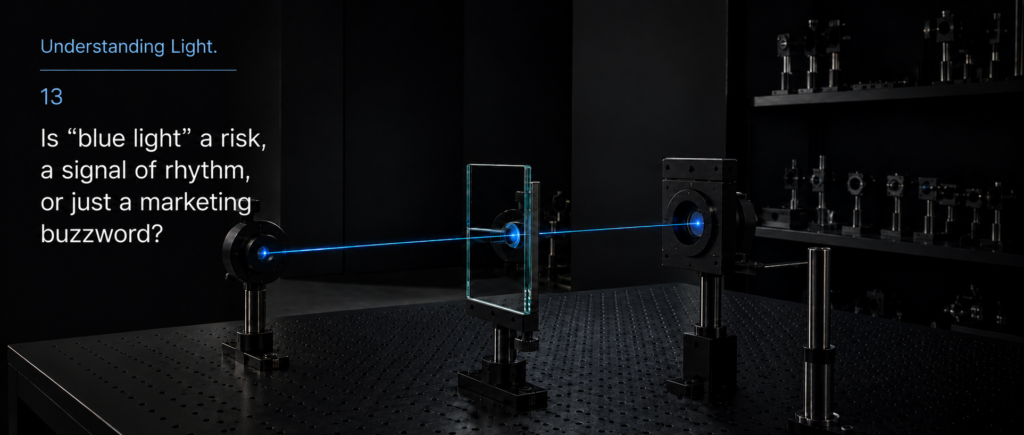
Behind the same term are actually three completely different questions.
Author | Lawrence Lin
Chairman, GLGA | Board Member, GLG | IWBI WELL Light Concept Advisor | Founder & CEO, LRS
Consumers sometimes ask me about “blue-light protection” lighting: “If blue light is harmful, why do we also want to increase melanopic stimulation during the day?” This is not a contradiction. Rather, the industry has long used the single term “blue light” to describe three different concepts.
Blue-light hazard, circadian-related stimulation, and visual fatigue need to be discussed separately. Their wavelength ranges may overlap, but their mechanisms, doses, evaluation methods, and risk contexts are different.
Blue-Light Hazard: Photochemical Retinal Damage
The blue-light hazard defined by CIE specifically refers to the risk of photochemical retinal injury, evaluated using the relevant hazard weighting function together with radiance/irradiance. It is not the same as an effect on sleep, nor is it the same as “feeling tired from looking at a screen.”
Under foreseeable normal-use conditions, ordinary white-light illumination generally does not constitute a blue-light hazard.
High-intensity specialized light sources, close-range viewing, or specific industrial environments still need to be evaluated according to requirements such as IEC 62471. The above conclusion should not be used to rule out every situation.
Circadian-Related Stimulation: Timing and Exposure Matter
The melanopsin pathway is relatively sensitive to short-wavelength visible light, but it should be described using the melanopic metrics defined in CIE S 026, rather than simply saying that there is “more blue light.”
Appropriate light exposure during the day and reduced exposure at night are time-based strategies. They should not be substituted with blue-light-hazard classifications.
Likewise, reducing the impact of screens at night is not simply a matter of putting a yellow filter over the display. Brightness, viewing distance, exposure duration, psychologically stimulating content, and the lighting of the entire room all matter.
Visual Fatigue: Often Not a Wavelength Problem
Dry eyes, reduced blinking, text that is too small, reflective glare, prolonged close-up viewing, and posture can all contribute to discomfort.
Blaming all visual fatigue on blue light can cause genuinely effective interventions to be overlooked.
A responsible “low-blue-light” product should explain which part of the spectrum has been reduced, what color performance has been sacrificed, which time periods the product is intended for, and which testing methods support the claim.
What We Can Say Today / What We Cannot Yet Say
What we can say today: Blue-light hazard has a specific photobiological safety definition; melanopic stimulation has its own measurement framework; and visual fatigue is a multifactorial issue.
What we cannot say: Blue light in ordinary white-light illumination necessarily damages the retina, or that removing blue light automatically solves sleep problems or visual fatigue.
Three Things You Can Do Today
- When you hear the term “blue light,” first ask whether the discussion concerns photobiological safety, circadian effects, or visual comfort.
- For specialized high-intensity light sources, use the IEC 62471 series for risk classification rather than substituting a marketing label.
- At night, prioritize reducing overall brightness and exposure duration, and then optimize the spectrum.
Evidence label: Established consensus.
These three questions should be measured and communicated separately.
References
- CIE Position Statement on Blue Light Hazard :https://cie.co.at/publications/position-statement-blue-light-hazard-april-23-2019
- IEC 62471-7:2023 :https://webstore.iec.ch/en/publication/68810
- CIE S 026:2018 :https://www.cie.co.at/publications/cie-system-metrology-optical-radiation-iprgc-influenced-responses-light-0
In the next article, we look at another issue often dismissed with the phrase “flicker-free”: Why can invisible flicker still affect lighting quality?

 English
  Chinese (Taiwan)
  Chinese (China)
  German