• CAF, CS, EML, EDI/DER… are these commonly referenced metrics actually talking about the same thing?

    In recent years, more and more terms that sound highly technical have emerged in the lighting industry: CAF, CS, EML, m-EDI, EDI, DER…

    Many manufacturers, designers, consultants, and system providers have heard of them—and to some extent, used them. But if we push one step further and ask:

    • What exactly does each of these metrics describe?
    • Are they actually talking about the same thing?
    • Can they be used interchangeably?

    The answers are often far less clear than people assume. This reflects a very typical situation in today’s lighting industry: There are more and more terms, but a true common language has not yet been established.

    If the industry genuinely wants to move from simply “lighting up spaces” to accurately understanding how light affects people, then the first step is not to invent yet another new term.

    It is to put these commonly used metrics back into their proper context.


    Are these metrics really describing the same thing?

    Let’s start with the conclusion: CAF, CS, EML, and EDI/DER are not different names within the same framework.

    They originate from:

    • different stages
    • different objectives
    • different modeling approaches

    Some function more like spectral efficacy ratios.
    Some behave more like physiological response models.
    Some are closer to application-level compromise metrics.
    And others are more like standardized, computable, and transferable baseline coordinates.


    So the issue is not whether these terms should exist

    The real issue is this: If the industry treats all of them as interchangeable “healthy lighting metrics,” confusion becomes inevitable.

    But if each metric is placed back into its proper role, many of the current ambiguities start to resolve themselves.


    Why is traditional lighting language no longer sufficient?

    In the past, the most familiar language of lighting was built around:

    • illuminance
    • luminance
    • correlated color temperature (CCT)
    • color rendering (CRI)
    • light distribution
    • glare

    These metrics are still essential. They primarily serve visual tasks and spatial quality:

    • Can we see clearly?
    • Is it comfortable?
    • Are colors accurate?
    • Is the space bright enough?

    But the scope of lighting has expanded

    A growing body of research now shows that light also affects:

    • circadian rhythms
    • alertness
    • emotional experience
    • even certain behaviors and physiological responses

    Standards and position statements from the International Commission on Illumination have clearly indicated that: the traditional photopic system is not sufficient to fully describe human responses related to ipRGCs (intrinsically photosensitive retinal ganglion cells).


    This changes the fundamental questions

    The industry can no longer stop at asking:

    • “How many lux is this space?”
    • “Is it 3000K or 4000K?”

    Instead, it needs to ask:

    • Which photoreceptive channels is this light stimulating?
    • What does this imply for vision, circadian regulation, and emotional response?

    This is the real context behind new metrics

    This shift is precisely why metrics like:

    • CAF
    • CS
    • EML
    • EDI / DER

    have emerged.

    They are not just “new terminology,” but attempts to extend lighting language from: visual description → human biological interaction

    In other words: from “how the space looks” to “how light actually affects people.”

    The human eye doesn’t just “see” — it also “feels” light.

    In the lighting industry, the most commonly discussed elements are rods and cones. That’s not wrong.

    Rods are mainly associated with low-light (scotopic) vision. Cones are responsible for color, detail, central vision, and typical daytime visual functions.

    But today we know that, beyond rods and cones, there is another critically important photoreceptive pathway in the human eye: ipRGCs (intrinsically photosensitive retinal ganglion cells).

    These are associated with melanopsin, are more sensitive to short wavelengths, and are closely related to non-visual responses such as circadian rhythms, pupil response, and alertness.

    However, to be more precise, what truly needs to be considered is not three systems, but five classes of photoreceptor channels: S-cone, M-cone, L-cone, Rod, and Melanopsin / ipRGC.

    What CIE S 026:2018 establishes is a standardized metrology framework based exactly on these five photoreceptors.

    In other words, for the first time, the industry has a shared language that is not only about “what can be seen,” but about “how light stimulates the five types of receptors.”

    This is a critical shift. Because it means the lighting industry is moving from “spatial output” to “human input.”


    What do CAF, CS, and EML actually represent?

    1. CAF: closer to a “spectral efficiency ratio” mindset

    CAF (Circadian Action Factor) has long been used to compare the potential of different spectra to stimulate circadian-related responses.

    Its core logic is straightforward: under the same visual lighting conditions, is this spectrum more biased toward “circadian effect” or “visual effect”?

    So CAF is essentially a weighted efficiency ratio. It helps compare different SPDs under the same photopic lux to determine which produces stronger circadian-related stimulation.

    This approach is not without value. Its advantages are simplicity, intuitiveness, and suitability for early-stage comparisons.

    But it also has clear limitations:

    • First, it reflects spectral properties rather than actual human exposure dose.
    • Second, it does not inherently include time, spatial context, viewing direction, or actual eye exposure.
    • Third, it is not the primary shared language in current international standards.

    So CAF helps you understand “how biased a spectrum is,” but it is not suitable as a complete coordinate for human response.

    CAF is more like a spectral screening tool, not a full human-centric lighting language.


    2. CS: closer to a “specific physiological response model”

    CS (Circadian Stimulus) has also had significant influence in recent years, especially in North America. Its logic differs fundamentally from CAF.

    Rather than being a simple ratio, CS attempts—through a circadian phototransduction model—to map spectral stimuli onto a response scale related to melatonin suppression.

    UL’s DG 24480 also proposes design targets based on this type of framework. The strength of CS is that: It goes beyond saying “more or less biased,” and tries to quantify “how strong the circadian system stimulation is.”

    But this is also where the challenge lies. Once a metric moves from “describing input” to “predicting response,” it inevitably introduces modeling assumptions:

    • What spectral sensitivity functions are used
    • How rod, cone, and melanopsin interactions are handled
    • How dose-response is defined
    • How exposure duration is treated
    • How pupil state, timing, and exposure history are incorporated

    As a result, CS has been accompanied by considerable methodological debate.

    So a fair summary would be: CS is important, but it is better suited as an application-layer or response-layer model, rather than a foundational common coordinate system for the entire industry.


    3. EML: closer to a “transitional language for application”

    EML (Equivalent Melanopic Lux) has been widely promoted in application contexts such as WELL.

    Its key contribution is that it helped many people realize, for the first time: Not all lux are the same.

    From a communication and adoption standpoint, EML has played a significant role. It translates complex spectral–receptor relationships into a format that is easier to understand and specify in project requirements.

    However, from a stricter standardization perspective, EML is not the ideal end state. The industry has increasingly shifted toward melanopic EDI, and further toward the more comprehensive α-opic EDI / DER framework, because these align better with the standardized structure defined in CIE S 026 and enable consistent use across organizations and systems.

    So in one sentence: EML is a bridge toward human-centric lighting—but not the most suitable final coordinate system.


    Why are EDI / DER closer to a true coordinate system?

    Because they resemble a system that can be recorded, compared, and transmitted—like a “spectrum.”

    1. EDI: describing “equivalent stimulus dose”

    EDI (Equivalent Daylight Illuminance) can be understood as: How much illuminance from standard daylight (D65) would be required to produce the same level of stimulation for a given photoreceptor?

    This allows results from different spectra to be compared within a unified framework.


    2. DER: describing “stimulation efficiency”

    DER (Daylight Efficacy Ratio) can be understood as: How efficient a given light is, per unit of photopic illuminance, at stimulating a specific photoreceptor.

    CIE TN 015:2023 clearly defines the relationship: melanopic EDI = illuminance × melanopic DER

    Together, these two quantities are powerful:

    • EDI reflects the actual dose reaching the human body
    • DER reflects the intrinsic efficiency of the light spectrum

    One is exposure-focused, the other is source-focused. This combination is exactly what manufacturers, designers, control systems, and simulation tools need.


    Why move from single m-EDI toward a full EDI / DER framework?

    This is not a rejection of melanopic metrics. In fact, many recent consensus recommendations are indeed centered on melanopic EDI.

    For example, Brown et al. (2022) suggest indoor light exposure guidelines such as:

    • At least 250 lx during the day
    • Preferably below 10 lx in the evening
    • As close to 1 lx as possible at night

    These are important. But looking further ahead: Humans do not respond to light through melanopsin alone.

    Visual performance, color discrimination, adaptation, spatial perception, aspects of emotional experience, and more complex neural responses all involve the combined action of rods, S/M/L cones, and ipRGC pathways.

    So if the industry aims to build a future-oriented human-centric lighting coordinate system, focusing only on m-EDI is not enough.

    What we need is a more complete EDI / DER framework: Not just melanopic—but incorporating stimulation across all five photoreceptor classes into a unified language.

    This does not mean every project must present all five values. It means: The foundational language of the industry should leave room for a complete human model.


    From “selling light” to “describing humans”: the industry needs a new staff notation

    I like to use an analogy: EDI / DER in human-centric lighting is like musical notation in music.

    Musical notation is not the music itself, but it is the foundational language that allows music to be recorded, transmitted, reproduced, and collaboratively created.

    EDI / DER is similar.

    It is not sleep itself.
    Not emotion.
    Not comfort.
    Not spatial aesthetics.

    But it provides a way to more precisely describe: What this light is doing to the five photoreceptive channels of the human body.

    With such a coordinate system, many long-standing ambiguities in the industry can finally be addressed collaboratively:

    • LED manufacturers can provide more meaningful spectral data
    • Luminaire manufacturers can define products in terms of human impact
    • Control systems can move beyond brightness and CCT to modulating receptor stimulus
    • Simulation tools can evolve from illuminance-based to human-input-based modeling
    • Designers can move from “feels healthier” to “designing with coordinates”

    Without such a system, the industry easily remains stuck in vague language:

    More natural
    Closer to daylight
    More circadian-friendly
    More comfortable
    Healthier

    These terms are not useless—but without an underlying framework, they struggle to become a shared language across organizations and product chains.

    The real value of EDI / DER lies in this: For the first time, “how light affects humans” can be written down—like a score.


    What does this mean for LEDs, luminaires, systems, and designers?

    For LED and module manufacturers

    Future competitive data cannot be limited to lm/W, CCT, and CRI.

    SPD and α-opic / EDI / DER information will become increasingly critical.


    For luminaire manufacturers

    In the future, luminaires won’t just deliver lumens into space.

    They will deliver specific receptor-stimulation structures to the human eye.


    For control system manufacturers

    Control strategies should no longer stop at “what time to switch to what CCT and what dimming level.”

    A more advanced control objective should be: To achieve a target balance of stimulus dose and experience
    for a given time, space, task, and user group.


    For designers

    Human-centric lighting design will go beyond “cooler in the morning, warmer in the evening.”

    It will require thinking in terms of:

    • Which photoreceptors this light primarily stimulates
    • What the actual dose at the eye level is
    • How to balance visual performance, circadian support, and emotional experience
    • How daylight, electric light, reflections, and viewing direction interact

    Once designers start thinking this way, lighting design evolves from “placing fixtures” to “modulating human response.”


    Final point: the industry doesn’t lack terms—it lacks the ability to read the “score”

    CAF, CS, EML, EDI / DER…
    These terms often feel confusing not because they lack importance, but because they are frequently discussed at the same level.

    In reality, they answer different questions:

    • CAF → more like a spectral efficiency ratio
    • CS → more like a specific physiological response model
    • EML → more like an application-layer transitional language
    • EDI / DER → closer to a standardized, computable, and transferable coordinate system

    If the industry truly wants to move from “illuminating spaces” to “effectively influencing people,” the next step is not to invent yet another concept— but to learn how to read this system.

    Illuminance tells us how bright it is. EDI / DER begins to tell us how light acts on humans. And that may well be the real starting point of the human-centric lighting era.


    CTA

    If your organization is exploring:

    • How to upgrade LED or luminaire data from traditional photometric parameters to a language closer to human-centric lighting
    • How to integrate EDI / DER into product definitions, control systems, or design simulations
    • How to establish lighting evaluation methods that address circadian rhythms, visual performance, and emotional experience

    You’re welcome to get in touch.
  • Not just “flicker-free”: Healthy lighting must enter the time domain

    From Percent Flicker and Flicker Index to SVM, PstLM, and PAVM — rethinking the dynamic relationship between light and humans

    For more than a decade, the LED lighting industry has commonly used the statement: “Our lights are flicker-free.”

    But the real question is: What does “flicker-free” actually mean?

    • Is it because camera sensors cannot capture visible banding?
    • Is it because the human eye cannot perceive flicker?
    • Is it because Percent Flicker is low?
    • Is it because SVM is within limits?
    • Or because PstLM passes compliance thresholds?

    From the perspective of healthy lighting, human-centric lighting, and age-inclusive environments, the issue is far more complex than this.

    Flicker should more precisely be understood within the framework of Temporal Light Modulation (TLM). It is not a single phenomenon, nor can it be defined by a single metric.

    More importantly, flicker is not only a property of the light source itself. It is: the dynamic light exposure experienced by a person in a specific space, at a specific time, performing a specific activity, under a specific physiological and psychological state.

    This is why next-generation healthy lighting cannot be limited to discussions of spectrum, illuminance, correlated color temperature, or color rendering index, nor even melanopic EDI / DER alone.

    We must also incorporate the temporal quality of light into the system-level understanding of lighting.


    1| Flicker is not a single phenomenon, but a set of phenomena

    In the lighting industry, all temporal variations in light output are often broadly referred to as “flicker.” However, strictly speaking, variations in light output over time can lead to different types of human perceptual and physiological responses.

    At minimum, these can be categorized into three major visual phenomena:

    1. Direct Flicker: visible flicker

    This is the most intuitive form of flicker. It refers to situations where the human eye directly perceives light as flashing, pulsing, or fluctuating.

    This typically occurs under conditions such as:

    • low frequency operation
    • high modulation depth
    • poor driver quality
    • unstable dimming behavior

    It most commonly leads to:

    • visual discomfort
    • eye strain
    • attention disruption
    • headaches
    • adverse reactions in sensitive individuals

    This layer is typically described using metrics such as Percent Flicker, Flicker Index, and PstLM / Mp.

    2. Stroboscopic Effect: motion discontinuity perception

    This is not perceived as flicker in the light itself, but rather as temporal distortion of moving objects. For example:

    • fan blades appearing to stop or reverse
    • hand movements appearing discontinuous
    • rotating machinery appearing to change speed incorrectly
    • motion trajectories appearing segmented

    This is not only a comfort issue. In environments such as industrial facilities, healthcare, sports, kitchens, and laboratories, it can become a safety risk.

    This layer is primarily described using SVM (Stroboscopic Visibility Measure).

    3. Phantom Array Effect: spatial-temporal image splitting

    This is a historically underestimated phenomenon. It typically occurs during rapid eye movements (saccades). Instead of fixating steadily on a light source, humans constantly move, scan, shift gaze, and change focus.

    In such conditions, certain lighting systems—especially:

    • high-intensity point sources
    • linear LED luminaires
    • vehicle headlights
    • stage lighting
    • retail display lighting

    may produce the perception of multiple separated light images or streaks. This is known as the Phantom Array Effect.

    It is particularly common in:

    • high-brightness point sources
    • exposed LED systems
    • linear luminaires
    • automotive lighting
    • entertainment lighting
    • retail environments
    • outdoor nighttime lighting
    • high-contrast visual scenes

    In the latest TLM framework, this effect is increasingly quantified using PAVM (Phantom Array Visibility Measure).

    This leads to a critical realization: Humans are not static lux meters. Humans move, scan, turn, fatigue, and respond to light in individualized ways.


    2 | What do common flicker metrics actually represent?

    Let us break down the main indicators.

    1. Percent Flicker (modulation depth)

    Percent Flicker is the most intuitive metric. It describes the relative difference between the maximum and minimum light output within a cycle.

    In simple terms: the deeper the fluctuation, the higher the Percent Flicker.

    If light output drops close to zero during a cycle, Percent Flicker becomes high. If light output remains nearly constant, Percent Flicker is low.

    Its advantages:

    • simple
    • intuitive
    • easy to interpret

    However, its limitations are significant. It does not tell us:

    • frequency of modulation
    • waveform shape
    • whether it is sine wave or PWM
    • duty cycle characteristics
    • perceptual visibility
    • stroboscopic risk
    • phantom array potential
    • fatigue or headache risk

    Therefore, Percent Flicker only answers: How deep is the fluctuation?

    It does NOT answer: Is this fluctuation harmful or perceptible to humans?

    These are fundamentally different questions.

    2. Flicker Index

    Flicker Index extends beyond Percent Flicker by considering the area under the waveform over time, relative to the average level.

    This makes it more sensitive to:

    • waveform shape
    • duty cycle behavior
    • PWM characteristics
    • temporal distribution of light output

    For example, two systems with identical Percent Flicker (e.g., 50%) may have very different perceptual impacts depending on whether the waveform is smooth (sine-like) or sharp (square-like).

    Flicker Index can better capture these differences. However, it still does not represent full human response.

    It does not incorporate:

    • frequency-dependent visual sensitivity
    • task-dependent perception
    • motion-based stroboscopic effects
    • eye-movement-related phantom array effects
    • individual sensitivity differences
    • long-term fatigue or neurological response

    Thus, Flicker Index helps describe waveform quality, but cannot be directly equated with health risk.

    3. Frequency

    Frequency is a fundamental parameter in all TLM analysis.

    It answers: How many times per second does the light fluctuate?

    Measured in Hz. However, frequency alone is insufficient for risk assessment.

    Because at the same frequency (e.g., 1,000 Hz):

    • low modulation depth may be harmless
    • high PWM modulation may still cause issues
    • stationary viewing may reduce perception
    • rapid scanning of bright sources may induce phantom array effects
    • sensitive individuals may react differently

    Therefore, frequency must always be interpreted together with:

    • modulation depth
    • waveform type
    • duty cycle
    • dimming level
    • viewing condition
    • task type
    • population sensitivity

    In other words: Frequency defines the time scale, but not the full human risk profile.

    4. PstLM / Mp: direct flicker perception metrics

    PstLM is used to describe short-term visible flicker perception (direct flicker).

    It helps answer: Can a typical observer perceive flicker under given conditions?

    In newer frameworks such as TM-39, Mp is also used for similar evaluation of direct flicker. Its key value is that it shifts analysis from purely physical waveform characteristics to human perception-based assessment.

    However, it has limitations. It does not fully capture:

    • motion discontinuity perception
    • phantom array effects during eye movement
    • migraine triggering potential
    • long-duration fatigue effects
    • cognitive load impact
    • neurological responses (EEG/fMRI-level effects)

    Thus, PstLM / Mp is essential for direct flicker assessment, but not sufficient as a complete human discomfort model.

    5. SVM: stroboscopic visibility measure

    SVM is designed to describe the visibility of stroboscopic effects.

    It answers: Will moving objects appear discontinuous under this lighting?

    It is critical in:

    • manufacturing
    • machining
    • rotating machinery environments
    • laboratories
    • kitchens
    • sports facilities
    • medical procedure areas
    • logistics and warehousing
    • fast hand-motion tasks

    Its importance is not whether light flickers, but whether motion perception is distorted. In environments with rotating machinery, stroboscopic effects can lead to misinterpretation of equipment motion, creating safety hazards.

    However, SVM is not a universal indicator. It does not fully predict:

    • phantom array effects
    • headaches or migraine triggers
    • long-term visual fatigue
    • neurological sensitivity responses
    • non-visual physiological effects

    Therefore, SVM is a key metric for dynamic visual safety, but not a comprehensive “overall comfort score.”

    6. PAVM: Phantom Array Visibility Measure

    PAVM is a relatively recent and important development.

    It corresponds to the Phantom Array Effect, which refers to the perception of multiple separated light images or streaks when the human eye moves—such as during saccades, scanning, or head rotation.

    This type of effect has historically been underrecognized, largely because conventional testing assumes a stationary observer.

    However, in real-world conditions, humans are never static. We constantly:

    • walk
    • turn our heads
    • scan environments
    • shift attention between near and far objects
    • move between screens and lighting environments
    • visually browse objects in retail spaces
    • observe exhibits while in motion
    • scan vehicle headlights at night

    Therefore, PAVM addresses a critical gap in traditional flicker evaluation.

    It is particularly relevant for assessing:

    • retail environments
    • exhibition and museum spaces
    • stage and entertainment lighting
    • high-brightness point sources
    • automotive lighting
    • linear luminaires
    • outdoor nighttime lighting
    • educational and medical environments

    The emergence of PAVM highlights a fundamental shift: Flicker evaluation can no longer assume static viewing conditions. It must account for human motion, eye movement, and real behavioral patterns.


    3 | Core differences between key metrics

    We can summarize the relationships between the main indicators as follows:

    MetricsMain DescriptionLayer ClassificationMain PurposeMaximum Limitations
    Percent FlickerDepth of light wave fluctuationsDescription of physical stimuliFast judgment of modulation degreeDoes not consider frequency and human body perception
    Flicker IndexWaveform area and duty cycleDescription of physical stimuliDetermine waveform qualityNot a human response model
    FrequencySpeed of light fluctuationsTime parametersDetermine time scaleCannot judge risk individually
    PstLM / MpDirectly visible flickerVisual response modelDirect FlickerDoes not cover SE / PAE / physiological discomfort
    SVMJumping sensation of moving objectsVisual response modelStroboscopic EffectNot suitable for representing overall health risk
    PAVMImages separated by eye movementVisual response modelPhantom Array EffectStill mainly a visual model

    Therefore, we can draw a key conclusion:

    Percent Flicker, Flicker Index, and Frequency describe the physical stimulus itself;
    PstLM / Mp, SVM, and PAVM describe different layers of visual response;
    but none of them alone can fully define human discomfort or neurological response.


    4 | Why we cannot simply say “flicker-free”

    The term “flicker-free” is fundamentally too vague.

    When a product claims to be “flicker-free,” it should at minimum clarify:

    • Is Percent Flicker very low?
    • Is Flicker Index very low?
    • Does it comply with PstLM requirements?
    • Does it comply with SVM requirements?
    • Has PAVM been measured?
    • Was it tested at 100% output, or also at 10%, 20%, and 50% dimming levels?
    • Is this based on single-luminaire testing or full spatial system testing?
    • What dimming method is used—sine-wave, DC, PWM, or quasi-square waveform?
    • Were sensitive populations considered, such as children, elderly users, or individuals prone to migraines or neurological sensitivity?

    If these questions are not addressed, then “flicker-free” is merely a marketing phrase.

    A genuinely professional statement should instead specify: Under defined output levels, defined dimming conditions, and defined control methods, the luminaire exhibits the following values: Percent Flicker, Flicker Index, Frequency, PstLM / Mp, SVM, and PAVM.

    Only then can performance be verified, compared, and meaningfully applied in healthy lighting design.


    5 | Flicker must be understood within the framework of “human × space × time × activity”

    One of the most common mistakes in healthy lighting is reducing complex human responses to a single metric.

    In the past, lighting was simplified into lux. Later, it became CCT. Then CRI.
    Today, many people reduce healthy lighting to melanopic EDI.

    But real-world conditions are not that simple.

    Human-centric lighting must return to four dimensions: human × space × time × activity

    Flicker should be understood in the same way.

    1. Human: different people have different sensitivity to flicker

    Not everyone responds to light in the same way. Under identical lighting conditions, some people may experience no issues, while others may report glare, irritation, headaches, or fatigue.

    Groups that require special attention include:

    Children and adolescents

    They spend long hours in classrooms, tutoring centers, study desks, and screen-based environments.

    Flicker may not always be explicitly reported, but it can manifest as:

    • reduced attention
    • reading fatigue
    • visual discomfort
    • irritability
    • decreased learning efficiency

    Classroom lighting should not be evaluated solely by illuminance levels. It must also consider whether light remains stable, especially under dimming conditions, and whether low TLM performance is maintained in real operation.

    Office workers and sub-healthy populations

    Many office workers already experience:

    • dry eyes
    • headaches
    • sleep disruption
    • neck and shoulder tension
    • reduced attention
    • visual fatigue

    High temporal light modulation (TLM) in office environments may not be the sole cause, but it can act as an aggravating factor. This is particularly relevant in:

    • open-plan offices
    • smart lighting systems with adaptive dimming
    • sensor-based control systems
    • environments mixing multiple lighting brands and drivers

    In such cases, system-level TLM management becomes essential.

    Migraine-sensitive and neurologically sensitive individuals

    These individuals may not only be sensitive to brightness, but also to:

    • flicker
    • high contrast
    • bright point sources
    • dynamic lighting changes
    • phantom array effects
    • visual noise

    For them, lighting discomfort is often more pronounced and complex. Therefore, healthy lighting should not only be designed for the “average user,” but also for sensitive populations.

    Elderly users

    The issue for elderly populations is not simply “more light.” They generally require:

    • stable illumination
    • soft visual environments
    • low glare
    • low flicker
    • safe dynamic perception
    • non-disruptive nighttime lighting

    In corridors, kitchens, staircases, bathrooms, and long-term care environments, both stroboscopic effects and phantom array effects can significantly impact safety and spatial perception.

    Medical and long-term care populations

    In healthcare environments, users are often in a vulnerable physiological and psychological state. They may experience:

    • poor sleep
    • anxiety
    • fatigue
    • pain
    • increased sensitivity to environmental stimuli

    In such contexts, light is not just illumination—it is part of the recovery environment.

    Therefore, in addition to illuminance, glare, and spectrum, TLM must also be considered as part of lighting design in hospitals, wards, nursing stations, and rehabilitation spaces.

    2. Space: single-luminaire compliance does not guarantee system compliance

    Many flicker evaluations remain at the single-luminaire level. However, in real environments, people are not exposed to one lamp—they experience:

    • multiple luminaires
    • multiple angles
    • multiple reflections
    • multiple control circuits
    • multiple drivers
    • multiple dimming states
    • multiple visual tasks

    A single compliant luminaire does not guarantee a compliant space. For example:

    • phase differences between luminaires
    • beat frequency between different drivers
    • waveform inconsistencies across dimming groups
    • reflections amplifying high-brightness artifacts
    • differences between eye-level exposure and desk-level measurements
    • perceptual effects during walking or scanning (including PAE-related phenomena)

    Therefore, future lighting acceptance testing should not rely solely on single-luminaire reports.

    Instead, it should evaluate real spatial exposure, including:

    • user eye-level conditions
    • desktop plane conditions
    • wall and surface reflections
    • circulation paths
    • lighting scenes and modes
    • nighttime operation modes
    • multi-luminaire simultaneous operation
    • scene transitions

    This marks the shift from “luminaire flicker” to “spatial TLM exposure.”

    3. Time: flicker risk varies across operating conditions

    Flicker should not be evaluated only at 100% output.

    In practice, many LED systems exhibit their most problematic behavior under dimmed conditions, especially:

    • 10% dimming
    • 20% dimming
    • low-level nighttime modes
    • sensor-driven dimming systems
    • scene switching events
    • daylight harvesting adjustments
    • standby modes
    • emergency operation modes
    • low-duty-cycle PWM control

    This is why healthy lighting products must provide TLM performance data across multiple dimming levels—not just full output conditions.

    Time also includes human biological timing. Morning, daytime, evening, nighttime, and pre-sleep conditions all require different lighting strategies. Nighttime healthy lighting should not be defined only by “low blue light.”

    It should also ensure:

    • low illuminance
    • low glare
    • low melanopic stimulation
    • low TLM
    • low visual stress

    A truly sleep-friendly lighting environment is not just warm in color temperature—it is stable, low-stimulus, low-fluctuation, and low-disruption as a system.

    4. Activity: different tasks require different flicker management

    The same luminaire can present very different risk profiles depending on the activity. For example:

    Reading

    Key concerns:

    • direct flicker
    • eye fatigue
    • attention interference
    • long-term visual stability

    Office work

    Key concerns:

    • interaction between display and lighting TLM
    • long-duration visual load
    • stability under dimming conditions
    • risk of eye strain and headaches

    Industrial environments

    Key concerns:

    • rotating machinery
    • moving objects
    • stroboscopic effects
    • safety misperception risks

    Healthcare environments

    Key concerns:

    • precision tasks
    • patient sensitivity
    • long working hours and fatigue
    • nighttime lighting in care stations

    Retail and exhibition spaces

    Key concerns:

    • high-brightness point sources
    • rapid visual scanning
    • phantom array effects
    • balance between visual comfort and product presentation

    Residential and hospitality environments

    Key concerns:

    • emotional comfort
    • relaxation
    • sleep preparation
    • nighttime safety
    • low visual stimulation

    Therefore, healthy lighting should not be defined as “one scenario = one metric set,” but rather as a system where different activities require different lighting recipes.


    6 | The real meaning for all-age and sub-healthy populations

    All-age healthy lighting is not about making light brighter or warmer.

    Its real purpose is to address: the integrated lighting needs of different ages, physiological states, spaces, times, and activities.

    Within this framework, flicker management represents the temporal quality of light. If we define lighting functions as:

    • illuminance → visibility (“can I see clearly?”)
    • CCT → visual atmosphere (“what does the light feel like?”)
    • CRI → color accuracy (“are colors rendered correctly?”)
    • EDI / DER → spectral biological stimulus (“how does the spectrum interact with physiology?”)

    Then TLM management addresses something different: whether light is stable, non-disruptive, and temporally compatible with human perception and physiology.

    This is especially important for sub-healthy populations.

    Because sub-health is rarely a single condition—it is a cluster of chronic stress factors, such as:

    • poor sleep
    • eye fatigue
    • mental tension
    • headaches
    • anxiety
    • reduced attention
    • heightened environmental sensitivity

    In such states, every environmental stimulus can become a load.

    Flicker, glare, high-intensity point sources, incorrect color temperature, and excessive nighttime stimulation can all accumulate into physiological stress.

    Therefore, future healthy lighting should not only aim to be “bright” or “visually appealing,” but should instead focus on: a measurable, manageable, and verifiable low-burden lighting environment.


    7 | What product development should look like

    Future healthy lighting products should not only specify:

    • power
    • luminous flux
    • color temperature
    • CRI
    • beam angle
    • UGR

    They should also clearly provide:

    • Percent Flicker
    • Flicker Index
    • Frequency
    • PstLM / Mp
    • SVM
    • PAVM
    • waveform characteristics
    • duty cycle
    • dimming curve behavior
    • driver ripple characteristics
    • TLM performance at 100%, 50%, 20%, and 10% output levels
    • performance under different control protocols

    Especially for products claiming:

    • healthy lighting
    • eye protection lighting
    • learning environments
    • sleep-friendly lighting

    Full transparency of temporal behavior is essential. Because “flicker-free” is not a scientific endpoint.

    A truly professional product should instead state: Under defined output conditions, control strategies, and application scenarios, the TLM-related risks are controlled within specified ranges.


    8 | What lighting design practice should evolve into

    Lighting design should not rely solely on illuminance calculations or photometric files.

    A more complete data structure is required: Photometry + Spectrum + Alpha-opic + TLM Profile

    A healthy lighting design dataset should include:

    • photometric distribution data
    • spectral power distribution (SPD)
    • EDI / DER metrics
    • CCT / Duv
    • CRI / TM-30
    • Percent Flicker
    • Flicker Index
    • Frequency
    • PstLM / Mp
    • SVM
    • PAVM
    • dimming states
    • control profiles
    • scene tags

    Only with this level of integration can we begin to build a true digital twin of healthy lighting.

    Not just simulating how bright a space is, but simulating: how a human actually experiences dynamic light exposure over time, across activities and spatial contexts.


    9. How site acceptance testing should evolve

    Commissioning should no longer be limited to single luminaires or desktop illuminance measurements.

    Especially in schools, offices, healthcare facilities, long-term care environments, hotels, high-end residential projects, and industrial spaces, evaluation should progressively include:

    • single-luminaire TLM
    • multi-luminaire combined TLM
    • eye-level user exposure TLM
    • task plane TLM
    • surface reflection TLM
    • dimming-state TLM
    • nighttime-mode TLM
    • scene-transition TLM
    • PAE risk during movement and scanning
    • SVM risk under dynamic mechanical operation

    This marks the transition from: “product compliance” → “spatial compliance”

    It is a critical step in moving healthy lighting from concept to engineering verification.


    10 | Next-generation healthy lighting: beyond spectrum, beyond flicker

    The lighting industry has gone through several stages of evolution:

    1. from “having light” → “enough brightness”
    2. from “brightness” → “energy efficiency”
    3. from “efficiency” → “light quality”
    4. from “light quality” → “healthy lighting”

    But today, healthy lighting cannot be reduced to isolated indicators. We cannot only talk about:

    • high CRI
    • low blue light
    • no flicker
    • high EDI
    • full spectrum
    • eye protection
    • sleep support

    These are all meaningful, but incomplete. The next step is to return lighting to real human life:

    • What kind of person?
    • In what kind of space?
    • At what time?
    • Performing what activity?
    • In what physiological and psychological state?
    • Receiving what spectral, spatial, temporal, and dynamic light exposure?

    This is the true foundation of human-centric lighting.


    Conclusion: stop asking only “is there flicker?”

    We should stop asking: Does this light have flicker?

    And instead begin asking: Under what frequency, waveform, dimming condition, spatial configuration, task context, and population sensitivity does this system produce direct flicker, stroboscopic effects, phantom array effects, and potential visual or physiological discomfort?

    This is not overcomplicating the problem. It is clarifying it. Because humans are not static instruments. Spaces are not single-luminaire test setups. Time is not an average value. And activities are not abstract scenarios.

    True healthy lighting must shift from static parameters to dynamic exposure:

    • from spectrum → time
    • from single luminaire → spatial system
    • from average user → real human diversity
    • from product metrics → lived experience

    This is the direction flicker research must evolve toward.

    And it is the challenge that next-generation healthy lighting, all-age lighting environments, and sub-healthy-friendly spaces must address.


    Lawrence Industry Observation

    I believe the healthy lighting industry is approaching a major inflection point.

    One group of companies will continue to rely on marketing language, such as:

    • flicker-free
    • eye-friendly
    • full-spectrum
    • low blue light

    Another group will move into engineering language, including:

    • SPD
    • EDI
    • DER
    • PstLM
    • SVM
    • PAVM
    • dimming profiles
    • spatial exposure models

    And one step further, the real leaders will operate in a human-centric language framework: human × space × time × activity × individual sensitivity

    This is the direction I have consistently emphasized. Healthy lighting is not about optimizing a single metric in isolation.

    It is about building a lighting environment system that is:

    • measurable
    • verifiable
    • manageable
    • continuously optimizable

    Within this system, flicker management is not optional. It is a fundamental component.

  • Measuring an Award-Winning Project : Insights from the Nangang Multi-level Connectivity Platform for Public Lighting

    2025 Taiwan Lighting Environment Award Winner | On-site Measurement Review

    Aesthetics are necessary, but so is data. A compelling narrative matters, but the real test is whether the project can withstand on-site measurement.

    A lighting award-winning project is not worth discussing only because its night scene looks attractive or photographs well. More importantly: does it genuinely ensure safe walking, visual comfort, clear wayfinding, controlled glare, and verifiable performance in real conditions?

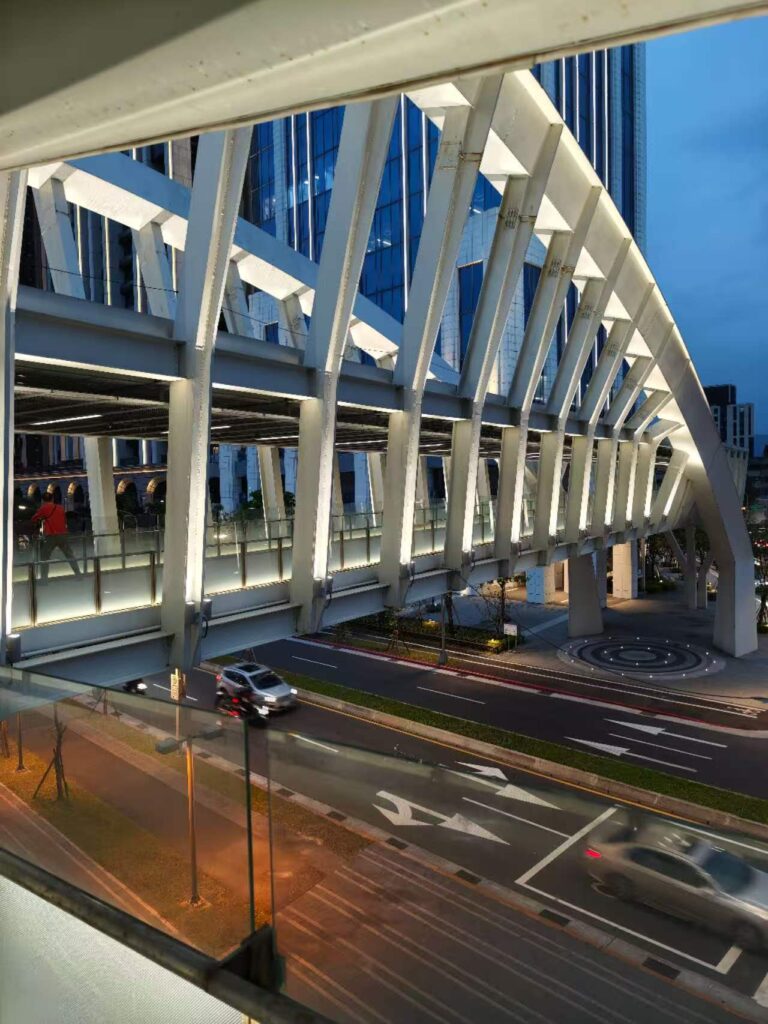
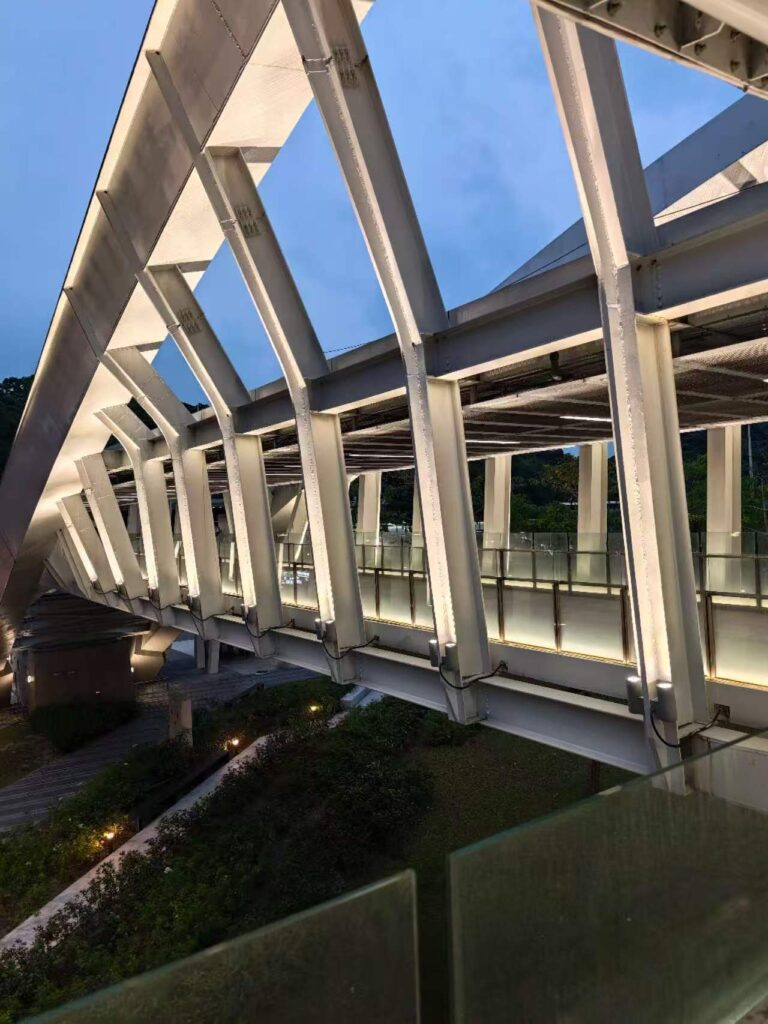
    This evaluation focuses on the 2025 Taiwan Lighting Environment Award-winning project: the Nangang Multi-level Connectivity Platform.

    It is a particularly valuable case study because it does not simply “brighten” a bridge. Instead, it transforms an urban transport connector into a legible, walkable nighttime public space with a sense of urban landmark identity.


    1. Core Value: Not Brighter, but More Controlled

    In many public lighting designs—especially pedestrian bridges, elevated walkways, underground passages, and transit-adjacent spaces—the typical approach is: more luminaires equal greater safety, and higher illuminance equals better security.

    However, real-world experience often shows the opposite. Excessive brightness can cause discomfort; exposed light sources can generate glare; excessive contrast can impair visual adaptation; and even if the ground appears bright, the perceived visual field may become chaotic and unstructured.

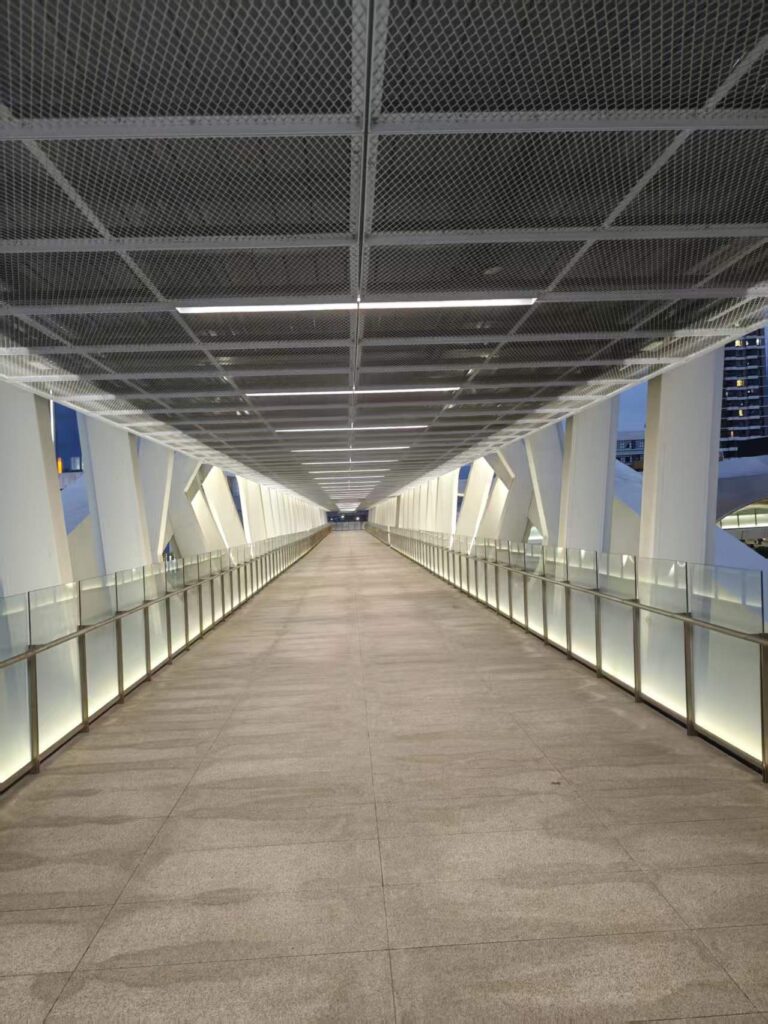
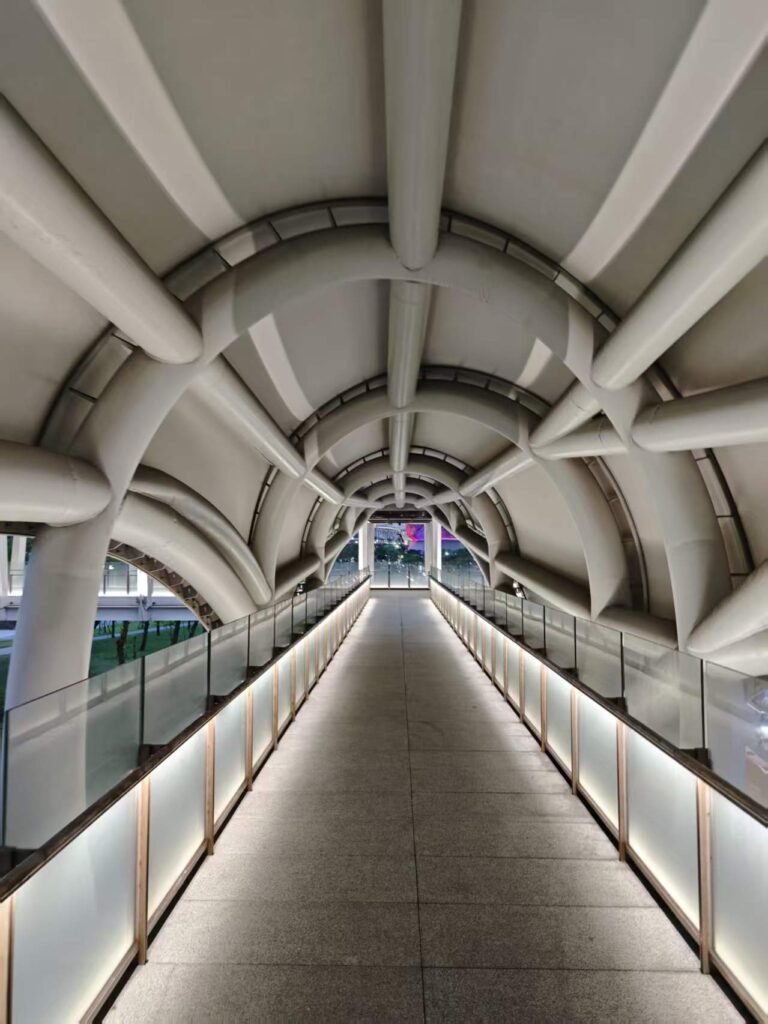
    The more mature aspect of the Nangang Multi-level Connectivity Platform lies in its approach: it does not rely on heavy downward lighting to flood the ground. Instead, it uses structural elements, railing boards, façade reflections, light shielding, and linear guidance to construct a softer, continuous, and controlled nocturnal spatial experience.

    This is essential because at night, pedestrians do not need high lux at a single measurement point—they need a stable luminance order across their entire field of view.


    2. On-site Measurement Data: Low Illuminance, Yet Spatial Legibility Achieved

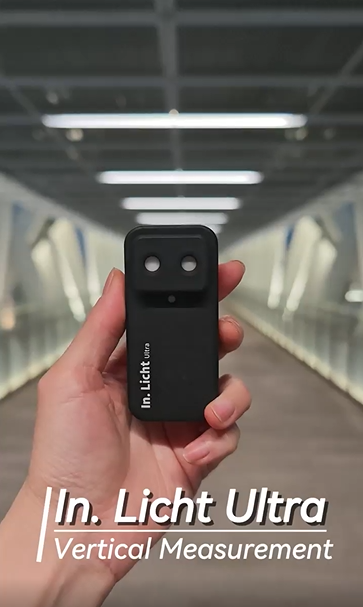
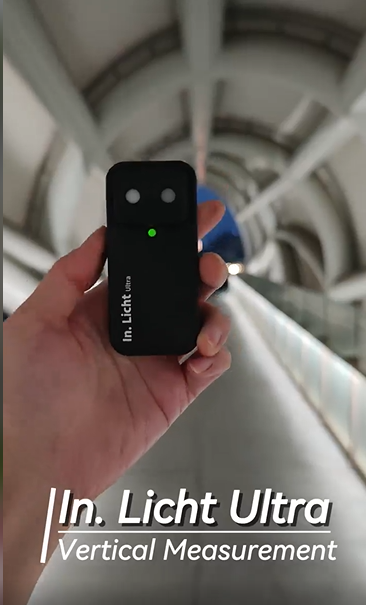
    Based on In. Licht Ultra field measurements, one representative dataset is as follows:

    MetricMeasured ValueInitial Interpretation
    Illuminance12.1 luxNot high, but acceptable for nighttime circulation if distribution is uniform and glare is controlled
    CCT (Correlated Color Temperature)3911KClose to 4000K; neutral with a slight warm tone, suitable for transit-connected spaces
    CRI / Ra88.1Good overall color rendering
    R943Moderate red rendering; not a critical issue but has room for improvement
    x / y0.389 / 0.396Stable chromaticity, close to the neutral white region
    Foot-candle1.12 fcApproximately equivalent to 12.1 lux

    Another measurement point shows:

    MetricMeasured Value
    Illuminance17.0 lux
    CCT (Correlated Color Temperature)3992.7K
    CRI / Ra92.4
    R964

    This indicates that there are still variations between different locations, but the overall design direction remains consistent: it is not a high-illuminance scheme, but rather a low to medium-low illuminance design that emphasizes light distribution and spatial reflection.

    An illuminance level of 12–17 lux would be far from sufficient in office, reading, or commercial display environments; however, in the context of outdoor nighttime pedestrian connectivity spaces, such standards cannot be applied using indoor lighting criteria.

    For this type of space, more important questions include: Is the pathway clearly legible? Are boundaries identifiable? Are steps, corners, railings, and entrances visible? Are there any glaring light sources? And when moving from dark to bright areas or vice versa, can the human eye adapt smoothly?

    From visual observation, the railing panels, bridge structure, and ground edges are continuously articulated. Light is not merely cast onto the ground; instead, it reveals the contours of the space. This is precisely what makes the design more worthy of discussion than conventional public lighting approaches.


    3. Correlated Color Temperature: Around 4000K, Clear but Not Harsh

    Measured CCT ranges from approximately 3911K to 3993K, close to 4000K. This is a relatively appropriate choice for transit-oriented public spaces.

    It does not create the overly relaxed or yellowish perception often associated with 3000K, nor does it introduce the harshness and visual tension commonly seen in 5000K+ cool white light. For environments such as station connections, urban transfer corridors, and pedestrian platforms—where orientation and legibility are essential—around 4000K maintains a clear, clean, and publicly legible visual character.

    However, this does not mean 4000K is a universal standard. In contexts adjacent to residential areas, hotels, waterfronts, or leisure spaces—or during late-night operation hours—zoning or time-based control should be considered. For example, maintaining clarity during peak hours while reducing brightness or shifting to a warmer tone at night can better balance public safety with environmental comfort.

    This reflects a broader direction for future urban lighting: not a fixed color temperature applied uniformly, but dynamic adaptation based on people, space, time, and activity needs.


    4. Color Rendering: Overall Good, but Red Reproduction Still Has Room for Improvement

    In terms of CRI and TM-30, the color rendering performance of this project is generally acceptable to good.

    MetricValue
    CRI / Ra88.1
    Re82.7
    R943
    TM-30 Rf86.9
    TM-30 Rg96.6

    Another set of measurement points is:

    MetricValue
    CRI / Ra92.4
    Re88.8
    R964
    TM-30 Rf88.3
    TM-30 Rg96.5

    First, Ra is approximately 88–92, indicating that overall color rendering is quite good. For a public circulation space, this is already clearly better than many outdoor lighting systems that prioritize only cost and efficiency.

    Second, TM-30 Rf is about 86.9–88.3, indicating stable color fidelity; Rg is around 96.5–96.6, meaning color saturation is not artificially boosted. Visually, this results in a restrained, clean appearance without excessive vividness or unnatural color rendering.

    Third, R9 ranges from about 43–64, showing that red color rendering capability is from moderate to acceptable. For general pedestrian environments, this is not a critical issue; however, if the area requires better facial recognition, public art presentation, nighttime landscape for vegetation, commercial street vibrancy, or a higher-quality urban night interface, R9 could be further improved.

    This also reminds us that CRI is not everything. A high Ra does not mean all colors are rendered well. In future evaluations of public lighting, TM-30, R9, spectral distribution, and actual spatial use cases should be considered together, rather than relying solely on a single Ra value.

    5. Circadian rhythm and nighttime health: low m-EDI is reasonable

    This measurement also includes human-centric lighting (HCL) indicators related to biological rhythm:

    MetricValue
    CAF0.55
    EML8.07
    m-EDI7.32 lux
    S/P Ratio1.68
    CS0.01


    The other set of measurement points shows:

    MetricValue
    CAF0.60
    EML12.45
    m-EDI11.29 lux
    S/P Ratio1.78
    CS0.02

    These data indicate that its stimulation of the human circadian rhythm at night is very low. For outdoor public circulation spaces at night, this is actually appropriate.

    Daylight lighting should help people stay alert, synchronize their biological rhythm, and improve vigilance. Night lighting, on the other hand, should ensure safe passage while minimizing disruption to sleep and the surrounding nocturnal environment.

    Therefore, the key is not to increase m-EDI, but to ensure:

    • adequate visual safety
    • no excessive glare
    • no excessive blue-light stimulation
    • no attempt to “daylight-ify” nighttime public space

    This project is relatively restrained in that sense. It allows people to see clearly, but does not try to turn night into day. This is a commendable approach.


    6. Flicker: SVM is controlled, but we should not rely on a single metric

    Regarding flicker performance, the supplementary data shows:

    MetricValue
    SVM0.44
    Percent Flicker99.9%
    Flicker Index0.50
    Frequency17,910.49 Hz

    Another set of measurement points is:

    MetricValue
    SVM0.27
    Percent Flicker99.9%
    Flicker Index0.33
    Frequency13,930.38 Hz

    The data set is well suited for public communication and education. When people see a percent flicker value of 99.9%, the immediate reaction is often: is this dangerously high? That interpretation is overly simplistic.

    Flicker risk cannot be evaluated by percent flicker alone. It must be considered together with frequency, waveform, modulation depth, SVM, PstLM, and the actual usage context.

    Here, SVM ranges from 0.27 to 0.44, indicating that the perceptible flicker risk is relatively well controlled. At the same time, the measured frequency is approximately 14–18 kHz, which is far beyond the range of human visual perception. This means that even with a high percent flicker value, most users are unlikely to experience visible flicker in normal conditions.

    However, this does not mean flicker can be ignored. In public environments, there are multiple real-world scenarios to consider: smartphone camera capture, vehicular vision, fast movement, walking while reading, elderly users, children, individuals with flicker sensitivity, and performance under different dimming levels and driver conditions.

    A more rigorous interpretation would therefore be:
    from the perspective of SVM and high-frequency operation, the visible flicker risk is relatively controlled; however, the high percent flicker and flicker index still justify further verification under multiple dimming levels and across different luminaire positions.

    This also highlights why on-site measurement is essential. Relying only on manufacturer datasheets cannot fully predict real-world temporal light output once drivers, dimming systems, wiring conditions, and control logic are all integrated in an actual installation.


    7. The most valuable aspect: replacing “light stacking” with “light order”

    What stands out in this project is not a single outstanding metric, but the overall design logic.

    It does not reduce public safety to “brighter is better.”
    It does not turn bridge lighting into a visually aggressive light show.
    It avoids exposing light sources directly in primary sightlines.
    It prevents chaotic patches of brightness and darkness in pedestrian space.

    Instead, it:

    • uses linear lighting along railings to define walking boundaries
    • uses structural lighting to articulate rhythm in the bridge geometry
    • relies on reflected light to reduce direct glare
    • maintains low illuminance to preserve nighttime scale
    • uses neutral CCT to keep spatial clarity
    • controls output to reduce environmental disturbance

    This reflects a more advanced public lighting strategy: not filling space with luminaires, but placing light only where it is functionally necessary. Not maximizing ground brightness, but stabilizing human visual perception. Not optimizing for photographs, but for real pedestrian experience—safe, natural, and unobtrusive.


    8. Remaining technical validation gaps

    A single or even several measurement snapshots are still insufficient to fully define lighting quality. For a complete assessment of an award-level project, the following datasets should ideally be included:

    1. Multi-point illuminance and uniformity across entrances, exits, mid-span, corners, stairs, escalators, railing zones, glass reflection zones, and under-bridge shadow areas.
    2. Vertical illuminance at eye level, which better represents facial recognition, spatial perception, and visual comfort.
    3. Luminance distribution and glare risk, especially reflections from glass railings and sightline intrusion from luminaires.
    4. Weather condition variability, particularly rain, wet surfaces, and haze—critical in humid climates.
    5. Time-based control behavior, including peak hours, late night operation, and adaptive dimming strategies.
    6. Full flicker validation, across different fixture types, dimming levels, circuits, and including SVM, PstLM, percent flicker, flicker index, and frequency.

    With these additional datasets, the project could move beyond a “visually successful installation” and become a reference case for measurable, verifiable, and optimizable public lighting design.


    9. A broader industry reminder: awards must enter a verification era

    The broader implication is not limited to this single project. It points to a structural shift in the lighting industry:

    Lighting awards should no longer be based primarily on imagery, narrative, or conceptual design intent.

    Future evaluation of “good lighting” should be able to answer, at minimum:

    • Is the space actually comfortable in real use?
    • Is glare truly controlled?
    • Is illuminance sufficient without excess?
    • Does the spectrum match spatial and temporal context?
    • Is color rendering appropriate for functional needs?
    • Has flicker been properly validated?
    • Does the system minimize environmental and human disruption over time?

    These questions cannot be answered by perception alone, nor by drawings, nor by luminaire specifications. They require field measurement, user validation, contextual calibration, and longitudinal observation.


    10. Conclusion: maturity in public lighting is not brightness—it is understanding people

    The value of the Nangang Elevated Walkway system lies not in achieving maximum brightness, but in demonstrating a more mature principle: public lighting does not need to win by intensity.

    A mature urban lighting system balances safety, comfort, energy efficiency, low glare, low environmental impact, and verifiability.

    Its significance is not that it “looks good,” but that it shows how light can:

    • serve movement
    • organize space
    • reduce visual strain
    • respect nighttime conditions
    • and be meaningfully measured and evaluated

    In this sense, the project’s true value is not that it makes the city brighter, but that it makes light more orderly.

    And that is exactly the capability future public lighting systems will require.

    Aesthetics matter. Data matters. Narrative matters. But ultimately, real-world performance must stand up to measurement.

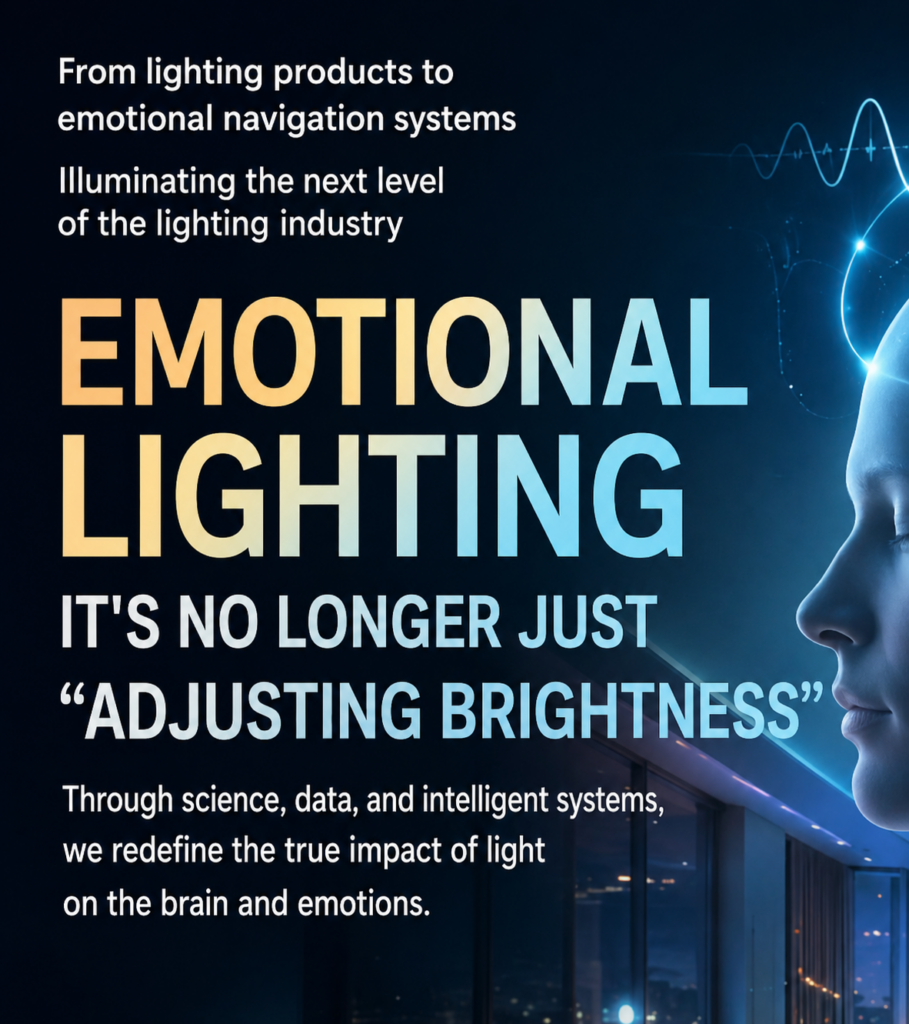
  • Emotional lighting should no longer be just about “changing colors”

    From colored-light products to “emotional navigation systems”—how should the lighting industry evolve?

    Abstract

    “Emotional lighting” has become a popular topic in recent years, yet most products still remain at the stage of color tuning, atmosphere creation, and storytelling. They are still far from truly influencing human states. Effective emotional lighting should not merely output colored light; it should evolve into a measurable, verifiable, feedback-driven, and iterative closed-loop system integrating light × human × brain.

    This article explores the underlying logic of emotional lighting from perspectives such as circadian rhythm, alertness, the limbic system, reward mechanisms, EDI/DER, and PBM. It also proposes a more meaningful direction for the industry: future lighting products should not just sell luminaires, but move toward adaptive emotional navigation systems.


    Introduction

    In recent years, concepts like “pastel lighting,” “emotional lighting,” “ambient lighting,” “color therapy,” and “dopamine spaces” have gained significant popularity.

    However, if we are honest, most so-called emotional lighting products in the industry are still far from truly influencing human states.

    Many products are highly capable of changing colors and telling compelling stories; yet they often do not know:

    • Whether the user is more relaxed or more irritated at that moment
    • More alert or more fatigued
    • Comforted or overstimulated

    In other words, most “emotional lighting” today is essentially lighting with visual styling, rather than evidence-based human-centric systems with a closed-loop validation process.

    And this is precisely the gap the industry must address next.


    1. Why most “emotional lighting” today is not yet professional

    The conclusion first: If emotional lighting is to produce real effects, it cannot remain at colored light output—it must evolve into a stimulus–perception–feedback–adjustment system.

    Because “emotion” has never been something controlled by a single color button.

    It involves at least four layers:

    • Layer 1: Visual perception
      A space that appears warmer, softer, lighter, or more dramatic will certainly influence subjective preference.
    • Layer 2: Physiological arousal
      The same light can make a person more alert—or more fatigued; more focused—or more irritable.
    • Layer 3: Circadian effects
      The key factors are not just color, but also timing, duration, dose, direction, and prior light exposure history.
      The CIE’s 2024 position statement reiterates that “the right light at the right time” should be characterized using the CIE S 026 α-opic framework, rather than relying solely on CCT or traditional illuminance.
    • Layer 4: Stable emotional experience
      Feelings such as happiness, relaxation, safety, and healing are rarely caused by a single color. They are shaped by multiple factors, including sleep quality, alertness level, stress state, circadian alignment, reward system activity, and environmental security.

    Therefore, being able to adjust RGB does not mean one understands emotional lighting.


    2. Why colored lighting often “feels right” but isn’t necessarily effective

    Because most colored-light products control output, but not dose. Common industry practices include:

    • Preset scenes (happy orange, healing blue, meditation purple, energetic red)
    • App-based interaction
    • Pairing with music, scent, or marketing narratives
    • Assuming users will “feel better”

    The core issue is not aesthetics—it is the lack of measurement and validation.

    If an emotional lighting system does not know the user’s:

    • Current alertness
    • Stress level
    • Fatigue
    • Sleep condition
    • Sensitivity to stimuli
    • Emotional stability

    …it cannot determine what light should be delivered, nor whether the intended effect has been achieved.

    Research on light interaction with the brain’s limbic system suggests a valuable direction. Instead of relying only on subjective questionnaires, it explores extracting brain-state indicators—such as anxiety tendency, depression tendency, tension level, sleep index, brain fatigue, external/internal focus, and hemispheric dominance—through frontal EEG, algorithms, and database modeling.

    These metrics may not yet constitute industry standards, but they point to a critical shift: If emotional lighting is to advance, devices must evolve from “emitting light” to “measuring humans.”


    3. How light actually influences emotion (beyond “dopamine”)

    A common claim today: “This light stimulates dopamine and makes people happy.”

    This is overly simplistic. A more rigorous statement is: Light does not directly “create happiness.” Instead, it alters the emotional baseline through:

    • Retinal input
    • Circadian synchronization
    • Sleep homeostasis
    • Activation of alertness systems
    • Indirect modulation of brain regions related to emotion and reward

    Over the past two decades, research has shown:

    • Nighttime light, especially short-wavelength stimuli, significantly suppresses melatonin
    • The spectral sensitivity of this effect differs from that of the visual system, indicating non-visual photoreception beyond rods and cones
    • Melanopic EDI is a strong predictor of nighttime melatonin suppression

    In other words, the foundation of emotional lighting is not merely “color psychology,” but a continuous system: Light → Eye → Brain → Circadian Rhythm → Emotion


    4. Three terms the industry should stop conflating

    To avoid conceptual confusion:

    • Orexin – regulates wakefulness, motivation, and goal-directed arousal
    • Serotonin (5-HT) – associated with mood stability and daytime state
    • Dopamine – linked to reward prediction, novelty, and motivation

    If emotional lighting is to move toward interdisciplinary collaboration, these terms must be used precisely from the outset.


    5. Don’t treat dopamine as an ever-increasing “happiness knob”

    Terms like “dopamine lighting” or “dopamine spaces” are fine as marketing labels—but not as scientific models.

    Dopamine is better understood as a signal of:

    • Reward prediction error
    • Novelty
    • Motivation and exploratory behavior

    When stimuli exceed expectations, dopamine responses increase. But once stimuli become predictable and repetitive, the effect diminishes and may even fade into the background. This has direct implications:

    • Short-term stimulation ≠ long-term value
    • Feeling “excited” ≠ being sustainably “happier”

    Mature emotional lighting should prioritize:

    • Circadian alignment
    • Daytime activation
    • Minimal nighttime disruption
    • Sleep recovery
    • Stress regulation
    • Emotional stability
    • Resilience

    6. Light and emotion involve more than dopamine

    Light’s influence extends beyond the reward system:

    • Orexin → wakefulness, motivation, goal-oriented activation
    • Serotonin → mood stability, daytime function, seasonal mood variation

    A classic Lancet study showed that serotonin production in the brain correlates positively with daily light exposure. Thus, a more evidence-based statement is not: “This light makes you release happiness hormones.”

    But rather: Appropriate light exposure—at the right time, dose, direction, and spectrum—supports a better emotional baseline through circadian, alertness, sleep, and neural pathways.

    Light does not directly create happiness; it creates the conditions under which happiness, stability, recovery, and focus are more likely to occur.


    7. Why the limbic system matters for lighting

    Emotion does not occur in luminaires or color palettes—it occurs in the brain.

    Recent research combining fMRI and EEG has explored how different lighting conditions affect emotional brain regions, proposing a Limbic System Score (LSS) to quantify interactions between parameters such as CCT, CRI, flicker, illuminance variation, and exposure time.

    Key observations include:

    • Excitement peaks around 3000–4000K
    • Happiness peaks around 4000K
    • Higher CCT (~5700K) tends to suppress emotional activation

    Additional findings suggest relationships between specific brain regions and CCT thresholds, for example:

    • Calcarine → minimal negative emotion response around 4000K
    • Frontal Superior → strongest emotional excitation around 4400K
    • IFG & MCC → highest stability around 4200K

    These are not yet universal standards, but they demonstrate: Emotional lighting is measurable—not purely subjective.

    More importantly, this work shifts emotional experience from narrative into a quantifiable, modelable, and iterative “light recipe language.”


    8. From EDI / DER to PBM: building a true “stimulus language”

    For emotional lighting to become verifiable and scalable, the industry must move beyond vague descriptors like “warmer” or “softer.”

    Three key concepts:

    1. EDI (Equivalent Daylight Illuminance)
      Describes effective stimulus at the eye.
      The key question is not just “how bright,” but how much effective stimulus the eye receives.
    2. DER (Daylight Efficacy Ratio)
      Compares non-visual effectiveness under equal visual brightness, enabling cross-product comparison.
    3. PBM (Photobiomodulation)
      Requires full parameterization:
      • Wavelength
      • Intensity
      • Energy density
      • Exposure time
      • Pulse structure
      • Thresholds
      • Safety limits

    Effective light is not about “looking right”—it is about reaching the correct dose window.


    9. PBM’s key lesson: every stimulus has thresholds

    • Too little → ineffective
    • Too much → potentially inhibitory

    Thus, future emotional lighting must incorporate:

    • Threshold definition
    • Dose modeling
    • Safety boundaries
    • Closed-loop validation

    10. Emotion is not switching—it is navigation

    Lighting should not force a direct jump from “nervous” to “happy.” A more realistic pathway:

    • nervous → neutral
    • neutral → relaxed
    • relaxed → happy or alert

    This reflects actual human regulatory processes. Therefore, advanced emotional lighting is not a fixed scene library—it is a path-planning system.

    It must answer:

    • Where is the user now?
    • What is the target state?
    • What path is appropriate?
    • How long should transitions take?
    • What stimulus intensity is optimal?
    • When should stimulation be reduced or increased?
    • When should intervention be avoided entirely?

    11. The inevitable future: adaptive emotional navigation systems

    Next-generation systems will:

    • Continuously assess user state
    • Dynamically adjust lighting strategies
    • Optimize transitions over time

    Like navigation systems:

    • Determine current position
    • Select the optimal route
    • Adjust in real time

    Not forcing the same “shortest path” every time.


    12. Beyond luminaires: defining a system-level architecture

    Future value lies not in hardware alone, but in integrating:

    • EDI / DER
    • Temporal programming
    • Spatial distribution
    • Directional control
    • Stimulus dosing
    • State sensing
    • Feedback correction
    • Path optimization

    Lighting becomes: A programmable, measurable, verifiable, and navigable human-centric system—not just a product.


    Conclusion

    The next step in emotional lighting is not better color control—it is deeper human understanding.

    Color is not wrong. Atmosphere is not wrong. “Dopamine spaces” and “healing light” are not wrong. But stopping at color imagination is insufficient.

    The industry must move toward real research on: Light → Human → Brain → Emotion

    Both healthy lighting and emotional lighting must converge toward:

    • Measurement
    • Understanding
    • Validation
    • Human-state optimization

    Ultimately, emotional lighting should not simply “paint spaces with trendy colors.” It should function like music:

    • With rhythm
    • Dynamics
    • tonality
    • and a definable symbolic system
    • EDI / DER define what stimulus reaches the eye
    • PBM defines thresholds and dosage
    • Adaptive emotional navigation systems define how lighting regulates human states

    At that point, lighting is no longer about selling colored light—It becomes a new paradigm of: devices, algorithms, and evidence systems that redefine how humans interact with light.


    Postscript

    If the industry is willing to seriously advance this field, I strongly recommend initiating a round of cross-disciplinary collaborative research, involving:

    • Lighting companies
    • Sensor technology firms
    • Sleep medicine specialists
    • Psychologists
    • Neuroscientists
    • Spatial designers
    • Scenario/experience operators

    Because the real barrier in emotional lighting is no longer luminaire development.

    It is this: Are we willing to acknowledge that future lighting products must increasingly resemble human-centric technology systems?


    Scientific Basis / Further Reading

    • CIE, Position Statement on Integrative Lighting — Recommending Proper Light at the Proper Time, 3rd ed. (2024)
    • CIE S 026:2018, System for Metrology of Optical Radiation for ipRGC-Influenced Responses to Light
    • ISO/CIE TR 21783:2022, Integrative lighting — Non-visual effects
    • Brown et al., PLOS Biology (2022), recommendations for indoor daytime/evening/night light exposure
    • Brainard et al., Journal of Neuroscience (2001), action spectrum for human melatonin suppression
    • Thapan et al., Journal of Physiology (2001), melatonin suppression and non-visual photoreception
    • Lambert et al., The Lancet (2002), sunlight and brain serotonin turnover
    • Korshunov et al., Frontiers (2017), dopamine and circadian regulation
    • Huang et al., Dose-Response (2009 / 2011), biphasic dose response in PBM/LLLT
    • de Freitas & Hamblin, Frontiers in Neuroscience (2016), review of PBM mechanisms
  • Lumileds浮沉錄:一部LED產業主導權轉移史

    HP OptoPhilipsPE與地緣政治:他曾定義一個時代,最終卻成為時代轉身中的待售資產

    導語

    如果今天再回頭看 Lumileds,我認為它早已不是一家普通公司的興衰故事。

    它更像是一面鏡子。映照的不是單一企業的成敗,而是過去三十多年裡,LED 產業的主導權如何從美國光電實驗室、歐洲品牌體系,逐步轉向亞洲製造體系、資本市場與地緣政治框架。

    這家公司出身 HP 光電血脈,曾經推動紅光 LED、高亮度 AlInGaP、LUXEON 高功率封裝、車用 LED 等多條技術路線,也實實在在支撐了 Philips Lighting 從傳統光源向 LED 的戰略轉身;但它自己,卻在產業成熟、資本改寫與地緣政治升溫的洪流中,被一再轉手、反覆估值,最終兩度因美國國安疑慮而交易告吹。它的源流可以一路追溯到 HP 在 1960 年代末期推進 LED 商業化,之後經 Agilent 演化,最終在 1999 年形成 Lumileds。

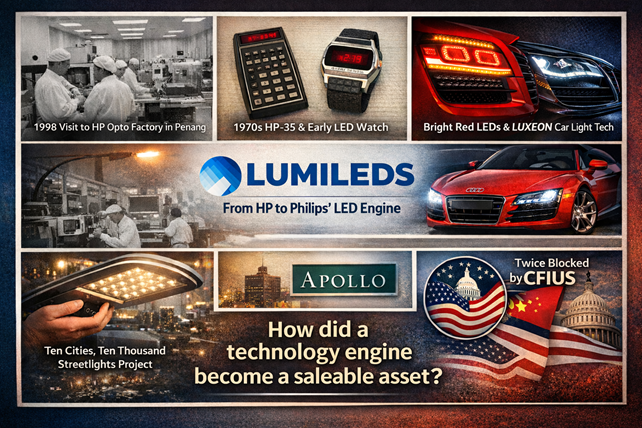
    而我對這段歷史,不只是旁觀。1998 年,我曾造訪檳城的 HP Opto 工廠。後來在東貝光電擔任採購時,東貝曾是 Lumileds 在台灣最大的客戶之一;再之後,我又參與十城萬盞路燈項目,採用了 Lumileds 的產品,與他們有過很多互動。也因此,Lumileds 在我眼中,從來不只是新聞稿上的一家外商公司,而是一個我曾在不同年代、不同位置上近距離接觸過的產業角色。

    一、Lumileds 的根,其實不在照明,而在 HP 時代的光電半導體

    很多後來進入行業的人,容易把 Lumileds 直接理解成 Philips 旗下的 LED 公司。這樣說不能算錯,但遠遠不夠。

    Lumileds 的根,真正埋在 HP 的光電半導體體系裡。

    早在 1968 年,HP 就已開始推進 LED 商業化;1970 到 1972 年間,HP 的 LED 已被用在 HP-35 計算機與數位手錶。再往後,這條技術線一路延伸到高亮度 AlInGaP 紅黃光 LED,之後經由 Agilent 與 Philips 的合資,於 1999 年形成 Lumileds。換句話說,Lumileds 的血統,不是從傳統照明公司裡長出來的,而是從光電半導體工業裡長出來的。

    這件事很重要。因為它決定了 Lumileds 與很多傳統照明企業本質上的不同。它不是先懂燈具、通路、工程與品牌,再慢慢學會 LED;它是先懂材料、外延、晶片、封裝、可靠性,再一步一步走向應用與照明。

    這種出身,決定了它在 LED 產業早期能扮演的角色,遠遠不只是供應商,而更像是一個技術平台。

    二、HP Opto 不只是前身,更是 LED 產業早期的人才母體

    如果只把 HP Opto 看成 Lumileds 的前身,其實還是低估了它的歷史地位。

    在我看來,HP Opto 更像是 LED 產業早期的一所「實戰學校」。

    它培養出的,不只是工程師,也包括懂材料、懂製程、懂封裝、懂可靠性、懂產品化、懂全球營運的一整代專業人士。像 Michael Krames 這樣後來在 LED 產業極具代表性的技術領袖,就是沿著 HP optoelectronics 到 Philips Lumileds 這條線成長起來的。

    而從整個行業後來的人才流動來看,這個體系外溢出的人才,也陸續流向 Lumileds、Cree、Bridgelux,以及歐美與中國許多 LED 與照明企業,成為不同公司中的技術骨幹、管理層與關鍵專業人士。這部分未必能用一份單一名單完整窮盡,但作為長期身處行業的人,這個脈絡其實非常清楚。HP 到 Lumileds 這條線,不只輸出了產品,也輸出了一整套方法論:如何把實驗室裡的光電技術,做成可以量產、可以驗證、可以打進全球市場的產品與組織。這條主線對整個 LED 產業的外溢影響極深。

    所以,若說 Lumileds 是 Philips LED 轉型的技術引擎,那麼 HP Opto 更像是整個 LED 時代早期的人才母體,甚至可以說,是半導體照明產業的一所「黃埔軍校」。

    三、它曾經不只是領先,而是定義過 LED 的一個時代

    Lumileds 最值得敬重的地方,不只是曾經很強,而是它真的定義過幾個市場。

    從 1990 年代中後期到 2000 年代初,Lumileds 接連推出了 SuperFlux、SnapLED、第一代高功率 LED、LUXEON 系列,並在 AlInGaP 效率、高功率白光、暖白高功率 LED、手機閃光、日行燈、全 LED 頭燈等多個節點上站在行業前沿。Audi A8 W12 的日行燈、Audi R8 的全 LED 頭燈,也都可以看到它當年的技術影響力。

    如果你經歷過那個時代,就知道這些不只是「推出新產品」而已。

    紅黃光高亮度化,讓 LED 真正吃下了滑鼠、訊號顯示、汽車尾燈與煞車燈市場。

    高功率白光與封裝突破,讓 LED 不再只是 indicator,而開始有資格談 illumination。

    而高可靠性與車規導入,則讓 LED 從電子零件變成汽車品牌設計語言的一部分。這些路,今天看起來彷彿是自然演進,但在當年,其實是少數幾家公司用很長時間、很深技術,一步一步踩出來的。Lumileds 就是其中最關鍵的幾家之一。

    四、Philips 為什麼能華麗轉身?Lumileds 是不能不提的底盤

    後來 Philips 能從傳統光源巨頭成功轉向 LED,很多人會先想到品牌、渠道、系統與全球市場能力。這些都對,但若少了 Lumileds,這個故事並不完整。

    Philips 在 2005 年收購 Agilent 在 Lumileds 的持股,本質上不是單純多買一家元件公司,而是把一套足以支撐自己照明轉型的底層光源技術平台收進體系。再到 2015 至 2016 年準備出售時,Philips 對 Lumileds 的定位,依舊是 LED 元件與汽車照明領域的重要核心資產。

    從產業視角看,這是一個很高明、也很典型的動作。

    當傳統照明帝國意識到未來屬於半導體照明,它若只守著燈泡、燈具、通路與品牌,遲早會被動;但若掌握了底層技術平台,它就有機會主導轉型節奏。

    所以我一直認為,Lumileds 對 Philips 的價值,從來不只是供應商,也不只是內部事業部。它曾是 Philips Lighting 華麗轉身背後最重要的技術底盤之一。

    五、真正的轉折,不是技術衰退,而是角色改變

    但一家公司的命運,往往不取決於它曾經多重要,而取決於母體還要不要它。

    Philips 後來逐步聚焦健康科技,Lumileds 於是從曾經的轉型引擎,慢慢變成可以拆分、估值、出售的資產。2015 年,GO Scale Capital 主導的財團原本擬以約 33 億美元企業價值取得 Lumileds 多數股權;到了 2016 年改由 Apollo 接手時,整體企業價值已降到約 20 億美元。

    最值得玩味的,不只是價格差異,而是估值邏輯變了。

    當一家公司是集團轉型的技術引擎時,它帶有戰略溢價。

    當它變成可出售的成熟資產時,它就很快會被改用財務資產的方式來衡量。這是 Lumileds 命運真正轉折的起點。

    六、為什麼會被一再轉手?因為 LED 產業的價值中心已經變了

    Lumileds 的故事,如果只寫成「一家好公司命運多舛」,其實太淺。

    更深一層是:它的命運變化,正是 LED 產業價值中心變化的結果。

    早期 LED 產業的價值中心,在材料、外延、晶片、封裝與可靠性。

    中期開始,價值中心逐步向大規模製造、成本優化、供應鏈效率與全球擴產轉移。

    再往後,價值又往模組、系統、控制、品牌、場景與軟硬整合延伸。

    Lumileds 在第一階段極強,在第二階段仍然重要,但到第三階段,它雖然依舊有技術底蘊,卻不再是唯一的舞台主角。它後來仍持續推出 CSP、矩陣車燈、SkyBlue、NightScape、microLED 等技術節點,說明它不是沒有創新;問題在於,創新還在,不代表產業主導權還在。

    也就是說,Lumileds 不是死於技術停滯。 它更像是被整個產業的價值遷移,慢慢從舞台中央推到了側翼。

    七、從 PE 到地緣政治:Lumileds 為何兩度卡在 CFIUS

    Lumileds 最耐人尋味的地方,是它兩次想賣給與中國資本相關的買方,都卡在美國國安審查。

    第一次是 GO Scale 交易。2016 年 1 月,這筆交易終止,原因就是 CFIUS 疑慮未能排除。

    第二次則是三安與 Inari 擬收購 Lumileds International。2025 年 8 月,雙方宣布交易;到了 2026 年 4 月,交易再次終止,公開披露指出,CFIUS 認定這項擬議聯合收購存在未解決的國家安全疑慮。

    這件事非常關鍵。它說明今天的 Lumileds,已不能只用「一家 LED 公司」來看。

    只要牽涉到美國技術、業務、客戶、供應鏈,或具戰略含義的半導體光電能力,它就可能被放進更大的國安與科技競爭框架中審視。

    這也是為什麼我說,Lumileds 的命運不是單一企業命運,而是 LED 產業從技術競爭,走向技術競爭加地緣政治競爭的縮影。

    八、我為什麼對這家公司特別有感?因為我看過它在不同時代的位置

    今天回頭寫 Lumileds,我其實很難用純學術口吻。因為我看過它在不同時代的樣子。

    我看過 1998 年檳城 HP Opto 工廠那種帶著半導體工業榮光的氣質。

    我也在東貝擔任採購時,見過它作為上游關鍵供應商的份量。

    我更在十城萬盞那種 LED 普及化與城市照明快速替代的歷史現場,見過它如何把自身產品推進大規模應用。

    這些經歷讓我更強烈地感受到:Lumileds 的可敬,不只是它曾經很強;而是它幾乎參與了 LED 從技術萌芽、高亮度突破、汽車滲透、通用照明爆發,到大規模商品化的每一個關鍵階段。

    但也正因如此,它後來的命運更讓人唏噓。一個曾經幫助產業跨代、也幫助 Philips 轉身的技術引擎,最後卻沒能穩穩掌握自己的歸屬。

    九、以史為鑑:Lumileds 給今天所有企業的,不只是感慨,而是警示

    我認為 Lumileds 最值得今天行業反思的,不是「英雄遲暮」,而是下面幾件事。

    第一,核心技術要持續升級,更要持續導入市場。

    第二,元件龍頭若無法逐步上移到系統、場景、標準或平台,最後很容易被重新估值為成熟製造資產。

    第三,母公司若把關鍵技術引擎視為可處置資產,短期可能是正確財務決策,長期未必是最優戰略選擇。

    第四,PE 可以重整資本結構,卻不一定能重建產業主導權。

    第五,在今天,半導體光電資產的跨境併購,已不能只用商業邏輯理解,而必須同時接受國安與地緣政治邏輯的檢驗。

    結語

    Lumileds 的故事,最讓人感慨的地方在於:它不是一家沒有技術的公司,不是一家沒有歷史的公司,也不是一家沒有貢獻的公司。

    恰恰相反,它太有技術、太有歷史、也太有貢獻了。

    它曾來自 HP 最強的光電血脈,曾替 Philips 撐起 LED 轉型的底盤,曾定義紅光、高亮度、功率封裝與車用 LED 的時代,

    也曾作為人才與管理母體,孕育並外溢出一整代影響歐美與中國 LED 產業的專業人士與管理層。

    卻也正因如此,在產業成熟、資本轉向、主導權東移與地緣政治升溫之後,它成為反覆被交易、卻始終難以安放的關鍵資產。

    所以,Lumileds 留給今天所有企業的真正問題不是:為什麼它這麼坎坷?

    而是:當一家企業曾因核心技術而偉大,它是否有能力讓這項技術持續升級、持續主導市場,並且始終掌握在真正理解其長期價值的戰略主體手中?

    如果沒有,那麼今天的技術引擎,明天就可能只是下一輪交易裡的待售資產。

  • 歐司朗 120 週年:一家百年寡占者,如何被時代改寫?

    從技術寡占、品牌高地到碎片化肉搏市場——這不只是 OSRAM/LEDVANCE 的故事,也是所有曾經成功企業都該讀懂的一課

    摘要

    OSRAM 迎來品牌 120 週年。本文不只回顧其從傳統光源到數位光子學的技術演進,也從我曾參與 MLS 與 LEDVANCE 整合、並擔任 LEDVANCE CEO 的視角,重新審視一個百年寡占者如何從賣方市場高地,走入碎片化競爭的全球肉搏戰。這既是 LED 時代改寫產業規則的必然,也是所有曾經成功企業都必須面對的反思:核心技術是否持續升級?Go-to-Market 是否尊重市場差異?品牌與渠道是否真正以市場為中心,而非永遠以總部為中心。

    導語

    今年,OSRAM 迎來品牌 120 週年。

    對很多人而言,這是一家偉大的德國照明企業;

    對照明行業而言,它幾乎參與了整個現代光源工業的主線發展:從白熾燈、螢光燈、卤素燈,到 LED、汽車照明、紅外與感測,再到今天所謂的數位光子學。OSRAM 品牌最早註冊於 1906 年,而公司則在 1919 年由 Auergesellschaft、Siemens & Halske 與 AEG 的燈業務合併而成。

    但如果只把這篇寫成一篇品牌慶生文,我覺得太可惜。

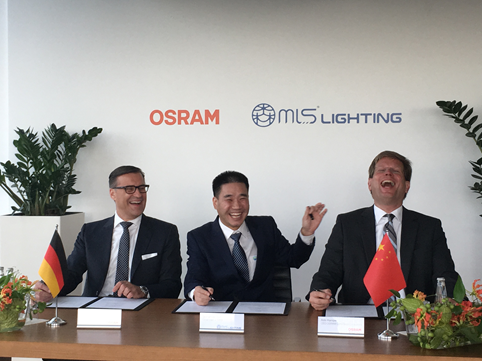
    因為在我看來,OSRAM 這 120 年真正值得回望的,不只是它曾經有多輝煌,而是它如何從一個技術領先、擴產就能增長的賣方市場寡占者,一步步走到後來必須在全球各地,與成千上萬個競爭者短兵相接的局面。這裡面當然有行業演進的必然,也有企業面對未來時的遲疑與失策。這不是旁觀者評論,而是我在參與 MLS 與 LEDVANCE 的整合、並後來擔任 LEDVANCE CEO 的過程中,親眼看到的一段產業權力重排。

    一、OSRAM 的偉大,從來不只是「老牌子」,而是它曾經代表一整個工業時代

    OSRAM 的起點,本身就帶有很強的工業整合基因。品牌在 1906 年誕生,公司於 1919 年正式成立,背後是德國幾家重要工業力量把燈泡業務整合到同一品牌之下。它不是單一創業故事,而更像是一個工業時代的集體作品。

    也因此,OSRAM 長期不是單純賣產品,而是在賣一套非常完整的能力:材料、工藝、製造、品質、一致性、全球標準、品牌信用、渠道覆蓋。

    後來它一路把這個能力,從傳統光源延伸到更多技術節點。官方 120 週年頁面梳理了其技術演進里程碑:從汽車燈、低壓鈉燈、螢光燈、氙燈、卤素燈,到紅外 LED、彩色 LED、白光 LED,再到更後來的薄膜晶片技術與今天的 Digital Photonics。這意味著它曾經不只是照明企業,而是光科技演進的重要推動者。

    所以,OSRAM 值得尊敬的地方,不只是做大過,而是它曾經長時間站在技術和市場的雙高地上。

    二、它與西門子的關係,說明了它原本就站在工業體系中心

    如果要理解 OSRAM 的歷史,繞不開 Siemens。

    OSRAM 成立時就與 Siemens 有深度關係,而在很長時間裡,它也一直是西門子體系中的重要組成。直到 2013 年,Siemens 推動 OSRAM 分拆上市,將 80.5% 的 OSRAM 業務分拆給股東,自己保留 17% 股份,另有 2.5% 轉入 Siemens Pension Trust。這是 OSRAM 從集團型工業體系,走向獨立資本市場的一個重要節點。

    這個動作在當時未必代表衰退,反而更像是一種戰略重估:當照明產業開始從傳統光源進入 LED 與半導體時代,OSRAM 必須面對新的資本敘事、新的競爭邏輯,以及不同於西門子工業母體的估值方式。分拆本身,是對未來的一次重新定義。

    只是後來回頭看,分拆只是開始,真正艱難的是:當一家公司離開過去那個穩定的大工業秩序後,它有沒有能力適應一個更快、更碎、更殘酷的新市場。

    三、它和 GE、西門子、AEG 的關係,提醒我們:照明曾經是一個高度寡占的工業體系

    今天很多年輕從業者進入行業時,看到的是高度內卷、高度同質化、價格透明的 LED 市場,很難想像照明曾經是一個真正意義上的全球寡占產業。

    OSRAM 的成立,本身就是歐洲工業整合的結果;而更早期的照明產業,也與專利、技術、材料和跨國協議高度交織。這說明一件事:照明過去不是低門檻生意,而是一門由少數巨頭主導、技術與產能深度結合的工業。

    在那個年代,對龍頭企業而言,增長很多時候不是「要不要重新定義自己」,而是「要不要擴產、如何擴產」。

    因為市場本質上仍是供給稀缺的賣方市場。誰有技術、品牌、品質和全球通路,誰就更有議價權。

    這一點很重要。因為後來 OSRAM/LEDVANCE 所遭遇的尷尬,不是普通企業都會經歷的那種競爭,而是從寡占高地被拉入碎片化混戰的失重感。

    四、真正改變一切的,不是某個對手,而是 LED 把整個行業規則改寫了

    我一直認為,OSRAM/LEDVANCE 後來所面對的局面,首先是行業演進的必然,其次才是企業自身的應對失誤。

    原因很簡單:LED 改變的不是光源而已,而是整個照明產業的底層規則。

    當光源從傳統工業製造,轉向半導體、電子化、模組化與全球供應鏈協同之後,產業門檻的構成就變了。市場不再只獎勵那些擁有深厚歷史資產、標準能力與品牌信用的大公司,也開始獎勵更快的供應鏈、更低的成本結構、更高頻的產品迭代,以及更貼身的本地競爭能力。

    這意味著,原本屬於少數巨頭的遊戲,逐漸變成大量企業都能進場的戰場。

    不是 OSRAM 突然變差了,而是它原本那套贏法,不再自動成立了。

    五、但把一切都歸因於「時代變了」,也不公平

    如果只是行業宿命,那麼所有傳統巨頭都應該以同樣方式失速。

    但事實不是如此。

    所以我認為,OSRAM/LEDVANCE 的經驗真正值得所有企業反思的,不只是市場從賣方轉成買方,不只是競爭者從幾十家變成幾千家,而是:曾經的寡占者,是否仍有能力持續升級核心技術、持續儲備下一代技術,並且有決心把這些能力導入市場;同時,它的 Go-to-Market 模式,是否真的願意尊重各個市場的差異,而不是總以總部視角看待全球。

    這才是關鍵。

    很多企業不是看不見未來,而是以為自己過去成功的方式,仍足以管理未來。

    六、第一個教訓:核心技術不能只「領先過」,而要能持續升級、持續商業化

    OSRAM 的技術實力毋庸置疑。從官方 120 週年資料可以看出,它在多個時代都站在重要技術節點上:汽車光源、放電燈、卤素燈、紅外 LED、白光 LED、薄膜晶片、數位光子學。它從來不是沒有技術的公司。

    但對任何寡占者來說,問題往往不是「有沒有領先過」,而是:

    • 能不能持續推進下一代技術;
    • 能不能把技術儲備變成真正的市場方案;
    • 能不能在新技術剛成形時,就建立相應的組織能力、供應鏈能力與商業化能力。

    很多企業到後來會出現一種典型情況:有研發、有專利、有實驗室、有工程能力,卻沒有足夠果斷地把它推進市場,或沒有及時把組織調整到能承接新技術的節奏。

    這種問題在順風時不明顯,一旦市場規則改變,就會很致命。

    因為技術領先若不能轉化為新的商業秩序,它就只能停留在榮譽簿上。

    七、第二個教訓:真正拖垮寡占者的,常常不是競爭者變多,而是決策模型失效

    這是我認為最值得今天所有大型企業反思的一點。

    很多全球性龍頭在強勢時期,都建立了一套「總部最懂」的系統:

    • 總部定義產品
    • 總部定義品牌
    • 總部定義價格帶
    • 總部定義節奏
    • 地方市場主要負責執行

    這套模型在供給稀缺、技術節奏相對穩定、品牌權威很強的年代,是有效率的。

    但一旦市場進入高度分化的競爭階段,它就會慢慢失靈。

    因為不同市場的現實根本不一樣:

    • 對價格的敏感度不一樣
    • 對品牌的理解不一樣
    • 通路的權力結構不一樣
    • 對交期、服務、SKU、促銷與客製化的要求不一樣
    • 競爭者密度與打法更完全不同

    如果還總是以總部為核心,而不是以市場為核心,企業就很容易低估本地需求、拖慢回應速度,最後不是某一個決策錯了,而是整個決策模型都開始失效。

    很多寡占者真正的問題,不是沒有資源,而是反應速度已經慢於市場變化速度。

    八、第三個教訓:品牌與渠道,不能只追求全球一致,更要追求市場有效

    這一點,在照明這種跨區域、跨通路、跨應用場景的產業裡,尤其明顯。

    品牌不是總部自己認為清楚就夠了,品牌真正的價值,在於市場是否願意為它付費、是否願意讓它進入採購決策、是否願意在渠道端替它留位置。

    OSRAM 在歷史上很成功地經營了全球品牌,也通過不同市場路徑來擴張。比如在北美,透過 SYLVANIA 建立強勢存在;LEDVANCE 今日也仍把 SYLVANIA 品牌故事作為北美重要資產之一。

    再看日本市場,三菱電機曾在 1980 年代末與 OSRAM 成立兩家合資公司,一家偏生產、一家偏銷售。到 2012 年三菱電機重整照明業務時,官方也明確說明,這些合資的原意就是結合 OSRAM 的技術優勢與三菱電機的銷售優勢;即使重組後解除合資,雙方仍保留銷售與生產合作。這其實就是一種很典型的「尊重市場結構」做法。

    這些案例都說明:真正強的全球品牌,不是把一套總部想像複製到全世界;

    而是清楚知道,全球可以有統一方向,但市場必須有在地打法。

    品牌若只對總部負責,渠道若不對市場現實負責,再好的歷史資產,最後也可能被一點一滴耗掉。

    九、第四個教訓:總部控制力,不等於市場掌控力

    很多企業在巔峰時,很容易把兩件事混為一談:我能控制全球組織,等於我能掌控全球市場。

    但這兩件事其實差很多。

    總部控制力強,可能代表流程嚴謹、品牌一致、風險可控;但市場掌控力強,則意味著前線足夠敏捷,能快速判斷需求、調整產品組合、重設價格帶、改變渠道策略、甚至重寫打法。

    在市場單一、節奏較慢的時代,兩者可能重合;但在今天這種碎片化、區域化、即時競爭的時代,兩者常常是衝突的。

    如果總部仍然習慣把所有決策往上收,地方市場就會越來越像執行單位,而不是作戰單位。

    一旦前線不敢決策、不被授權、不被尊重,再強的品牌也很難打贏貼身肉搏戰。

    所以,對所有曾經的寡占者而言,真正需要建立的不是更強的總部控制,而是更高品質的全球—在地協同能力。

    十、LEDVANCE 的分拆與出售,不只是交易,更是產業權力重排

    2016 年,OSRAM 監事會批准出售一般照明燈與光源業務,也就是後來大家熟知的 LEDVANCE,買方為由 IDG、MLS 與義烏國資組成的中國財團,交易價格超過 4 億歐元。OSRAM 當時對外表述得很清楚:這是其向高科技公司轉型的重要里程碑。

    後來到了 2018 年,LEDVANCE 公告 MLS 成為唯一股東,並提到 LEDVANCE 源自 OSRAM 的一般照明業務,業務遍及 140 多個國家與地區。

    如果只從財務交易看,這是一筆分拆出售;但如果從產業史看,它遠不只如此。

    它其實代表了一次重要的全球權力轉移:一邊是歐洲老牌工業體系,把一般照明這個競爭越來越激烈、毛利越來越薄的業務剝離出去;

    另一邊則是中國企業憑藉製造、供應鏈、成本效率與資本能力,接住全球品牌、通路和市場體系,開始重組一般照明的競爭格局。

    我後來身在其中,更強烈感受到:這不是某一家公司突然不行了,而是原本屬於一個時代的贏法,正在被另一套能力體系取代。

    十一、所以,這到底是行業必然,還是自身失策?

    我的答案是:首先是行業的必然,其次是企業的失策。

    必然在於,LED 確實把照明產業從高門檻、相對寡占的工業,推向更電子化、更供應鏈化、更全球化、也更中國化的競爭結構。這個大方向,很難逆轉。

    但失策也真實存在。

    失策不一定是做錯某個單一決策,而是:

    • 沒有足夠快地重新定義技術的商業化方式;
    • 沒有足夠早地接受市場權力已從總部轉向前線;
    • 沒有足夠深地重建 Go-to-Market 模型;
    • 沒有在品牌與渠道上真正做到以市場為中心;
    • 仍然試圖用主導舊時代的方法,去管理一個已經完全不同的新時代。

    這才是最大的問題。

    十二、這不只是 OSRAM 的故事,而是所有曾經成功企業的共同課題

    我想,這篇文章寫到這裡,重點已經不只是回顧 OSRAM 120 年。

    更重要的是,它給所有企業——尤其是那些曾經在某個領域有過寡占地位、技術高地或品牌高地的企業——提了一個醒:寡占者最大的風險,不是失去昨天的優勢,而是把昨天的優勢,誤當成明天的能力。

    你曾經的成功,可能來自技術;但未來的成功,可能更取決於技術升級、組織升級、市場升級是否同步完成。

    你曾經靠總部主導贏得效率;但未來如果仍然低估市場差異、低估前線判斷、低估本地需求,你的決策模型本身就可能成為競爭劣勢。

    你曾經靠品牌與渠道建立護城河;但如果品牌不能重新定義、渠道不能貼近市場,護城河也會被時間慢慢填平。

    結語

    OSRAM 120 週年,值得致敬。

    因為它不只是歐洲工業的一段歷史,也是一部完整的照明產業進化史。從 1906 年品牌註冊,到 1919 年公司成立,再到後來與 Siemens 的長期關聯、2013 年分拆上市、2016 年出售 LEDVANCE、以及在不同市場透過 SYLVANIA、與三菱電機合作等方式走向全球,這家公司的一生,幾乎濃縮了現代照明產業的主要脈絡。

    但我更想說的是:真正值得今天的企業學習的,不是 OSRAM 曾經有多強,而是它的曲折提醒了我們——

    沒有任何一家企業,可以永遠用主導舊時代的方法,繼續贏得新時代。

    這,才是 OSRAM 120 年留給行業最重要的啟示。

  • The Rise and Turns of Lumileds: A Story of Shifting Power in the LED Industry

    From HP Opto and Philips to private equity and geopolitics:

    Summary

    Lumileds is more than a company with a complicated ownership history. It is a lens through which to view the shifting center of power in the LED industry. Born from the HP Opto lineage, it helped define major eras in red LEDs, high-brightness performance, power packaging, and automotive applications, while also supporting Philips’ strategic transition into LED lighting. But as the industry matured, value migrated from core device technology toward scale, cost, systems, and ecosystems. Capital restructuring and geopolitics then further reshaped the company’s fate, turning Lumileds from a strategic engine into an asset repeatedly put up for sale. Its story raises a larger question for every technology-driven company: can core technical capability remain strategically owned, continuously upgraded, and continuously translated into market control — or will it eventually become just another asset on the transaction table?

    A company that once helped define an era, only to become an asset for sale**

    In 1998, I visited the HP Opto factory in Penang.

    Even now, I still remember the feeling.

    That was not the LED industry people know today — an industry reshaped by price competition, manufacturing scale, and supply-chain efficiency. Back then, LED still carried a very strong semiconductor-industrial character: clean, restrained, precise. Behind it stood real hard power — materials, process engineering, packaging, reliability — and also the quiet confidence of a technology era that still believed deep engineering could shape the future.

    Later, when I was responsible for procurement at Everlight, Lumileds was one of our most important suppliers in Taiwan. Later still, in China’s “Ten Cities, Ten Thousand Street Lamps” (十城萬盞)street-lighting programs, I again encountered Lumileds products in real projects and real deployment decisions.

    So in a sense, I did not come to know Lumileds only through headlines or corporate history. I encountered it repeatedly, in different historical positions, at different stages of the industry.

    That is why, when I look back at Lumileds today, I find it difficult to see it as merely the story of one company’s ups and downs.

    To me, it is more like a coordinate point in the industry’s collective memory.

    If you follow its journey carefully, you can almost retrace the most important shifts in the LED business over the past three decades: from American optoelectronics labs to European strategic integration, from the golden age of high-brightness LEDs, power packaging, and automotive applications to the rise of Asian manufacturing, and then on to capital restructuring, private equity ownership, and the new reality of geopolitics and national security review.

    Some companies grow inside an era. Lumileds, in my view, is one of the rare companies that lived through the turning of an entire era.

    And what it leaves behind is not just a technical legacy. It leaves a question that every technology-driven company must eventually face:

    How does a technology engine become a saleable asset?

    1. Lumileds did not begin as a lighting company. It began in semiconductor optoelectronics.

    Many younger people in the industry instinctively think of Lumileds as simply a Philips LED company. That is not wrong. But it is not enough.

    The roots of Lumileds are not really in traditional lighting. They are in HP’s optoelectronics and semiconductor heritage.

    This matters. Because it means Lumileds did not grow out of the conventional logic of lamps, fixtures, channels, and lighting engineering. It grew out of a different logic altogether: materials, epitaxy, chips, packaging, reliability, and productization.

    Many lighting companies first understood “light” and then learned “LED.” The HP–Agilent–Lumileds line followed the reverse path: it first understood semiconductor light, and only then expanded into lighting, automotive, and broader real-world applications.

    That difference in origin shaped everything. It shaped the kind of problems the company solved. It shaped the kind of talent it built. And it shaped the role it played in the early LED industry.

    Lumileds was never just another supplier. At its core, it was a platform company born from deep technology. And that is exactly why its later fate became so symbolic.

    2. HP Opto was not just a predecessor. It was one of the early talent nurseries of the LED industry.

    If we describe HP Opto merely as the predecessor of Lumileds, we still underestimate its historical importance. To me, HP Opto was more like a practical academy for the early LED industry.

    It trained not only engineers, but an entire generation of people who understood how to move from material science to manufacturing, from chip to package, from reliability to product, and from product to large-scale market adoption.

    That kind of capability was rare. LED was never the kind of technology that could succeed simply because a laboratory proved it could work. It had to cross many thresholds: scientific feasibility, manufacturability, reliability, consistency, customer trust, application fit, and economic viability.

    What made the HP Opto lineage special was not only that it produced technology. It produced people who knew how to industrialize technology.

    Over time, talent from that lineage did not remain within one company. It spread outward — into Lumileds, Cree, Bridgelux, and many other LED and lighting businesses across Europe, the United States, and China.

    That is why I do not see HP Opto merely as a historical ancestor. I see it as one of the early talent and management mother-bodies of the LED era.

    If Lumileds later became an important technology engine for Philips’ transformation, then HP Opto was, in many ways, one of the industry’s earliest academies of execution.

    It did not only produce products. It produced methods, discipline, industrial DNA, and a generation of professionals who would shape the next chapters of the LED business.

    3. Lumileds did not merely lead. It helped define an era.

    Younger professionals entering the industry today may find it difficult to imagine how strong Lumileds once was. It was not just another company making LEDs. For a significant period of time, it was one of the companies defining the path of the industry itself.

    Its technologies influenced several key turning points: High-brightness red and amber LEDs helped LEDs take over applications such as mice, signal indication, automotive tail lamps, and brake lights. Power white LEDs and packaging breakthroughs helped LEDs move beyond indication and earn the right to be taken seriously for illumination. Automotive-grade reliability and integration helped turn LEDs from mere electronic components into part of automotive brand language and design identity.

    If you lived through those years, you know these were not just product launches. They were moments when a handful of companies, through deep technical investment and long-term execution, carved out entirely new application paths.

    Today, it seems obvious that LEDs belong in automotive lighting, in general illumination, in street lighting, in architectural lighting. But none of that was inevitable. Those roads were built. And Lumileds was one of the companies helping to build them.

    4. Why was Philips able to turn so successfully toward LED? Lumileds was one of the crucial foundations.

    When people think about Philips’ transition from a traditional lighting giant into the LED era, they often think first of brand strength, global channels, systems capability, and market reach.

    All of that matters. But the story is incomplete without Lumileds. What Philips understood, earlier and more clearly than many others, was that if the future of lighting belonged to semiconductor light sources, then controlling fixtures, channels, and branding would not be enough. It also needed access to the underlying source technology platform.

    This is what made Lumileds strategically important. Lumileds was not just a component supplier sitting somewhere inside the broader Philips structure. It was one of the technical foundations that allowed Philips Lighting to move from legacy light sources into the LED age with real credibility and momentum.

    In other words, Philips’ LED transition was not only a commercial repositioning. It was also a reassembly of technical capability. And Lumileds was one of the key pieces in that reassembly.

    5. The real turning point was not technical decline. It was a change in role.

    A company’s fate is often determined not by how important it once was, but by whether it is still seen as part of the future. That, in my view, was the decisive turning point for Lumileds.

    The problem was not that it forgot how to innovate. The problem was that its role changed.

    When it was seen as a strategic engine, it carried strategic premium. When it became a separable asset, it began to be judged through a different lens: valuation, transaction structure, buyer suitability, and exit logic.

    This is where many technology companies begin to lose control of their destiny. Not because the technology suddenly becomes weak. But because the company ceases to be treated as a strategic capability and starts being treated as a financial object.

    From strategic asset to financial asset. From engine of transformation to asset available for disposal. That shift is subtle at first. But once it happens, it changes everything.

    6. Why was Lumileds sold and resold? Because the center of value in the LED industry moved.

    If we reduce the Lumileds story to “a great company with bad luck,” we miss the deeper point. Its fate changed because the center of value in the LED industry changed.

    In the early phase of LED, value was concentrated in materials, epitaxy, chips, packaging, and reliability. Whoever mastered those layers had technical authority. Whoever had technical authority could occupy a commanding position in the value chain.

    But as the industry matured, value began to migrate. It shifted from core technical breakthroughs to manufacturing scale. From manufacturing scale to cost structure and supply-chain efficiency. And then further still, toward modules, systems, controls, branding, scenarios, and integrated hardware-software ecosystems.

    That shift is profound. It means that a company that was extraordinarily powerful in the “component age” may not remain equally central in the “systems age” or the “platform age.”

    Lumileds did not stop innovating. That is not the point. The point is simpler, and harsher: Innovation can continue, while industry control quietly moves elsewhere.

    This is one of the hardest truths for old technology leaders to accept. Sometimes you do not become weak. Sometimes the center of gravity simply moves.

    7. From private equity to geopolitics: why Lumileds was blocked twice

    One of the most revealing aspects of the Lumileds story is that attempts to sell it to buyers tied to Chinese capital were blocked twice by U.S. national security review. At that point, Lumileds was no longer just an LED company. It had become a sensitive optoelectronic asset.

    Once a company touches U.S. technology, U.S. operations, U.S. customers, or strategically relevant semiconductor capabilities, the question is no longer just: who wants to buy it, and at what price?

    The question becomes: how will it be interpreted inside a broader framework of national security, technology competition, and supply-chain control?

    That is why Lumileds is so important as a case study. Its story cannot be understood only at the level of corporate management. It belongs to a larger narrative: from technology competition, to technology plus capital restructuring, to technology plus capital plus geopolitics.

    And that same logic is now visible far beyond lighting.

    8. Why does this company feel personal to me? Because I saw it in different positions across different eras.

    When I write about Lumileds today, it is difficult for me to write as a detached observer. Because I saw it in different forms, at different moments.

    I saw the Penang HP Opto factory in 1998, when LED still carried that distinctive semiconductor-industrial seriousness. I saw Lumileds again as a major supplier when I was in procurement at Everlight. And I saw it again in the phase when LED began moving rapidly into larger-scale urban lighting and infrastructure programs.

    So for me, Lumileds is not just a company name in an article. I have seen it as a technology source. I have seen it as a supplier of consequence. I have seen it participate in the transition from high-end technical capability to large-scale real-world adoption.

    That is why its story carries weight. It was not a latecomer riding a trend. It was there across nearly every important phase of the LED era: early technical formation, high-brightness breakthroughs, automotive penetration, general-lighting expansion, and finally mass-market commoditization.

    A company like that ending up repeatedly traded, repeatedly reviewed, and never quite settled in ownership — that is bound to provoke reflection.

    9. What should the industry learn from Lumileds?

    If we revisit Lumileds today, the real takeaway is not merely that its story is unfortunate. It is that it offers several warnings to every technology-driven business.

    First, core technology must continue to advance — but it must also continue to enter the market effectively. Technical leadership that does not translate into next-generation market relevance will eventually thin out.

    Second, component leaders that fail to move upward toward systems, platforms, scenarios, standards, or ecosystem control are likely to be revalued as mature manufacturing assets.

    Third, when a parent company begins to see a technical engine as a disposable asset, the short-term financial logic may be sound, but the long-term strategic cost may be much higher than it first appears.

    Fourth, private equity can repair balance sheets, restructure portfolios, and improve financial flexibility — but that is not the same as restoring a company’s historical place in the industry.

    Fifth, critical semiconductor and optoelectronic assets can no longer be understood through commercial logic alone. They are increasingly shaped by three forces at once: technology logic, capital logic, and national-security logic.

    Ignore any one of them, and you may fundamentally misread where you stand.

    Conclusion

    What makes the Lumileds story so striking is this: It was not a company without technology. It was not a company without history. It was not a company without contribution.

    Quite the opposite. It carried some of the strongest optoelectronic DNA of the HP era. It helped support Philips’ LED transformation. It helped define the eras of red LEDs, high-brightness performance, power packaging, and automotive LED adoption. And it also served as a talent and management mother-body whose influence spread far beyond one corporate boundary.

    And yet, precisely because of all that, it eventually became a key asset that was repeatedly sold, repeatedly re-evaluated, and repeatedly difficult to place. So the real question Lumileds leaves behind is not: Why was its journey so turbulent?

    The real question is: When a company becomes great because of core technology, can it continue upgrading that technology, continue shaping the market with it, and keep that capability in the hands of a strategic owner who truly understands its long-term value?

    If not, then today’s technology engine may become tomorrow’s asset for sale.

  • OSRAM at 120: How a Century-Old Oligopolist Was Rewritten by Its Time

    From technological leadership and brand power to fragmented, close-range competition — this is not only the story of OSRAM/LEDVANCE, but a lesson every former market leader should study.

    Introduction

    This year, OSRAM marks its 120th anniversary.

    For many, OSRAM is a great German lighting company. But in my view, seeing it only as a “legacy lighting brand” does not go nearly far enough.

    OSRAM was never just a company, and never just a brand. It participated in almost the entire arc of modern lighting history: from incandescent lamps, fluorescent lamps, and halogen, to LED, automotive lighting, infrared, sensing, and today’s broader world of photonics and digital light technologies.

    Yet what is even more worth revisiting than its history is the path it has taken over the past decades: from being a technology-led oligopolist in a seller’s market — where growth could often be unlocked simply by expanding capacity — to becoming a company forced to fight, market by market, against thousands of competitors in highly fragmented global battlegrounds.

    Was that outcome inevitable because the industry changed? Or was it also the result of strategic misjudgment?I believe the answer is both.

    But the more important question for today’s business leaders is this: when a company has spent decades at the top, can it still reinvent the way it wins?

    I was not an original OSRAM employee. But I was deeply involved in the LEDVANCE chapter — from my role as Managing Director within MLS to later serving as CEO of LEDVANCE. I witnessed, from inside the process, how industrial power, brand architecture, channel logic, and competitive rules were all being rewritten.

    So this is not intended to be a simple anniversary tribute. Rather, I want to use OSRAM at 120 as a lens to reflect on the evolution, the challenges, and the lessons of a century-old oligopolist.

    1. OSRAM’s greatness was never just that it was “old” — it once represented an entire industrial era

    The name OSRAM carries the imprint of the industrial age. It was not a startup story in the modern sense.

    It was born out of a period of deep European industrial consolidation. And because of that, OSRAM never sold only “lamps.” It sold a complete industrial capability:

    • materials expertise
    • manufacturing scale
    • process know-how
    • quality control
    • standards and certification
    • brand trust
    • global distribution reach

    In the era of traditional lighting, these capabilities created a very high barrier to entry. Not everyone could do it. Fewer still could do it reliably, globally, and at scale. That is why OSRAM was not simply a “large company.” It occupied a genuine industry high ground.

    For a long time, it stood for: stronger technology, more stable quality, broader product portfolios, and greater authority in the market. This is why, when we look at OSRAM today, we should not start with what it later struggled with.

    We should first acknowledge what it once truly was: one of the defining winners of its age.

    2. From seller’s market to buyer’s market: many giants did not suddenly become weak — the rules of the game changed

    To understand the later challenges faced by OSRAM and LEDVANCE, we must begin with one simple truth: this was, first of all, an industry transition that was structurally inevitable.

    In the era of traditional light sources, the industry had several defining characteristics: First, technological and manufacturing barriers were high.

    Second, brands and channels were highly concentrated.

    Third, demand grew steadily over long periods.

    Fourth, the number of global competitors was limited, and the market remained, in essence, a seller’s market.

    In that context, if a market leader had strong technology, a trusted brand, and broad channels, growth often really was a matter of capacity expansion.

    Then LED changed everything. LED looked like a source substitution, but in reality it rewrote the foundations of the entire industry:

    • technology diffused faster
    • manufacturing became more replicable
    • products became more commoditized
    • costs declined more quickly
    • supply chains became more global — and more China-centered
    • the number of market participants surged
    • channels became more fragmented
    • price competition became more direct and more frequent

    What had once been a long-distance race among a handful of dominant players gradually turned into a crowded battlefield with thousands of companies competing across markets.

    So what OSRAM and LEDVANCE later faced was not simply “more competition.” It was something deeper: the lighting industry collapsing from a technology-driven seller’s market oligopoly into an overcompetitive buyer’s market.

    That was not caused by any one company alone, nor by the arrival of any single competitor. It was the result of a structural rewrite of the industry itself.

    3. But it would be too easy — and too unfair — to explain everything by saying “the times changed”

    If this were only fate, then all legacy giants should have lost momentum in exactly the same way. They did not.

    Which brings us to the second layer of analysis: industry change may have been inevitable, but how a company responds determines whether it adapts or gets trapped.

    In my view, the most valuable lesson from OSRAM and LEDVANCE is not merely that margins were squeezed or competitors multiplied. It is that every former oligopolist must ask itself a harder set of questions:

    • Has core technology continued to evolve?
    • Has the next generation of technology been actively built and prepared?
    • Were those technologies decisively brought to market?
    • Has the organization been upgraded to match the new pace of competition?
    • Has the Go-to-Market model truly respected the differences between markets?
    • Have brand-building and channel-building been centered on markets — or have they remained centered on headquarters?

    These are the questions that matter most. Many companies do not fail because they cannot see the future. They fail because they assume that the logic that made them successful in the past will remain sufficient in the future.

    4. First lesson: technology cannot merely have been leading once — it must keep evolving and keep converting into market power

    One of the easiest traps for an oligopolist is to treat technological leadership as a static asset. Being ahead once does not mean remaining ahead. Having the capability to develop technology does not mean having the speed to commercialize it. Owning R&D capacity does not mean having the organizational ability to turn it into new market order.

    The real issue is never simply whether a company has technology. The real issue is this: Can it continuously push the next generation forward, and can it decisively translate technical reserves into market capability?

    Many former leaders did not lack R&D, patents, labs, or engineering talent. What they often lacked was:

    • the willingness to accelerate the next wave
    • the speed to bring emerging technologies into the market
    • the organizational structure to support the transition
    • the ability to form a new business system around the new technology

    This is why some companies later seem, from the outside, to be neither weak nor obsolete — only late. Not incapable, but too slow. Not technically empty, but commercially under-converted.

    For any former oligopolist, technology leadership that does not keep renewing itself — and does not keep converting into market advantage — eventually turns from moat into museum piece.

    5. Second lesson: what often drags down former oligopolists is not the number of competitors, but the collapse of their decision model

    This, to me, is one of the most important lessons. Many global leaders build a highly centralized operating logic during their strongest years:

    • headquarters defines the products
    • headquarters defines the brand
    • headquarters defines the pricing architecture
    • headquarters defines the pace
    • regional teams execute

    In an era of supply scarcity, strong brands, and relatively stable product structures, this model can be highly efficient. But once markets start to differentiate sharply, it begins to fail.

    Because market reality is never uniform:

    • price sensitivity differs
    • buying behavior differs
    • channel power structures differ
    • engineering vs. retail mix differs
    • competitor density differs
    • service expectations differ
    • SKU complexity differs
    • decision chains differ

    If a company continues to govern everything from a headquarters-centered logic, three things tend to happen: First, local demand gets underestimated. Second, decision speed falls behind market speed. Third, regional teams gradually lose their fighting capability.

    At that point, the issue is no longer one bad product or one weak market. The issue is that the entire decision model has become unfit for the environment.

    Many former oligopolists do not lose because they lack resources. They lose because: their response speed becomes slower than the speed of market change.

    6. Third lesson: brand and channel strategy cannot only answer to headquarters — they must answer to market outcomes

    This is another area where multinational companies often misread the challenge. Headquarters tends to look at branding through the lens of consistency. Markets judge brands through the lens of effectiveness. Headquarters wants one unified narrative, one unified image, one unified asset system.

    But markets ask different questions:

    • What does this brand actually mean here?
    • Does it influence specification or procurement?
    • Does it help channels make money?
    • Is its positioning clear enough across price segments?
    • Can it still compete meaningfully against local rivals?

    The same brand can mean very different things in different markets. In mature markets, it may signal reliability and quality. In emerging markets, it may first be compared on price. In project markets, it may need to win through technical support and delivery performance. In retail, it may need to fight through shelf presence, promotions, e-commerce traffic, and consumer education.

    That is why brand strategy cannot only pursue global uniformity; it must also pursue local effectiveness.

    The same applies to channels. Strong channel-building is not about replicating the headquarters’ ideal blueprint around the world. It is about respecting the actual power structure, economics, and operating logic of each market.

    Global brands absolutely need unified direction. But market competition must respect local reality.

    If the brand answers only to headquarters, and the channel does not answer to the market, then even the strongest historical asset will slowly be consumed.

    7. Fourth lesson: stronger headquarters control does not necessarily mean stronger market control

    At their peak, many companies naturally fall into a dangerous assumption: the more tightly we control the organization, the more securely we control the market.

    But these are not the same thing. Headquarters control may produce process discipline, brand coherence, and risk management. Market control, however, is reflected in something else:

    • whether the front line is respected
    • whether local teams are empowered
    • whether products can be adjusted quickly
    • whether price and channel strategies can react in real time
    • whether branding can adapt to local competition
    • whether decisions are made where the competition actually happens

    When markets become more fragmented and more immediate, a company that keeps pulling decisions upward turns local teams into execution arms instead of fighting units.

    Once the front line loses authority, flexibility, and speed, a familiar pattern appears: internally, the company still looks orderly; externally, it becomes increasingly hard to win.

    For every former oligopolist, the goal should not be ever-stronger central control. It should be a higher-quality model of global-local coordination. Headquarters should own direction, platforms, principles, and capital allocation.

    The market front line must own sufficient definition power, reaction speed, and battle-readiness.

    8. The LEDVANCE carve-out and sale were not just a transaction — they marked a reordering of industrial power

    The capital moves that followed made these structural shifts even more visible. The carve-out, the sale, and the eventual transfer of much of the general lighting business into a new ownership and manufacturing logic were not isolated financial events. They reflected a broader reorganization of value in the global lighting industry.

    In one sense, this was the handoff between two capability systems: On one side stood the accumulated strengths of the traditional European industrial model — brand, product definition, customer relationships, global organizational experience, channel architecture. On the other stood the capabilities that Chinese companies built during the LED era — manufacturing efficiency, supply chain control, cost competitiveness, speed, and capital efficiency.

    So this should not be understood merely as “selling a business.” It was, more fundamentally: a formal passing of the baton between the old order and the new order in lighting.

    Having later operated within that reality, I felt this very clearly: This was not simply a case of one company becoming weak. It was a case of an old winning logic no longer being sufficient in a new competitive age.

    9. So was it industry inevitability, or strategic misjudgment?

    My answer remains: first, it was industry inevitability; second, it was corporate misjudgment.

    The inevitability lay in the fact that LED pushed lighting out of an era defined by technological oligopoly, concentrated brands, and relatively stable channels, into one defined by electronics, supply chains, globalization, fragmentation, and speed.

    But the misjudgment was also real. Not necessarily as one single wrong decision, but as a pattern:

    • not upgrading the technology path fast enough
    • not recognizing early enough that market power was shifting toward the front line
    • not truly rebuilding the Go-to-Market model
    • not making brand and channel strategy genuinely market-centered
    • continuing to manage a new market with methods designed for an old one

    That, in my view, is the deeper failure mode.

    10. This is not only OSRAM’s story — it is the shared challenge of every former winner

    At this point, the real subject is no longer only OSRAM at 120. The deeper point is what this story says to every company that once held a technology high ground, a brand high ground, or a channel high ground: the greatest risk for an oligopolist is not losing yesterday’s advantage; it is mistaking yesterday’s advantage for tomorrow’s capability.

    A company may once have won through technical superiority. Tomorrow it may need organizational superiority, market adaptability, and system capability as well.

    It may once have won through central coordination and scale efficiency. Tomorrow it may lose because it ignored local market intelligence and local competitive reality.

    It may once have built a moat through brand and channels. Tomorrow it will have to prove again that the brand still matters, and that the channels still work in a transformed market structure.

    For every business, the underlying question is the same: Are you willing to accept that a new market requires a new way of winning?

    Conclusion

    OSRAM at 120 deserves respect. Not only because it is a historic company, but because its journey is a condensed history of the modern lighting industry itself.

    What deserves the most attention today, however, is not only how strong OSRAM once was. It is what its path now teaches us: no company can keep winning a new era with the methods that defined the old one.

    That, to me, is the most important lesson OSRAM’s 120 years leave to the industry.

    Short Summary

    Written on the occasion of OSRAM’s 120th anniversary, this article goes beyond celebrating the company’s history. Drawing from my own experience across the LEDVANCE chapter — from Managing Director within MLS to CEO of LEDVANCE — it reflects on how a century-old market leader moved from technological and brand high ground into fragmented global competition. LED reshaped the rules of the lighting industry; that part was structural and inevitable. But what deserves deeper reflection is how technology renewal, organizational renewal, and market renewal often fail to happen in sync — especially when the Go-to-Market model remains headquarters-centered long after markets have become deeply local.

  • Why do some spaces not impress at first glance, yet feel comfortable over time?

    The most comfortable spaces are often not the brightest ones.

    Some spaces don’t feel striking at first glance.

    They don’t rely on dramatic lighting, exaggerated design language, or an intentionally amplified sense of presence. Nor are they the kind of places that instantly look great in photos.

    But strangely, when you actually sit down and spend some time there, you begin to notice a rare kind of comfort:

    You don’t feel tired.
    You don’t feel restless.
    You don’t feel the urge to leave.
    In fact, you may even want to stay a little longer.


    We’ve all likely been to places like this.

    It could be a restaurant, a café, a hotel lobby, or simply an unremarkable reception area. It may not be luxurious or visually impressive, but once you enter, your body and attention gradually relax.

    You may not immediately be able to explain why, but you can clearly feel it: the space is smooth, stable, and easy to stay in.


    Very often, this sense of “being able to stay” doesn’t come from high-end finishes or expensive materials.
    It comes from something else:

    The light isn’t constantly disturbing you.


    1. We are often misled by first impressions

    Today, many spaces—especially under the influence of social media, showrooms, and display environments—are increasingly designed for immediate visual impact.

    They need highlights.
    They need contrast.
    They need memorability.
    Ideally, they create a “wow” moment the moment you walk in.

    There’s nothing inherently wrong with this. Spaces need identity, and commercial environments need attraction. Design naturally carries the task of expression.

    The problem is: what works at first glance doesn’t necessarily feel comfortable over time.

    Some spaces are great for photos, but not for sitting.
    Some feel powerful at first, but become tiring over time—your eyes fatigue, your attention drifts, and you may even feel inexplicably irritated.
    Others feel “overdesigned” in every detail, yet never truly allow you to relax.

    This reflects a broader issue today: too much emphasis on instant stimulation, and too little on the experience of staying.

    But in most real scenarios, people don’t just glance and leave.
    They sit, eat, talk, work, rest, wait, read—or simply zone out.

    At that point, the value of lighting is no longer just about presence,
    but whether it continuously drains people.


    2. What truly determines comfort is not just brightness

    When people talk about comfortable spaces, their first instinct is often brightness or color temperature.

    But what actually determines whether people want to stay is more subtle—and more fundamental.


    First, the stability of light.

    This isn’t just technical stability, but perceptual stability. The lighting shouldn’t fluctuate, shouldn’t be unevenly distributed, and shouldn’t compete for attention across different areas.

    When the eyes and nervous system don’t need to constantly adapt, people are more likely to settle.


    Second, visual comfort and focal ease.

    People don’t just look at a table or a single fixture. We look at people, walls, forward, and into the distance—our gaze constantly shifts across layers.

    If the lighting causes the eye to jump between uncomfortable bright spots, or forces it to avoid glare, it becomes difficult to truly relax.


    Third, avoiding overstimulation and distraction.

    More highlights don’t mean better quality. More layers don’t mean more comfort.

    Too many emphasized elements, decorative light sources, or overly expressive lighting gestures can make a space feel visually “noisy.”

    This kind of noise isn’t auditory—it’s a constant visual disturbance.


    Finally, whether the space forces you to “work” to see.

    Many people don’t realize this: eye fatigue isn’t always caused by darkness.

    More often, it comes from constant adjustment— adjusting focus, adapting to brightness changes, reallocating attention.

    These small but continuous efforts accumulate, directly affecting whether people are willing to stay.


    So truly comfortable lighting is not necessarily the brightest, nor the most dramatic. It’s the kind of light that doesn’t force people to constantly negotiate with the space.


    3. The value of good lighting is that it helps people relax—without noticing

    I’ve always felt that truly good lighting has an important yet often overlooked quality: It doesn’t necessarily impress you immediately, but it gradually allows you to relax.

    This sense of relaxation is not about dimness, boredom, or lack of design.

    It’s about not overwhelming your senses— so your attention can return to what actually matters: the activity, the people, the moment.


    When lighting is done right, people feel less fatigue. You don’t need to squint, constantly adjust your vision, or feel that something is off without knowing why.

    This low cognitive and visual load is critical across all environments—hospitality, offices, retail, and residential spaces.


    When lighting is done right, people also feel less pressure.

    Some spaces are actually well-designed, yet feel subtly tense. It could be overly intense highlights, excessive contrast, overly dark backgrounds, overly bright foregrounds, or a visual rhythm that feels too fast.

    Over time, this leads to irritation, distraction, and the desire to leave.


    When lighting is done right, it also reduces unnecessary distraction. Human attention is valuable.

    A good space should allow people to focus on conversation, work, dining, thinking, or rest— not constantly be pulled around by the lighting.


    And ultimately, what good lighting brings is not just that a space “looks good,” but something deeper:

    People want to stay.
    They want to engage.
    They want to spend.
    They want to work.
    They want to relax.
    They want to come back.

    This is the real value that commercial, hospitality, and even residential spaces should care about.


    4. Perhaps lighting should aim not for “wow,” but for “stay”

    Over the years, after observing many spaces and working extensively with light, one thing has become increasingly clear to me:

    Whether a space makes people want to stay may be more important than whether it impresses at first glance.

    Because “wow” is momentary. But “staying” reflects whether a space truly serves people.


    For commercial spaces, staying means dwell time, experience quality, interaction, and even conversion.
    For hotels, it means relaxation, stability, and memory.
    For offices, it means fatigue management, focus, and long-term comfort.
    For homes, it directly relates to daily life, rhythm, and companionship.


    So perhaps the real maturity of lighting is not about making it more intense, but making it more appropriate.

    Not just attention-grabbing, but supportive of staying.
    Not constantly asserting presence, but knowing when to step back.
    Not making every element speak, but allowing the whole to become calm.


    This shift may not appear dramatic, but it could mark the true beginning of higher-quality spaces.


    What is the most comfortable space you’ve stayed in recently?

    It may not be the most visually impressive— but it likely got the lighting right.

  • Why So Many “Circadian Lighting” Solutions Don’t Really Work

    The issue is not just the hardware. It is the DLMO logic.

    Abstract

    This article examines how LED component makers, luminaire manufacturers, control system providers, and lighting designers can build truly effective circadian lighting by following DLMO logic. It argues that the real challenge is not isolated parameters, but cumulative dose, eye-level delivery, and outcome validation.

    Over the past few years, more and more companies have started talking about circadian lighting, sleep lighting, and healthy light.

    But if we return to the underlying logic of DLMO — Dim Light Melatonin Onset — we quickly realize something important: truly effective circadian lighting is not simply about making light cooler during the day, warmer at night, or adding tunable white and dynamic scenes.

    The real issue is this:

    What kind of total light exposure does a person receive over the course of a day, at the eye, in the right timing windows, and does that exposure actually change physiology and behavior in a meaningful way?

    That is why I increasingly believe that the next real competition in circadian lighting will not be about who can tune more parameters. It will be about who can build an integrated solution around hardware + scenes + cumulative dose + validation.

    1. Why DLMO changes the definition of circadian lighting

    DLMO matters because it does not simply describe whether someone sleeps well.

    It helps answer a more fundamental question:

    When does the body’s internal night actually begin?

    In sleep medicine and circadian science, DLMO is widely used as a key phase marker of the central circadian clock, and it is often used to optimize the timing of bright light and melatonin interventions. Melatonin typically begins to rise about 2–3 hours before habitual sleep onset, and DLMO marks that transition.

    This means circadian lighting should not be defined merely as “healthy-looking lighting.”

    It should be judged by whether it can answer questions like:

    • Does it provide enough effective circadian stimulus during the day?
    • Does it reduce stimulation at the right time in the evening?
    • Does it avoid suppressing melatonin when the body is preparing for sleep?
    • Does it help stabilize or shift circadian phase in the intended direction?

    In other words, the true objective is not a single snapshot parameter.

    It is the daily exposure trajectory.

    I prefer to summarize this in two words: cumulative dose.

    2. The most common reason circadian lighting fails: it ignores cumulative dose

    When companies discuss circadian lighting, the first things they usually mention are:

    • spectrum
    • CCT
    • dynamic dimming
    • pre-set scenes

    All of these matter. But on their own, they are not enough. The circadian system does not decide its response from a single glance.

    It is shaped by accumulated time cues across the day:

    • Was morning light strong enough and early enough?
    • Was daytime exposure sustained and effective?
    • Did stimulation drop at the right time in the evening?
    • Was night-time exposure sufficiently reduced, or was the system repeatedly disturbed?

    The 2022 expert recommendations in PLOS Biology clearly state that healthy adults should receive relatively high melanopic EDI during the day, significantly lower levels in the 3 hours before bedtime, and as little as possible during sleep. These recommendations are based on vertical eye-level exposure, not just workplane illuminance.

    The industry implication is clear: Circadian lighting cannot stop at “what is the fixture doing right now?”

    It also has to answer:

    • How much effective circadian stimulus did this user actually receive today?
    • In which timing windows did it occur?
    • Was there unnecessary stimulation at the wrong time?
    • Is the total exposure profile supporting entrainment, phase advance, maintenance, or disruption?

    If a company cannot answer these questions, then many so-called circadian lighting solutions are still just adjustable white lighting.

    3. What LED component makers need to upgrade first

    Some people think DLMO is far removed from LED package manufacturers.

    I think the opposite.

    If the upstream logic does not evolve, the downstream ecosystem will struggle to build truly effective circadian solutions.

    1) Move from “efficacy + CCT + CRI” to a dual visual + non-visual language

    Most LED data sheets still focus on:

    • efficacy
    • CCT
    • CRI
    • binning
    • lifetime
    • electrical performance

    These remain essential. But they are no longer sufficient for the circadian era.

    Upstream suppliers should increasingly provide:

    • spectral power distribution
    • melanopic / α-opic relevant quantities
    • non-visual performance under different spectral mixes
    • spectral stability under dimming
    • circadian consistency under different drive conditions

    Because designers and control platforms are no longer just creating white light.

    They are building time-based light recipes.

    If LED suppliers cannot provide stable, traceable, and model-friendly spectral information, downstream players will struggle to implement circadian strategies with precision.

    2) Move from one universal LED” to “programmable spectral capability”

    The future is not about one fixed optimum point. It is about spectral combinations that can be shifted over time, with predictable non-visual impact.

    That means component makers should begin thinking in terms of:

    • spectral mixes suited for morning phase-advancing stimulus
    • daytime performance-supportive stimulus
    • evening wind-down modes
    • low-disruption night pathways

    That is no longer the traditional logic of selling a light source. It is the beginning of selling a programmable circadian foundation.

    4. What luminaire manufacturers must really do: deliver dose to the eye

    Circadian lighting does not happen on a specification sheet. It happens at the human eye.

    So for luminaire manufacturers, the real challenge is not just enabling tunable white.

    It is ensuring that the intended dose reaches the eye in a controllable and useful way.

    1) Move from plane-based lighting to eye-level lighting

    Circadian effectiveness is more closely related to actual eye exposure than to horizontal workplane illuminance. The major recommendations increasingly emphasize melanopic exposure at the eye.

    This means luminaire design must increasingly consider:

    • optical direction
    • emitting surface position
    • the balance between glare control and effective circadian delivery
    • direct / indirect / semi-indirect proportions
    • seated, standing, and reclined eye positions

    In short: The goal is not just to illuminate the room. It is to deliver the right circadian dose to the eye.

    2) Move from one luminaire logic to time-based luminaire roles

    A more mature circadian lighting system may not rely on one luminaire doing everything.

    Instead, it may include:

    • stronger morning/daytime stimulus luminaires
    • transitional evening luminaires
    • low-disruption night luminaires
    • bedroom or hotel pathway lighting
    • dual-logic luminaires for care tasks versus rest protection

    This is especially important in real-world environments. Research in ICU settings shows that visual task needs and circadian goals are not naturally aligned, and that dynamic, zoned, and time-based solutions are more realistic than static ones. 

    For luminaire companies, this means product families should move from “selling by room type” to “selling by time-task logic.”

    5. Why control systems matter more than ever

    I have said this for years: in the HCL and circadian era, control systems will be revalued.

    Because circadian lighting is not fundamentally a static hardware problem.

    It is a time orchestration problem.

    1) Move from scene switching to circadian scripting

    Traditional control systems are mostly valued for:

    • scheduling
    • dimming
    • CCT control
    • occupancy sensing
    • energy savings
    • scene recall

    But once we apply DLMO logic, the system has to answer more:

    • When should the morning stimulus begin?
    • How quickly should it ramp?
    • How should daytime cumulative dose be maintained?
    • When should evening reduction begin?
    • How should night-time visual needs be preserved while minimizing circadian disruption?

    This is no longer just “having scenes.”

    It is building physiology-aware time scripts.

    2) Control systems must begin to account for cumulative exposure and feedback

    This is one of the biggest future dividing lines.

    Advanced circadian controls should not only know the current output value.

    They should increasingly be able to:

    • estimate cumulative effective exposure over time
    • adjust electric light based on daylight contribution
    • respond to occupancy and activity type
    • estimate real user exposure
    • calibrate strategy with measurements and feedback

    In other words, the system should know more than “the room is currently 4000 K and 300 lux.”

    It should increasingly understand: How much useful daytime signal has this person already received today, and how much circadian margin remains for the evening?

    That is a much more DLMO-aligned system logic.

    6. Designers are becoming “time experience orchestrators”

    If LED component makers define the spectral raw material, luminaires determine delivery, and control systems determine temporal behavior, then designers ultimately determine how all of this becomes human experience.

    This is why I believe the role of the designer is being fundamentally upgraded.

    1) Design must move beyond “how bright and how beautiful”

    It must also ask:

    • At what time should this space support alertness?
    • At what time should it support restoration?
    • At what time must stimulation be reduced?
    • Do different users in the same space have different circadian needs?
    • How do visual comfort, operations, maintenance, and circadian goals coexist?

    That changes the design starting point.

    2) Designers must move from parameter thinking to exposure trajectory thinking

    The strongest designers in the next phase will not only specify:

    • 3000 K / 4000 K
    • 300 lx / 500 lx
    • UGR / CRI

    They will increasingly specify:

    • 7:00–9:00: rapid morning stimulus build-up
    • 10:00–15:00: sustained daytime signal
    • after 18:00: marked reduction in eye-level melanopic exposure
    • after 22:00: only low-disruption pathway lighting
    • distinct strategies for bed, desk, social, washroom, and transit activities

    That is much closer to a DLMO-aware design language.

    7. Hardware and scenes must be designed together

    Many companies still follow this sequence: First build the product.

    Then look for a “healthy lighting” use case. In circadian lighting, that order is often backwards.

    A more appropriate logic is: Define the scene objective first, then define the hardware requirement

    Scene 1: Office

    The goal is not simply high illuminance.

    It is sufficient daytime stimulus, limited evening carry-over, and good visual performance.

    That leads to hardware needs such as:

    • strong morning/daytime eye-level exposure
    • daylight integration
    • low glare without losing useful stimulus
    • spectral and control capability for evening reduction

    Scene 2: Bedroom / Hotel

    The goal is not to create a “sleep lamp” gimmick. It is to reduce melatonin suppression opportunities while preserving necessary function.

    That leads to hardware needs such as:

    • very low-disruption night lighting
    • low-stimulus bathroom and pathway lighting
    • evening transition modes
    • morning wake-up modes

    Scene 3: Healthcare / Senior living / Wellness

    The goal is to balance care tasks, resident rest, and staff circadian needs.

    That means hardware and controls must support:

    • zoning
    • scheduling
    • role-based logic
    • task-based logic
    • traceable validation

    So future circadian lighting products cannot be defined independently of scenes.

    Hardware must be designed for the scene, and the scene must be supported by the hardware.

    8. Why I keep emphasizing validation

    Because one of the biggest risks in this field is that many claims sound persuasive, but the outcomes may not be real.

    From a DLMO perspective, circadian lighting should not be judged only by whether it is dynamic.

    It should be judged by whether it changes the intended outcome.

    At least three layers need validation

    1) Output validation

    Is the system actually delivering what was designed?

    • actual SPD
    • actual illuminance
    • actual eye-level exposure
    • actual time profile
    • actual stability across dimming and tuning

    2) Dose validation

    Did the user actually receive the intended cumulative dose?

    • enough morning stimulus?
    • enough daytime accumulation?
    • timely evening reduction?
    • sufficiently low night-time exposure?

    3) Outcome validation

    Did that exposure trajectory actually change anything meaningful?

    • alertness
    • comfort
    • sleep quality
    • circadian stability
    • task performance in target applications

    This is why the ICU dynamic lighting study is valuable. It did not stop at comparing lighting configurations. It also looked at visual comfort and biological markers such as melatonin and cortisol. The authors rightly note the sample-size limitations, but the direction is important:

    circadian lighting ultimately has to return to outcomes. 

    9. Why validation toolchains matter

    If the industry is serious about cumulative dose and real outcomes, we can no longer rely only on intuition and one-off impressions.

    That is one reason we have continued building the In.Licht toolchain.

    In.Licht Pro

    Better suited for field diagnosis, inspections, and practical project communication.

    It helps teams see the basic light facts more clearly.

    In.Licht Ultra

    Better suited for R&D, quality control, comparison, and deeper spectral analysis.

    It helps teams understand why two lights that look similar may behave very differently.

    In.Licht Well

    Better suited for continuous monitoring and operational management.

    It helps move from “measure once” to long-term optimization, integrating EML, M-EDI, and broader environmental factors into one workflow.

    Together, they support a much more useful workflow: see the facts understand the mechanism build cumulative dose logic validate optimize

    10. Who will win next?

    I increasingly believe that the winners in the next phase will not simply be the companies that talk most about HCL or healthy light.

    They will be the ones that build real capability around:

    • programmable and model-ready spectral foundations
    • luminaires that deliver dose effectively to the eye
    • control systems that orchestrate physiological timing
    • design methodologies that integrate time, space, and activity
    • field workflows that measure, validate, and improve continuously

    At the center of this are two ideas:

    cumulative dose

    outcome validation

    The companies that can build products and projects around those two ideas will be much closer to the real value of next-generation circadian lighting.

    Conclusion: circadian lighting is not just another mode

    If we rethink the industry through the lens of DLMO, we see that circadian lighting is not simply a new “sleep mode” added to conventional lighting.

    It is a more fundamental shift:

    • LED components become the foundation of temporal light recipes
    • luminaires become dose delivery devices
    • controls become time orchestration systems
    • design becomes time experience design
    • validation becomes outcome validation, not just brightness checking

    That is how I understand circadian lighting.

    And that is why I believe the real future value lies not in one isolated product, but in a methodology that integrates:

    hardware + scenes + cumulative dose + effect validation

    That, in my view, is one of the most important directions for the next upgrade of our industry.

    Call-to-Action

    If you are:

    • an LED component maker
    • a luminaire manufacturer
    • a control system platform
    • a lighting designer or consultant
    • or a brand exploring circadian lighting for offices, hotels, residential, wellness, healthcare, or senior living

    I would be glad to connect.

    At Lighting Recipe Studio (LRS), we are interested in working with partners on:

    • DLMO-based product definition for circadian lighting
    • scene scripting based on cumulative dose logic
    • integrated R&D, measurement, and validation workflows
    • joint development from concept to real-world deployment

    Because circadian lighting should not just be dynamic.

    It should be effective.