Insights from Roger Sexton’s BBC Feature: CIE, WELL, and Eye-Level Mel-EDI Measurements
At 4 a.m., the hospital ward begins to quiet down. A resident physician has been working for nine consecutive hours. With physical fatigue setting in and her eyes strained, she looks forward to returning home at 6 a.m. and recovering with sleep.
However, once she enters a darkened bedroom and closes the blackout curtains, her biology delivers the opposite message: morning has arrived, and the body is preparing for wakefulness.
This paradox is at the heart of the BBC article “The hidden cost of the night shift and how to sleep it off,” shared recently by Roger Sexton, Board Member of the Good Light Group (GLG). The challenge faced by night-shift workers is not merely insufficient sleep; it is the disruption of an intrinsic circadian timing system shaped by human evolution.
The discussion also raises important questions for lighting science and healthy building design: how can standards such as the CIE recommendations and WELL Building Standard, together with measured eye-level mel-EDI (melanopic Equivalent Daylight Illuminance), help create environments that better support people working against their natural biological clock?
Roger also shared his own experience. After retirement, no longer needing to wake up at 7 a.m. every morning, his body gradually shifted into a form of biphasic sleep: sleeping for one period at night, naturally waking around 1 a.m., making a pot of tea, and then returning for a second period of sleep.
This is not a clinical study, but it raises an intriguing question: have we become too accustomed to viewing “sleeping straight through until morning” as the only correct way to sleep?
Rather than simply extending daytime sleep duration, the goal may be to redesign the interaction between sleep patterns, light exposure, and the body’s internal biological clock.
The Hidden Cost of Night Shifts Is Not Just Sleep Deprivation
Sleep is regulated by two interacting systems. The first is sleep pressure: the longer we remain awake, the stronger the drive to sleep becomes. The second is the circadian rhythm: the body’s internal biological clock that promotes wakefulness at certain times and sleepiness at others.
At the end of a night shift, workers may have accumulated substantial sleep pressure. Yet at the same time, exposure to morning daylight, the commute home, and the body’s own awakening signals are all sending the brain the same message: “A new day has begun.”
As a result, some night-shift workers, despite feeling exhausted, find that they can sleep only three or four hours after returning home before waking naturally. Blackout curtains can reduce light exposure in the bedroom, but they cannot completely erase the morning light that has already entered the eyes during the journey home, nor can they immediately reverse the body’s internal clock.
Roger also highlighted the BBC article’s discussion of cortisol and insulin resistance. More precisely, sleep restriction and circadian misalignment may work together to alter cortisol rhythms, sympathetic nervous system activity, inflammatory responses, and glucose regulation. Cortisol is one possible pathway involved, rather than a single explanation for all health risks associated with night-shift work.
The true disruption caused by night work is therefore not simply a loss of sleep, but the breakdown of an entire biological order:
The body needs to sleep, but the job requires wakefulness.
The body prepares for wakefulness, but the worker is only beginning to sleep.
Food is consumed during the biological night, while rest occurs during the biological day.
Workplace lighting is used to maintain alertness, but the light encountered after the shift may continue delaying sleep.
Sleep quantity matters, but circadian alignment depends equally on sleep timing, pre-sleep light exposure, and post-awakening light signals received by the eye.
What Can Ziwujue Teach Modern Night-Shift Workers?
One of the earliest discussions of sleep timing appears in The Yellow Emperor’s Inner Canon (Huangdi Neijing, Lingshu, “Discussion on Great Confusion”), where sleep and wakefulness are explained through the alternation of yin and yang between day and night:
“Wei Qi circulates through the yang during the day and through the yin at night. Therefore, when yang is exhausted, one falls asleep; when yin is exhausted, one awakens.”
Although expressed in the language of traditional Chinese medicine, the passage conveys a simple but enduring understanding of biological time: the human body changes with the cycle of day and night, and the restorative value of rest cannot be separated from when it occurs.
Several centuries later, during the Qing Dynasty, Cao Tingdong described this idea more explicitly in Lao Lao Heng Yan (Essential Sayings for the Elderly):
“Sleep during the daytime… and sleep again at night; within one day and one night, divide sleep and wakefulness into two periods.”
Cao also discussed taking a brief rest around midday while maintaining deep sleep during the Zi period (around midnight). However, these recommendations were written primarily for older adults rather than as a general prescription for today’s night-shift workers.
For this reason, we should avoid reducing Ziwujue to simplified claims such as:
Missing sleep during the Zi hours prevents the body from “detoxifying.”
Skipping a midday nap prevents the heart from repairing itself.
Yin is equivalent to melatonin, while yang is equivalent to cortisol.
Modern biphasic sleep has “proven” the ancient theory of Ziwujue.
Such claims are supported neither by the classical texts nor by contemporary circadian science. They also force an overly simplistic correspondence between two fundamentally different systems of knowledge.
Nevertheless, Ziwujue still offers a framework worth learning from. It suggests that a 24-hour day may include one principal sleep episode together with a second opportunity for recovery. In other words, healthy sleep depends not only on how long we sleep, but also on when we sleep.
We might therefore reinterpret Ziwujue as a functional Ziwu framework:
The biological “Zi” represents the primary or anchor sleep that should be consistently protected.
The functional “Wu” represents a second recovery opportunity—whether a scheduled second sleep period, a pre-shift sleep session, or a strategic nap adapted to one’s work schedule.
In this framework, Zi and Wu need not be rigidly tied to 11:00 p.m.–1:00 a.m. and 11:00 a.m.–1:00 p.m. For night-shift workers, what matters more is translating clock time into biological time.
Ancient physicians described this principle through the waxing and waning of yin and yang. Modern science explains it through the interaction between sleep pressure and the circadian rhythm. These are not the same mechanisms, yet they converge on a common insight:
The human body is not a work schedule that can simply be rewritten.
Can Biphasic Sleep Be Part of the Solution?
The BBC article highlights research by Norwegian scientist Line Victoria Moen, who studied night-shift workers in the Arctic. She found that some workers did not sleep continuously for seven or eight hours after their shift. Instead, they slept from around 9:00 a.m. to 1:00 p.m., followed by another sleep period before returning to work. This is also a form of biphasic sleep.
However, the term biphasic sleep currently encompasses at least three distinct patterns:
The historical pattern of a “first sleep – period of wakefulness – second sleep.”
The night-shift pattern, consisting of a main daytime sleep followed by a pre-shift recovery sleep.
A planned on-shift nap, typically lasting 20–50 minutes.
Although all three are described as biphasic sleep, they differ in physiological mechanisms, purpose, and duration.
Moen and her colleagues are still systematically reviewing the available evidence, and there is currently no universally accepted definition of biphasic sleep in the scientific literature. At present, the evidence supporting planned naps for reducing immediate sleepiness and improving alertness and job performance is considerably stronger than the evidence that biphasic sleep reduces long-term risks such as cardiovascular disease, cancer, or dementia.
Biphasic sleep may therefore be a valuable recovery strategy, but it should not be promoted as a universal remedy capable of eliminating all of the health risks associated with night-shift work.
The CIE Perspective: It’s Not Just About Light—It’s About the Right Light at the Right Time
The International Commission on Illumination (CIE) reminds us that light is more than a means of seeing our surroundings—it is also one of the body’s most powerful biological time cues.
In its updated 2024 Position Statement, the CIE summarizes this principle in a simple phrase:
Using the metrology defined in CIE S 026, we can quantify the circadian-effective light reaching the eye using melanopic Equivalent Daylight Illuminance (melanopic EDI, or mel-EDI), expressed in lux (lx). Rather than measuring the amount of visible light alone, mel-EDI estimates the light stimulus reaching the eye that is relevant to the melanopsin-containing intrinsically photosensitive retinal ganglion cells (ipRGCs).
For healthy adults aged 18–55 with regular daytime schedules, the expert consensus adopted by the CIE recommends:
At least 250 lx mel-EDI at the eye during the daytime.
No more than 10 lx mel-EDI during the three hours before habitual bedtime.
No more than 1 lx mel-EDI during sleep. If visual tasks are unavoidable at night, light exposure should be kept as low as practical while maintaining visual safety.
These values are research-based reference targets, not medical safety thresholds. Nor are they prescriptions that can simply be transferred to night-shift workers.
It would be tempting to assume a straightforward translation:
≥250 lx mel-EDI at the beginning of a night shift,
≤10 lx before going home,
≤1 lx while sleeping during the day.
But this is not the strategy proposed by the CIE.
CIE technical guidance explicitly states that these recommendations are intended primarily for day-active populations. For people who must remain active at night, lighting strategies should be individualized according to work schedules, non-work activities, and the person’s complete history of light exposure.
A permanent night shift, several consecutive night shifts, and rapidly rotating shifts all require different lighting strategies. Effective circadian lighting for shift workers must consider the entire 24-hour “light history”—including work, commuting, pre-sleep periods, daytime sleep, post-awakening exposure, and days off.
In other words, the CIE provides us with a measurable language for circadian light—but not a universal timetable for night-shift workers. Shift workers need both sufficient light to work safely and protected darkness to recover effectively.
The Value of WELL: Moving the Focus from Luminaires to the Human Eye
One of the most important contributions of the WELL Building Standard is its shift in perspective: evaluating lighting not by what luminaires emit, but by what building occupants actually receive.
The current WELL v2 Light Feature L03: Circadian Lighting Design is explicitly titled:
Meet Lighting for Day-Active People
That wording is especially significant when considering night-shift environments. It reminds us that lighting targets developed for daytime occupants should not automatically be treated as prescriptions for night-shift workers.
150 EML, approximately equivalent to 136 lx mel-EDI
275 EML, approximately equivalent to 250 lx mel-EDI
These values must be verified at eye level on the vertical plane, rather than by measuring horizontal desktop illuminance alone. The standard also requires that the specified exposure duration be achieved and confirmed through on-site performance verification.
Three practical details are frequently overlooked.
First, WELL’s Equivalent Melanopic Lux (EML) is not numerically identical to the mel-EDI defined by CIE S 026. A value of 150 EML should not be interpreted as 150 lx mel-EDI.
Second, WELL’s standardized performance verification measurements simulate eye-level exposure under defined conditions. In real workplaces, however, night-shift workers continually change posture—standing, sitting, looking down, or shifting their viewing direction—resulting in highly variable light exposure.
Third, WELL performance testing verifies the lighting performance of a particular space under specified conditions. It does not demonstrate that an individual night-shift worker receives optimal circadian light throughout a 24-hour day, nor does it directly predict health outcomes.
In short, standards define what should be achieved; field measurements reveal what has actually been achieved.
A lighting design can specify target values, and a luminaire datasheet can provide spectral power distribution (SPD), correlated color temperature (CCT), and illuminance data. However, the amount of light that actually reaches a worker’s eyes is influenced by many additional factors, including:
Luminaire location, beam distribution, and dimming settings.
Reflections from walls, floors, equipment, and surrounding surfaces.
Daylight entering through windows, as well as shading devices and curtains.
Obstructions such as partitions, monitors, medical equipment, or machinery.
The occupant’s posture, eye height, and primary viewing direction.
Whether the worker is facing the light source, facing away from it, or spending long periods looking downward.
Even within the same nurses’ station, using the same lighting installation and with identical desktop illuminance, two people—one facing a window and the other facing away from it—may receive substantially different eye-level melanopic EDI (mel-EDI).
The distinction between mel-DER and mel-EDI is therefore essential.
mel-DER (melanopic Daylight Efficacy Ratio) answers the question: For the same photopic illuminance, how effective is this spectrum at stimulating the melanopsin pathway?
mel-EDI (melanopic Equivalent Daylight Illuminance) answers a different question: At this specific location, viewing direction, and point in time, how much melanopic stimulus actually reaches the observer’s eye?
Consequently, specifying only a correlated color temperature, reviewing only a luminaire’s SPD, or measuring only horizontal desktop illuminance is insufficient to determine a person’s actual circadian light exposure.
Two light sources with the same 4000 K CCT may have different spectral distributions and therefore different mel-DER values. Likewise, even if two luminaires produce identical output, differences in installation geometry, room reflectance, and viewing direction can result in very different eye-level mel-EDI.
Specifications are not exposure. Simulations are not delivery. Design intent is not measured performance.
Why In. Licht Belongs in the “Last Meter”
Ultimately, successful circadian lighting is not achieved simply by writing 250 lx, 10 lx, and 1 lx into a lighting specification. It requires verifying what actually reaches the occupant’s eyes.
Using In. Licht Ultra (Works with WELL™) as an example, the instrument can be positioned at the actual eye height of a night-shift worker, with its sensor oriented toward the person’s primary viewing direction. It measures the spectral power distribution created by the combined effects of electric lighting, daylight, and room reflections while simultaneously reporting:
It is important to clarify that Works with WELL™ indicates that a product or solution can support specific WELL strategies or performance thresholds. It does not mean that a single measurement performed with the instrument constitutes WELL Certification or replaces formal third-party Performance Verification.
For a night-shift environment, measurement should not be limited to a single location or moment. Instead, it should encompass the critical phases of the worker’s daily cycle, including:
Pre-shift rest or recovery-sleep environments.
Workstations where alertness must be established at the beginning of the shift.
Primary task areas during the circadian low point.
Spaces occupied before leaving work when the body should begin preparing for rest.
Break rooms, changing areas, and transition spaces during the commute home.
The daytime sleep environment and any unavoidable nighttime pathways within the home.
For WELL project pre-assessments, measurements should follow the standard’s specified eye height, measurement orientation, and sampling methodology. For operational studies involving real night-shift workers, however, measurements should go further by reflecting actual eye height, primary viewing direction, and the timing of real work activities.
The measured results can then be compared with shift schedules, lighting control scenarios, and project-specific eye-level performance targets before optimizing:
Dimming levels
Spectral tuning
Local task lighting
Luminaire aiming
Shading strategies
Time-based lighting control sequences
After adjustments are made, the space should be measured again.
This creates a continuous workflow:
Performance Targets → Lighting Design → Field Measurement → Control Optimization → Re-Verification → Operational Review
The value of In. Licht lies in supporting design verification, on-site field measurements, and ongoing operational review, transforming eye-level lighting requirements from design intent into measurable, documented, and continuously optimizable performance data.
A single measurement cannot represent an individual’s long-term light dose, nor can it predict health outcomes. However, if eye-level exposure is never measured, “healthy lighting thresholds” risk remaining little more than design aspirations.
Measurement does not replace science—but without measurement, science is unlikely to become operational practice.
A More Practical “Functional Ziwu” Strategy
For night-shift workers, restoring biological order requires more than simply increasing sleep duration. It calls for an integrated approach to sleep timing, light exposure, and circadian biology.
1. Anchor the Primary Sleep Period
Whether adopting a monophasic or biphasic sleep pattern, maintaining one stable, protected anchor sleep should be the priority.
The sleep environment should not only be dark, but also minimize noise, maintain a comfortable temperature, and reduce interruptions from family activities, phone calls, or electronic notifications.
For permanent night-shift workers, this anchor sleep should remain as consistent as possible. For workers on rapidly rotating schedules, however, it is generally neither practical nor advisable to force a complete reversal of the body’s circadian rhythm.
2. Make the Second Sleep Planned Rather Than Accidental
If the primary daytime sleep lasts only three or four hours, a scheduled pre-shift recovery sleep or strategic nap can help restore alertness before work. Adequate time should also be allowed for sleep inertia to dissipate before safety-critical tasks.
The objective is not to force a perfect uninterrupted sleep episode, but to maintain both total sleep opportunity and operational alertness more reliably.
This can be viewed as a modern interpretation of the traditional Wu sleep—a functional recovery sleep, although it does not necessarily occur at midday.
3. Night-Shift Lighting Should Not Remain Constant Throughout the Shift
During the early part of a shift and during safety-critical tasks, workers require sufficient visual illumination together with appropriate eye-level circadian-effective light exposure to support alertness and performance.
As the end of the shift approaches—and particularly when workers intend to sleep soon after returning home—unnecessary light stimulation should be gradually reduced to facilitate the transition toward sleep.
However, lighting adjustments must never compromise visual performance or safety. Medical procedures, driving, industrial operations, and public safety always take precedence over circadian optimization.
4. Don’t Turn “Avoiding Light” Into a Safety Risk
Morning daylight after a night shift may delay daytime sleep, but if a worker is severely fatigued, driving safely is more important than minimizing light exposure.
Circadian strategies should never encourage practices that impair visual performance while driving, such as wearing excessively dark lenses solely to “protect melatonin.”
Traffic safety must always come first.
5. Different Shift Patterns Require Different Strategies
Workers covering occasional night shifts or rapidly rotating schedules are generally not good candidates for attempting a complete circadian phase shift.
Those working permanent or consecutive night shifts, on the other hand, may benefit from more stable anchor sleep, carefully timed light exposure, and consistent scheduling on days off.
There is no single circadian lighting recipe that fits every type of shift work.
6. Continuously Improve Using Eye-Level Measurements
Record not only mel-EDI, but also:
Measurement time
Measurement location
Viewing direction
Lighting control settings
Where possible, combine these data with:
Subjective sleepiness ratings
Sleep duration
Work performance or error records
Wearable-device data
Other physiological biomarkers
Together, these data can create a feedback loop linking:
The lighting environment → Personal light exposure → Physiological and behavioral responses
This is the critical step in moving from healthy lighting concepts to verifiable healthy light environments.
From a Cup of Tea at 1 A.M. Back to the Human Eye
Roger’s personal experience does not prove that biphasic sleep is appropriate for everyone. What it does suggest is that the human body may not always be willing to conform to the uninterrupted sleep schedule imposed by modern industrial society.
The tradition of Ziwujue offers a cultural perspective that respects biological timing.
The BBC article brings greater public attention to the conflict between night-shift work and the circadian clock.
The CIE provides a scientific language for quantifying the biological effects of light.
The WELL Building Standard shifts the focus from lighting design intent to eye-level performance and field verification.
And In. Licht helps bridge the final gap between design criteria and actual human light exposure.
Individually, none of these elements solves the challenges of night-shift work.
What is truly needed is a 24-hour biological time framework that integrates work schedules, sleep planning, lighting control, eye-level measurement, and operational management.
Perhaps, in the future, we should stop asking:
“Is this a circadian lighting system?”
Instead, we should ask:
“At what time, in what location, and in which viewing direction, how much melanopic EDI actually reached this person’s eyes? And when recovery was needed, how much genuine darkness did we preserve?”
Night-shift workers have never lacked only an opportunity to catch up on sleep.
What they lack is a biological time framework that can be designed, measured, and verified.
Author Lawrence Lin Founder & CEO, Lighting Recipe Studio (LRS) Chair, Good Light Group Asia (GLGA) Board Member, Good Light Group (GLG) IWBI WELL Light Concept Advisor
Disclaimer This article discusses lighting, sleep, and built-environment strategies and should not be considered medical advice. Individuals experiencing persistent daytime insomnia, excessive sleepiness while working, fatigue-related driving risks, or symptoms suggestive of Shift Work Sleep Disorder should seek evaluation from a qualified sleep medicine or occupational medicine professional.
Recently, Opple Lighting’s “Light Environment & Emotional Experience White Paper” has attracted significant attention from the lighting industry.
From “Energetic Morning Light” and “Calm Blue Sky” to “Romantic Autumn Sunset” and “Peaceful Winter Snowfall,” different lighting atmospheres are beginning to be associated with more specific emotional expressions. Residential, office, educational, hospitality, and commercial spaces are also exploring the application of different “emotional lighting environments.”
This undoubtedly sends an important signal: healthy lighting is evolving beyond simply enabling people to see clearly and comfortably, toward creating environments that support better sleep, improved mood, and more positive human experiences.
This is a meaningful and positive step forward for the industry.
However, as lighting increasingly moves into the fields of mental health and emotional regulation, the industry must maintain scientific rigor and restraint.
Emotional lighting is not simply about turning lights blue, green, orange, or purple. Nor does assigning labels such as “energizing,” “calming,” “relaxing,” or “uplifting” to different scenes represent a complete transformation from a lighting product into a health technology solution.
The real questions emotional lighting needs to answer are:
What type of light is actually received by the human eye?
Which retinal photoreceptors are stimulated, and to what extent?
At what time, from what direction, and for how long does light enter the eye?
How does it influence alertness, emotional states, and cognitive networks in the brain?
For whom, in which environments, and under what tasks does it create meaningful effects?
How can these effects be measured, validated, and ultimately translated into repeatable control strategies?
Without answers to these questions, “emotional lighting” risks becoming another technology buzzword wrapped in consumer marketing—following the path of concepts such as “full spectrum,” “eye-care lighting,” and “circadian lighting.”
01 | Emotional Lighting Has the Right Direction, but Its Evidence Boundaries Must Be Clearly Defined
The fact that light can influence human emotions is not difficult to understand. Once light enters the eye, it simultaneously activates two interconnected pathways.
The first is the visual image-forming pathway.
This pathway is related to the brightness, color, contrast, material perception, and spatial hierarchy that we see. Soft indirect lighting, warm colors, and natural variations between light and shadow may create feelings of relaxation, familiarity, or safety. In contrast, strong brightness contrasts, disturbing glare, flicker, or oppressive overhead lighting may contribute to stress, fatigue, and discomfort.
The second pathway is the non-visual—or more precisely, non-image-forming—physiological pathway.
Light interacts with the rods, cones, and intrinsically photosensitive retinal ganglion cells (ipRGCs) containing melanopsin. Together, these photoreceptors influence circadian rhythms, melatonin responses, alertness, sleep, pupil responses, and may further affect emotional and cognitive states.
Therefore, the influence of light on emotions involves multiple interacting factors, including:
spectral input,
visual perception,
circadian regulation,
arousal and alertness,
spatial meaning,
individual preferences,
and cultural experience.
This also means that statements such as “blue makes people calm,” “orange makes people energetic,” or “purple increases happiness”—even if correlations are observed in specific experiments—cannot be directly transformed into universal prescriptions across different populations, times, and environments without considering the original experimental conditions.
Age, chronotype, previous light exposure history, psychological state, cultural background, and even the task being performed at that moment may all influence the outcome.
Therefore, I prefer to define most current consumer-oriented “emotion modes” as: ambient scenarios carrying emotional meanings, rather than evidence-based psychological intervention solutions that have already been scientifically validated.
This approach protects innovation while respecting the boundaries of science.
02 | Why Are Illuminance, Color Temperature, and Color Alone Far From Enough?
Many existing “emotional lighting solutions” tend to be described using a few simple parameters: 2700 K or 6500 K; 300 lx or 1000 lx; warm color or cool color; direct lighting or indirect lighting.
These parameters are certainly important, but they are still insufficient to describe a complete light exposure experience.
Take 500 lx as an example. Is this horizontal illuminance measured on a desktop, or vertical illuminance received at eye level? Is the light source above the head, in front of the person, or from the side? How much short-wavelength content is present in the spectrum? Where is the user actually looking? Does the exposure occur in the morning, at noon, or before bedtime? Does it last for 5 minutes, 30 minutes, or 8 hours?
The same 500 lx can have completely different effects on vision, circadian rhythm, alertness, and emotional state depending on the spectrum, direction, field-of-view exposure, and timing conditions.
Similarly, color temperature is not a sufficient indicator of physiological impact. Two light sources with the same 3000 K CCT can have completely different spectral power distributions (SPD) and may generate different levels of melanopic stimulation. Conversely, light sources with different color temperatures can be engineered spectrally to deliver similar melanopic doses.
It must move toward: SPD + Alpha-opics + eye-level spatial light dose + timing + human factors + psychological and neurological responses
This is the fundamental difference between a “Lighting Recipe” approach and ordinary color-tuning scenarios.
03 | Why Are Alpha-opics the Scientific Foundation of Healthy Lighting?
The CIE S 026 standard established the α-opic photometry system, which describes the weighted stimulation of five types of retinal photoreceptors by light:
S-cones
M-cones
L-cones
Rods
The melanopsin-containing intrinsically photosensitive retinal ganglion cell (ipRGC) system
Among these metrics, α-opic EDI (Equivalent Daylight Illuminance) represents the equivalent daylight illuminance, relative to standard D65 daylight, that would produce the same level of stimulation in a specific photoreceptor system. α-opic DER (Daylight Efficacy Ratio) describes the photoreceptor stimulation characteristics of a light source relative to its photopic visual efficiency.
Put simply:
EDI answers: “How much light dose did the eye actually receive?” DER answers: “What physiological characteristics does this spectrum provide per unit of visual illuminance?”
These two metrics cannot replace each other.
A light source may have a very high melanopic DER, but if the installed lighting system does not effectively deliver light into the user’s eyes, the actual eye-level melanopic EDI may still be insufficient.
Conversely, a lighting system may achieve the target melanopic EDI simply by using very high illuminance, but this could introduce issues such as glare, excessive energy consumption, or reduced visual comfort.
Therefore, a truly complete healthy lighting loop should be understood as:
LED spectrum characteristics → luminaire distribution → spatial reflections → user eye-level exposure → time-based dose → human response
The implementation of GB/T 46119—2025 “Dose of Non-Visual Biological Effects of Light on Human Eyes” in March 2026 further demonstrates that China’s healthy lighting industry is moving toward a “dose-based” approach.
However, it is important to emphasize that non-visual light dose standards provide a foundation for measurement and research. They do not mean that scientifically validated lighting prescriptions for anxiety, depression, or specific emotional outcomes have already been established.
The CIE position statement “Integrative Lighting: Providing the Right Light at the Right Time” also clearly recommends the use of the CIE S 026 measurement framework in research and applications, while acknowledging that many practical application questions still require further research and consensus building.
This is the scientific attitude the industry should embrace: Recognize progress — while also recognizing what remains unknown.
04 | Moving from “Color–Emotion” to “Light–Brain–Emotion”
If emotional lighting aims to establish a truly scientific foundation, relying solely on questionnaire-based evaluations is not enough.
Subjective assessments are certainly important because emotions inherently involve personal experiences. However, if the only feedback is “I feel relaxed” or “I feel happier,” it remains difficult to distinguish whether the effect comes from:
the spectral characteristics of the light;
personal color preferences;
psychological priming created by scenario names and descriptions;
novelty effects; or
placebo-like responses.
Therefore, future research needs to combine psychological scales with more objective measures of human responses, including:
Electroencephalography (EEG);
Heart rate variability (HRV);
Pupil responses;
Sleep and activity rhythms;
Skin conductance and autonomic nervous system indicators;
Functional near-infrared spectroscopy (fNIRS);
Functional magnetic resonance imaging (fMRI).
The key value of fMRI lies in its ability to help researchers observe changes in brain regions and functional networks under different spectral compositions, light doses, and exposure conditions.
The research focus should not simply ask: “Which color do participants prefer?”
Instead, it should explore deeper questions:
Does light alter neural networks related to alertness and arousal?
Does it influence emotional valence and emotion regulation processes?
How do regions such as the amygdala, thalamus, hypothalamus, and prefrontal cortex respond?
Are there reproducible relationships between spectrum, timing, and dose?
How do individual differences influence responses?
Are subjective experiences consistent with measurable brain responses?
This is also the core logic behind Lighting Recipe Studio’s ongoing research into emotional light recipes and fMRI-based studies.
Our goal is not to use a single experiment to claim that “a certain type of light can treat a certain emotional condition.” Instead, we aim to establish a more rigorous research framework:
Starting from light input → applying retinal photoreceptor-weighted measurement → connecting to brain functional responses → returning to real-world spatial control and validation.
Moving from “color associations” to “mechanisms of action,” and from “user preference” to “quantifiable, verifiable, and reproducible outcomes” — this is the real threshold that emotional lighting must overcome.
05 | The Emotional Light Recipe, as Defined by LRS, Is Not a Fixed Set of Lighting Scenes
Within the research framework of Lighting Recipe Studio (LRS), an emotional light recipe consists of at least seven fundamental dimensions:
1. Spectrum It is not enough to look only at CCT. A complete evaluation should include the full spectral power distribution (SPD), Duv, color quality metrics, and α-opic responses.
2. Dose It is not enough to consider horizontal illuminance alone. Eye-level vertical illuminance, α-opic EDI, and actual exposure duration must also be considered.
3. Direction Forward light, overhead light, side lighting, indirect illumination, and large-area ambient lighting enter the visual field in fundamentally different ways.
4. Timing Morning, daytime, evening, and pre-sleep periods cannot follow the same physiological logic. The timing of exposure is a critical part of the lighting recipe.
5. Space Wall reflectance, luminance distribution, contrast, glare, daylight contribution, and the user’s viewing direction all influence the actual light exposure received.
6. Human Factors Age, daily schedule, chronotype, work tasks, psychological state, and previous light exposure history should all be incorporated into the model.
7. Feedback Subjective emotional responses, physiological signals, and brain responses should be used to continuously refine spectrum, dose, and lighting control strategies.
The closed-loop process is not: “Press the romantic mode button, and the lighting turns pink or purple.”
Instead, it is: Measurement → Modeling → Intervention → Recording → Validation → Optimization
This is also why LRS continues to develop In. Licht measurement instruments, eye-level spatial validation methods, spectral data models, dynamic lighting control systems, and neuroscience-based research.
The instrument is not the final goal, and a light recipe is not simply a static list of parameters.
The true objective is to establish a shared technical language connecting: light sources → luminaires → spaces → control systems → human responses
This is the foundation for moving emotional lighting from a visual experience into a measurable, verifiable, and continuously optimized human-centered lighting system.
06 | Emotional Lighting Could Become a Larger Industry Opportunity Than “Full-Spectrum Lighting”
Today, many companies still define healthy lighting as a “full-spectrum LED,” a high color rendering index (CRI), or a few selectable color-temperature scenes.
However, the true commercial value in the future may not come from a single type of light source, but from an integrated platform capability that can:
describe spectral characteristics and α-opic responses through engineering data;
calculate and measure eye-level light exposure doses in real spaces;
dynamically control lighting according to time and user needs;
record exposure patterns and human responses;
develop evidence-based lighting recipes for specific populations and scenarios through research and validation;
connect LEDs, luminaires, sensors, controllers, apps, BMS, and health management platforms.
This means emotional lighting is not only an opportunity for lighting manufacturers. It will also connect multiple industries, including:
LED and spectral technology companies;
sensor and measurement instrument companies;
smart control, DALI, and building system providers;
neuroscience, psychology, and sleep medicine research teams;
healthcare, wellness, education, office, and hospitality environments;
AI algorithms and digital health platforms;
industrial investors and long-term technology investors.
The future competition will not simply be about “who can create more colors.”
It will be about who can build a more reliable closed loop of evidence, data, patents, measurement, and system integration.
07 | A Reminder to the Industry
The exploration conducted by Opple Lighting and Wuhan University into pastel light, color vision, and emotional experiences deserves recognition. The willingness of leading companies to invest in research and bring psychological and emotional considerations into residential lighting environments represents a meaningful step forward for the industry.
However, we must collectively maintain clear boundaries:
Atmospheric enhancement is not the same as emotional therapy.
Short-term subjective feelings do not equal long-term psychological improvement.
Correlation does not prove causation.
A single experimental result does not automatically become a universal standard.
Product scenario names do not represent validated health outcomes.
Non-visual light doses should not be simply equated with psychological treatment.
The healthy lighting industry has previously suffered from the overextension of concepts. We should not repeat the mistake of demonizing “blue light,” nor should we position “full-spectrum lighting” as a universal solution. Likewise, we should not quickly turn “colored light” into a new prescription for treating anxiety, depression, or psychological disorders.
The true mission of healthy lighting is not to create new myths, but to build new evidence.
08 | Conclusion: Good Light Should Not Only Be Seen — It Should Be Understood and Proven
The true value of emotional lighting does not lie in adding a few attractive presets to luminaires. Its deeper significance is that it encourages the lighting industry to rethink its understanding of people.
Light is not merely a tool for illuminating objects. It is energy entering the eyes, a signal that regulates biological time, a medium that shapes spatial experience, and potentially an important interface connecting the environment, brain function, emotions, and human behavior.
However, the closer we move toward life sciences, the more humility we need. From Alpha-opics to EDI/DER, from eye-level light dose to spatial models, from psychological scales to EEG, fNIRS, and fMRI, and from laboratory evidence to real-world validation — this journey is far more challenging than simply changing colors, but it is also far more worthy of long-term investment.
Lighting Recipe Studio (LRS) is committed to working together with lighting manufacturers, semiconductor and sensor companies, control system providers, psychology and neuroscience research teams, medical institutions, and industry investors to advance:
Emotional lighting recipe and brain-response research;
Alpha-opics engineering data models;
Spectral, eye-level dose, and spatial human-factor validation;
fMRI, EEG, and multimodal human response studies;
Evidence-based lighting environments for specific populations and applications;
The industrial transformation from research and patents to products and integrated systems.
Emotional lighting should not be merely a color-tuning technology.
It should become a science that connects light, space, time, and human life responses.
Stop guessing light. Start measuring, understanding, and proving light.
About the Author
Lawrence Lin is the Founder and CEO of Lighting Recipe Studio (LRS), Board Director of Good Light Group, Chairman of Good Light Group Asia (GLGA), and IWBI WELL Light Concept Advisor. He has been actively advancing the development and application of CIE S 026, Alpha-opics, eye-level light dose measurement, HCL-ready engineering data models, and evidence-based healthy lighting validation systems.
Collaboration Areas
Emotional lighting recipes | Alpha-opics | fMRI/EEG neuroscience research | Spatial human-factor validation | Spectral sensing and measurement | Smart lighting control | Joint patents | Product commercialization | Strategic partnerships and industry investment
From Healthy Lighting to HCL-Ready Systems: Building the Future of Verifiable Human-Centric Lighting
A Newly Granted Invention Patent Signals the Lighting Industry’s Next Competitive Frontier
Lighting Recipe Studio (LRS) has reached another important milestone. One of its core technologies—“An Illumination System for Establishing a Database of Relationships Between Multispectral Circadian Lighting Scenarios and Psychological Stress Indicators”—has officially received a Notice of Grant for a Chinese Invention Patent.
This is more than just a patent announcement.
It reflects a fundamental shift taking place across the healthy lighting industry.
For many years, discussions around Human-Centric Lighting (HCL) have largely focused on visible characteristics such as tunable white, daylight simulation, dynamic color temperature, and visual comfort. While these features are valuable, they represent only the surface of what HCL should be.
True Human-Centric Lighting is not simply about making light feel more comfortable.
It must answer much deeper questions:
At what time of day is light delivered?
What spectral power distribution (SPD) does it have?
What biological light dose reaches the eye?
From what direction is the light received?
Does it genuinely support visual comfort, circadian entrainment, cognitive performance, emotional well-being, and long-term health?
Can its performance be measured, recorded, verified, and continuously maintained?
These are precisely the challenges that LRS has been addressing over the past several years.
We are not simply designing luminaires.
We are developing a technological framework for the next generation of healthy lighting—one that connects spectrum with circadian biology, lighting scenarios with human factors, design with measurement, devices with data, and concepts with verifiable engineering systems.
HCL is not a marketing slogan. It is an engineering system.
Today, healthy lighting has become a global trend. However, the industry must also acknowledge an important reality: many products marketed as “healthy lighting” remain limited to product specifications.
Some emphasize high CRI, low blue light, or full-spectrum LEDs. Others focus solely on tunable white from 2700 K to 6500 K. Some claim to simulate daylight. Others demonstrate promising laboratory results but cannot consistently deliver or verify those outcomes in real buildings.
This is why LRS has consistently emphasized that Human-Centric Lighting cannot be defined by luminaire specifications alone. It must become a verifiable lighting system operating within real architectural environments.
After all, light is not experienced inside an integrating sphere or on a product label. It is experienced at the human eye.
The same luminaire may produce one horizontal illuminance value on a desktop while delivering a completely different circadian stimulus at eye level.
A space that satisfies horizontal illuminance requirements may still fail to provide adequate vertical eye-level light exposure.
The same spectrum may promote alertness during the day yet disrupt sleep when delivered at night.
Even the same correlated color temperature (CCT) can produce significantly different melanopic EDI values, circadian responses, and visual experiences depending on its underlying spectral power distribution.
Looking ahead, truly valuable healthy lighting systems will require five essential capabilities.
1. Spectral Engineering
Beyond adjusting CCT, healthy lighting must optimize spectral power distribution (SPD) while balancing melanopic response, color rendering, visual quality, and photobiological performance.
2. Temporal Dose Management
Light is not a static parameter—it is a biological signal that changes throughout the 24-hour day. Morning, afternoon, evening, and nighttime each require different lighting strategies and biological light doses.
3. Eye-Level Lighting Design
What ultimately matters is not what the luminaire emits, but what the occupant actually receives at eye level.
4. Dynamic Adaptive Control
Effective Human-Centric Lighting is not based on fixed settings. It continuously adapts according to time, activity, occupancy, environmental conditions, and user needs.
5. Real-Time Verification
Without measurement, there can be no compliance.
Without data, there can be no effective operation and maintenance.
Without verification, there can be no truly evidence-based healthy lighting.
These principles define the foundation of the LRS technology platform.
LRS’s competitive advantage does not come from adding another measurement device. It comes from building an HCL-ready technology foundation that enables healthy lighting to be designed, implemented, measured, verified, and continuously optimized.
From the very beginning, our roadmap has never focused on isolated products.
Instead, we have focused on enabling healthy lighting across the entire value chain—from concept to design, manufacturing, deployment, validation, operation, maintenance, and future standards development.
To support this vision, LRS has established an integrated ecosystem spanning proprietary algorithms, patented technologies, measurement instruments, data platforms, application scenarios, and strategic industry partnerships.
We believe the future of healthy lighting belongs not only to better luminaires, but to measurable, verifiable, and interoperable Human-Centric Lighting systems.
01 | From Spectral Measurement to Circadian Measurement
For decades, lighting measurement has primarily focused on metrics such as illuminance, correlated color temperature (CCT), and color rendering index (CRI). While these remain essential, they are no longer sufficient to support the next generation of Human-Centric Lighting (HCL).
Today’s healthy lighting environments require a broader set of performance indicators, including:
The In. Licht measurement platform developed by LRS was created around these next-generation metrics, forming an HCL-ready measurement platform for healthy lighting.
Its purpose is not simply to display more parameters.
Its purpose is to enable lighting designers, manufacturers, building owners, and facility managers to answer the questions that truly matter:
Does the lighting in this space genuinely support healthy lighting objectives?
Can the lighting system be continuously monitored, validated, and optimized throughout its lifecycle?
02 | From Luminaire Specifications to Space-Level Verification
Many lighting systems perform well on paper. However, once installed in real environments, the results can be entirely different.
Why?
Because real spaces introduce complex variables such as surface reflectance, obstructions, installation angles, glare, desk height, viewing direction, occupancy patterns, and duration of light exposure.
This is why LRS has consistently advocated a simple but fundamental principle:
Healthy lighting should not be defined solely by luminaire specifications—it must be verified within the actual space where people experience the light.
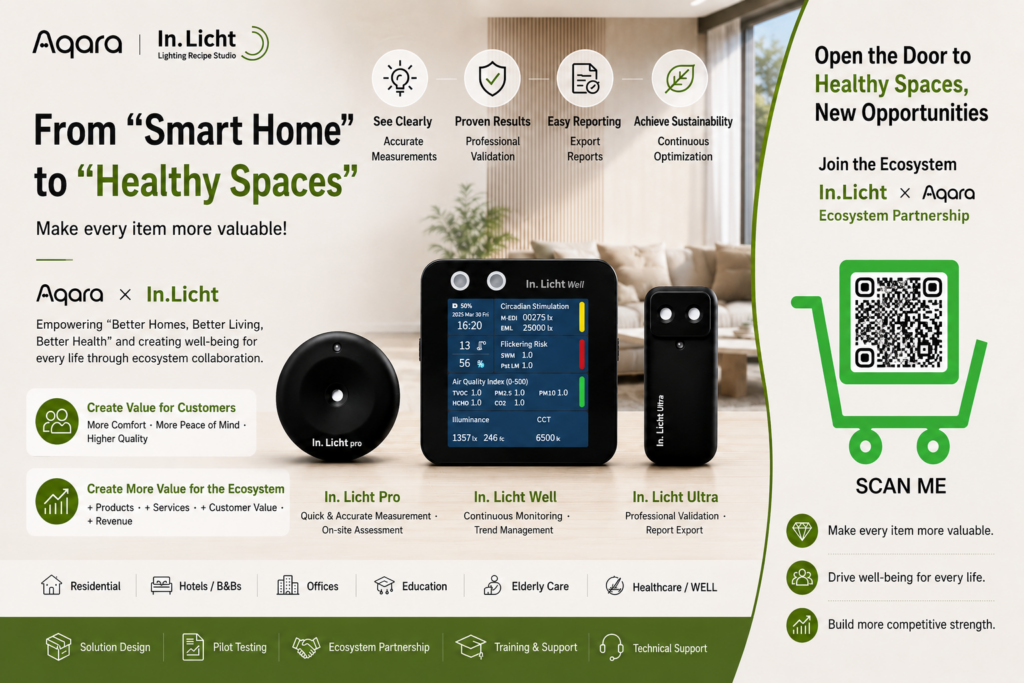
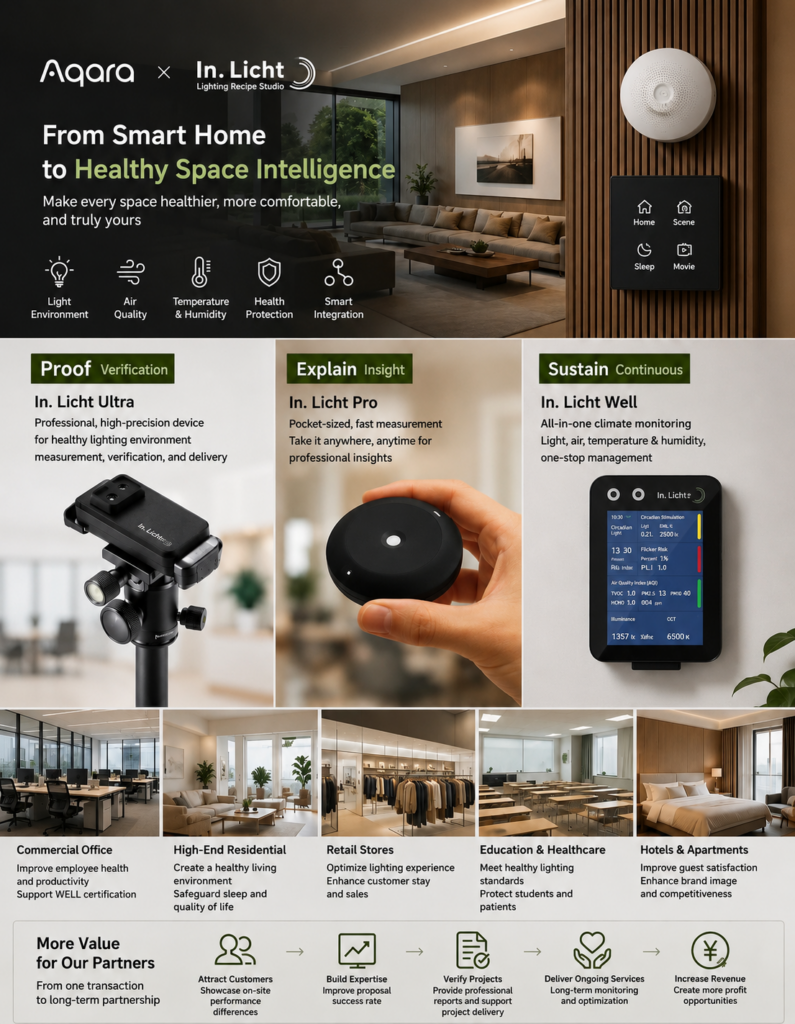
This philosophy is also reflected in the complementary roles of the In. Licht Ultra, Pro, and Well platforms:
In. Licht Ultra provides professional-grade measurement of spectral power distribution (SPD), flicker, circadian lighting metrics, and on-site lighting verification.
In. Licht Pro offers portable, rapid measurement capabilities for lighting designers, consultants, and field applications.
In. Licht Well enables long-term monitoring of indoor lighting environments, eye-level light exposure, and operational data integration for ongoing performance management.
Together, these platforms support a new approach to healthy lighting.
The objective is no longer simply to install luminaires.
It is to deliver a healthy lighting environment that can be continuously measured, validated, monitored, and optimized throughout its lifecycle.
03 | From Experience-Based Design to a Closed-Loop Data Ecosystem
For decades, lighting design has relied heavily on professional experience. Experience remains invaluable—but in the era of Human-Centric Lighting (HCL), experience alone is no longer enough.
Applications such as circadian lighting, mood lighting, healthcare lighting, educational lighting, workplace lighting, and senior living environments cannot be evaluated solely through subjective perception. They require objective data.
This is precisely the direction of LRS’s patent strategy.
Our research centers on establishing a relationship database between multispectral circadian lighting scenarios and psychological stress indicators. Rather than offering a handful of preset lighting modes, the future of healthy lighting should be built upon an interconnected data framework that links:
Spectral parameters
Time-based lighting parameters
Spatial lighting characteristics
Human-factor feedback
Psychological stress indicators
Circadian health metrics
Application requirements
Control strategies
Verification and operational data
This marks a fundamental transition—from lighting as a product feature to lighting as an engineered life-environment system.
Why This Matters
Real-world applications increasingly demonstrate that Human-Centric Lighting cannot remain a conceptual exercise. It must address the needs of diverse users, complex tasks, and practical operational constraints.
Consider hospital intensive care units (ICUs) and pediatric intensive care units (PICUs). Lighting must simultaneously support healthcare professionals’ visual performance, alertness, and circadian stability while minimizing disruption to patients’ sleep and recovery.
During the day, sufficient biological light stimulation is essential. At night, unnecessary circadian stimulation should be minimized. Clinicians need excellent visibility. Patients need restorative darkness. Visual requirements, circadian objectives, operational needs, and user experience often conflict with one another.
This illustrates an important reality:
The future of healthy lighting will not be defined by brighter illumination or lower color temperatures. It will be defined by the ability to achieve dynamic balance between visual performance, physiological health, psychological well-being, and operational efficiency within real environments.
Achieving that balance requires measurement, modeling, algorithms, intelligent control, and continuous data collection.
This is where LRS has built its technological advantage.
We are not simply developing HCL products. We are building the HCL-ready infrastructure that will support the next generation of healthy lighting.
The Next Competitive Frontier
The lighting industry’s next phase of competition will extend far beyond luminous efficacy, pricing, industrial design, or distribution channels.
Future leadership will belong to those who can:
Define the data language of healthy lighting.
Transform standards such as CIE S 026, WELL, IES, TM-30, flicker metrics, and human-centric performance models into practical engineering tools.
Integrate luminaires, sensors, control systems, lighting design software, and BMS/LMS platforms into a unified data ecosystem.
Demonstrate measurable performance in hospitals, schools, workplaces, senior living communities, and residential buildings.
Turn “good light” from a marketing promise into a deliverable, verifiable, and continuously optimized system.
Building the HCL-Ready Foundation
This is exactly what LRS is working to achieve. Our goal is not to introduce another standalone product, but to establish an HCL-ready technology foundation that creates value across the entire industry.
For luminaire manufacturers, it enables products to compete on measurable health outcomes rather than specifications alone.
For lighting designers, it transforms Human-Centric Lighting from a design concept into a verifiable engineering practice.
For building owners, it turns healthy lighting into a measurable and manageable building asset.
For standards organizations, it provides real-world data and engineering interfaces to support future industry development.
For BMS and LMS platforms, it integrates lighting into broader building health management systems.
For healthcare, education, offices, senior living, and residential applications, it enables lighting to genuinely support human health, well-being, and circadian biology.
The Next Step in Healthy Lighting: From Seeing Light to Proving Light
The lighting industry has evolved through several stages.
First, we asked whether there was enough light. Then we focused on whether the light was bright enough. Later, we pursued lighting that was more beautiful and visually comfortable.
Today, the question has changed: Is this light genuinely better for people?Can we prove it?Can we continuously improve it?
This is the principle that defines LRS’s vision: Stop guessing light. Start measuring light.
Good lighting should not exist only in marketing claims. It should be designed. Manufactured. Measured. Verified. Recorded. Managed. Continuously optimized.
That is why LRS continues to invest in patents, measurement instruments, algorithms, data platforms, standards collaboration, and real-world validation—building the technological foundation for the future of Human-Centric Lighting.
Conclusion | The Next Generation of Lighting Is Not Just About Illuminating Spaces—It’s About Supporting Human Health
At Lighting Recipe Studio (LRS), we believe the lighting industry is entering a new era.
In this new era, luminaires are no longer just building components. Light is becoming an environmental signal that influences sleep, alertness, concentration, mood, stress, recovery, and long-term health.
This transformation also calls for a greater sense of responsibility across the industry. It is no longer enough to build lighting products that are simply less expensive, brighter, or capable of changing color. We must create lighting that genuinely benefits people, adds measurable value to built environments, and delivers lasting societal impact.
LRS is committed to working with global lighting manufacturers, designers, researchers, healthcare and education providers, building technology platforms, standards organizations, and industry partners to accelerate the industry’s transition:
From Human-Centric Lighting (HCL) concepts to HCL-ready systems
From standalone products to closed-loop, data-driven ecosystems
From marketing claims to scientific validation
From competition within the lighting industry to the shared mission of creating healthier light environments for people everywhere
We are not simply illuminating spaces.
We are building the infrastructure that enables light to support human health and well-being.
Lighting Recipe Studio (LRS)
Quality You Can See — and Prove.
Good light shouldn’t just look better. It should be measurable, verifiable, and engineered to improve people’s lives.
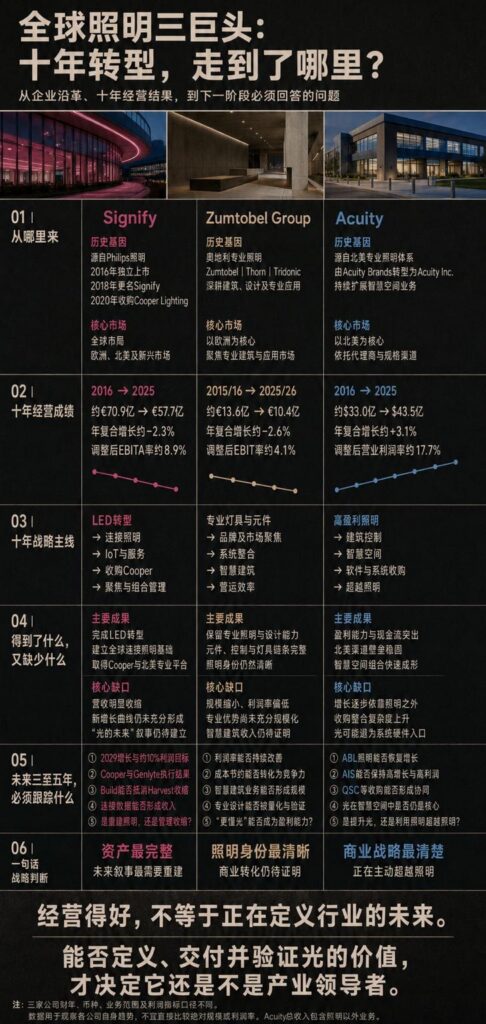
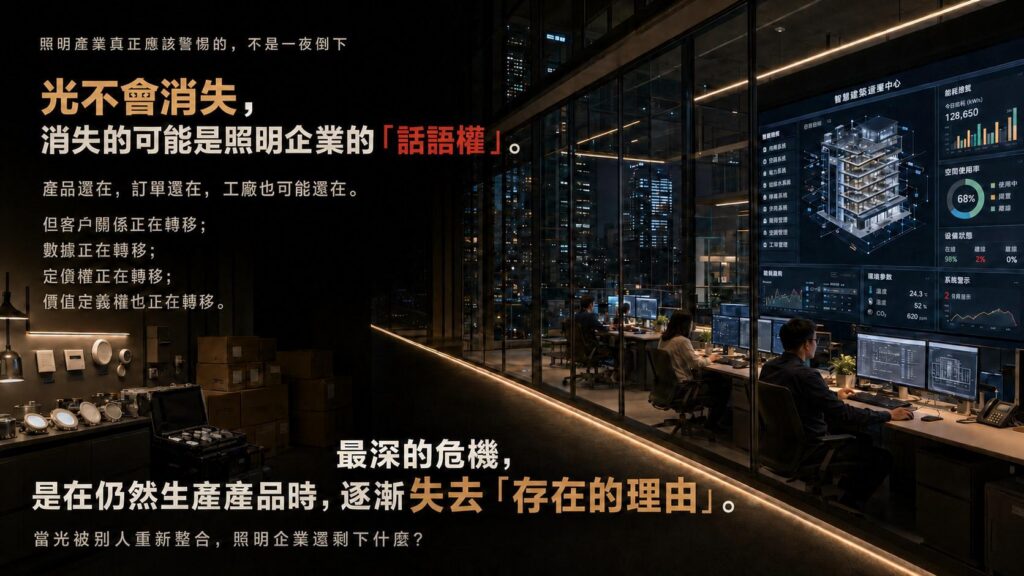
同樣必須公平指出,Signify並非沒有超越傳統照明的想像。公司持續投資連接照明、樓宇整合、智慧城市、循環經濟、健康與福祉,以及其他相鄰市場。其Brighter Lives, Better World 2030計畫,更設定要將具有「超越照明效益」的相關營收,由2024年的31%提高至2030年的41%。Brighter Lives, Better World 2030









 English
  Chinese (Taiwan)
  Chinese (China)
  German