Integrated Lighting Must First and Foremost Be Good Lighting
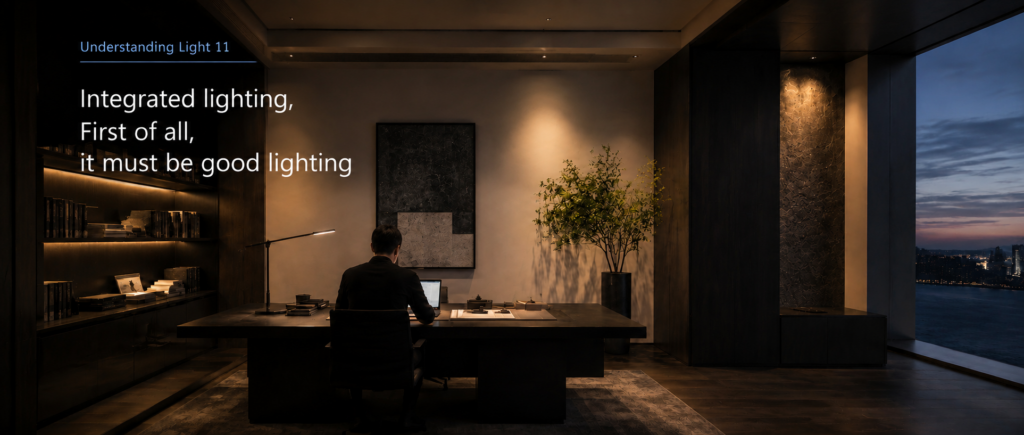
Without visual quality, no health-related objective can stand on solid ground.
Author | Lawrence Lin
Chairman, GLGA | Board Member, GLG | IWBI WELL Light Concept Advisor | Founder & CEO, LRS
An office once added a very bright luminous surface directly in front of employees in an effort to increase light exposure at the eyes. The measured numbers looked excellent, but employees began wearing hats, turning off the lights, and even blocking the light with cardboard. The design achieved its calculated target—but lost its users.
Integrated lighting is not about adding another number on top of conventional lighting. It must first satisfy visibility, comfort, safety, and spatial quality, and only then address appropriately timed non-visual stimulation. A lighting scheme that people actively try to escape from is unlikely to deliver its intended benefits over the long term.
The Non-Negotiable Foundations of Good Lighting
Illuminance should be appropriate to the task, and its distribution should not force the eyes to repeatedly adapt between extremely bright and extremely dark areas. Glare must be controlled, and screens and glossy surfaces should not produce distracting reflections. Color rendering should support the recognition of people, materials, and warning information. Temporal light modulation should not create noticeable flicker or stroboscopic effects.
The space also needs hierarchy. Uniformity does not mean making every surface equally bright, and dynamic lighting does not mean changing the color temperature every ten minutes. Human attention, orientation, and the atmosphere of a space often come from orderly relationships between different luminance levels.
The Metrics Need to Be Balanced
Increasing vertical illuminance may increase glare; increasing wall luminance may increase energy consumption; changing the spectrum may affect color rendering and system efficiency; excessive dimming may amplify temporal light modulation from certain drivers.
The value of engineering design lies precisely in finding the overall optimum within these constraints, rather than pursuing a single metric as the “champion.”
This is also the full meaning of what CIE describes as “proper light at the proper time”: the right light is not defined only by quantity and timing, but also by quality and the environment in which it is used.
User Behavior Is One of the Final Judges
If users frequently pull the curtains, disable automatic controls, or block luminaires, the first step should be to understand why.
Glare, temperature, privacy, screen reflections, or control logic can all cause the original design intent to fail. Post-occupancy feedback is not a soft bonus—it is evidence of whether the system actually works.
What We Can Say Today / What We Cannot Yet Say
What we can say today: Integrated lighting should simultaneously address visual comfort, task performance, safety, circadian-related objectives, energy, and building conditions.
What we cannot say: Achieving a particular melanopic value justifies sacrificing glare control, color rendering, flicker control, or user autonomy.
Three Things You Can Do Today
- Establish a combined checklist covering illuminance, glare, color rendering, temporal light modulation, controls, and mel-EDI.
- During mock-up testing, have real users sit, look, and perform tasks—not just let instruments take measurements.
- After acceptance, conduct a follow-up and observe “anti-design behaviors” such as blocking lights, turning lights off, or pulling curtains.
Evidence label: Established consensus.
The foundation of integrated lighting is meeting the requirements of overall lighting quality.
References
- CIE PS 001:2024: https://cie.co.at/publications/cie-position-statement-integrative-lighting-recommending-proper-light-proper-time-3rd
- ISO/CIE 8995-1:2025: https://www.iso.org/standard/76342.html
- GB/T 50034—2024 Publication Information: https://sczjjgfw.gov.cn/clas/wjhb/jsb/24/jsb202433.html
In the next article, we tackle one of the loudest terms in the market: Why doesn’t “full spectrum” automatically mean healthy, and why isn’t color temperature a cure-all?

 English
  Chinese (Taiwan)
  Chinese (China)
  German