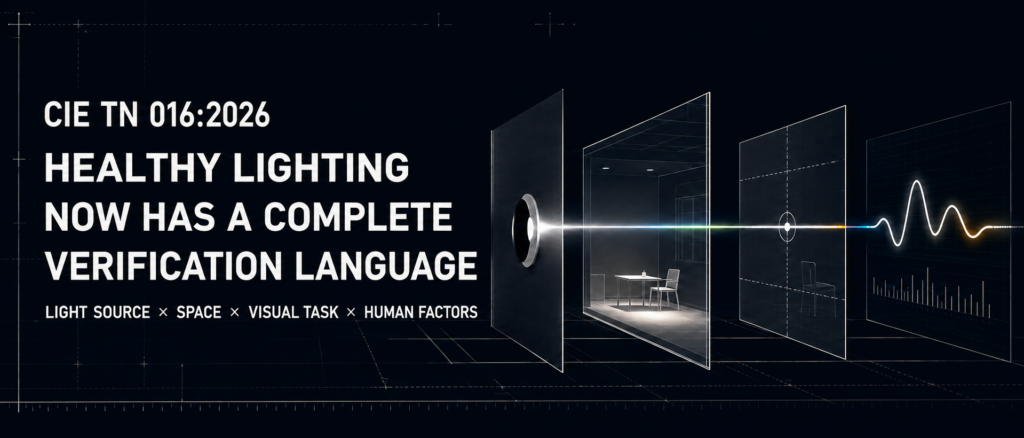
Establishing a complete evidence chain connecting light source characteristics, spatial conditions, eye-level exposure, and human-factor responses
Healthy Lighting Leaves Behind “Everyone Speaking a Different Language.”
CIE TN 016:2026 introduces the first comprehensive framework for reporting and validating light interventions—moving beyond “500 lx, 4000 K” to a complete evidence chain encompassing light source, spatial environment, eye-level light exposure, and human responses, and establishing a common language for comparable and reproducible light and health research.
By Lawrence Lin | Chairman, Good Light Group Asia (GLGA), Board Member, Good Light Group (GLG), IWBI WELL Light Concept Advisor, Founder & CEO, Lighting Recipe Studio (LRS)
In many studies on light and health, the experimental conditions are often described as follows: 4000 K, 500 lx, with a two-hour exposure. At first glance, this appears to be sufficiently specific.
But where was the 500 lx measured? Was it on the horizontal workplane or on the vertical plane at the observer’s eye? Where was the participant looking? What spectral power distribution actually reached the eyes? What was the melanopic Equivalent Daylight Illuminance (mel-EDI)? At what point in the participant’s circadian cycle was the experiment conducted? What kind of light exposure had the participant experienced beforehand?
If these questions remain unanswered, another research team may be unable to reproduce the study—even if it uses the same correlated color temperature, illuminance, and exposure duration.
This is precisely the challenge that the International Commission on Illumination (CIE) seeks to address with its newly released CIE TN 016:2026.
It does not propose a new “healthy lighting metric,” nor does it claim that any particular type of light is definitively effective. Instead, it accomplishes something more fundamental—and more important: before discussing how light affects people, it first makes clear exactly what light people are actually exposed to.
1. CIE S 026 Gives Us a Measuring Stick; TN 016 Begins Standardizing How We Record the Measurements
The full title of CIE TN 016:2026 is A Comprehensive Checklist for Reporting Light Characteristics in Laboratory-Based Human Studies Using Light As An Intervention. The document incorporates the ENLIGHT (Expert Network on LIGHT Interventions) consensus checklist into the CIE technical document framework for laboratory-based human studies that use light as an intervention.
CIE positions it as the first internationally endorsed consensus checklist for reporting light interventions.
The relationship between these two documents can be summarized in one sentence:
CIE S 026:2018 established the α-opic system for quantifying how visible light stimulates the five classes of photoreceptors in the human eye, whereas CIE TN 016:2026/ENLIGHT establishes a common language for how researchers should comprehensively document and report experimental conditions when using these quantities.
The former is essentially a measuring stick; the latter requires researchers to explain where the measurement was taken, in which direction, at what time, with what instrument, and under what conditions the participant received the light exposure.
TN 016 is not intended to replace existing documents. CIE TN 011:2020 discusses which factors should be recorded and reported in studies involving intrinsically photosensitive retinal ganglion cells (ipRGCs), while CIE TN 012:2021 provides guidance on measuring temporal light modulation. TN 016 consolidates these recommendations into a practical checklist that can be systematically followed.
The ENLIGHT checklist was developed through a four-round modified Delphi consensus process involving international experts. The first round included 65 participants with experience in human light intervention research. The process ultimately produced a checklist of 25 reporting items, which was subsequently tested and refined by independent experts.
The original consensus paper was published in 2023, and in 2026 it was formally issued by CIE as a Technical Note, aligning it with CIE’s existing framework for light measurement and reporting.
Its significance does not lie in introducing new terminology. Rather, it provides a common reporting framework that makes data generated by different laboratories easier to interpret, compare, and reproduce, thereby increasing their suitability for inclusion in systematic reviews and meta-analyses.
2. What Has Been Missing Is Far More Than a Spectral Distribution Curve
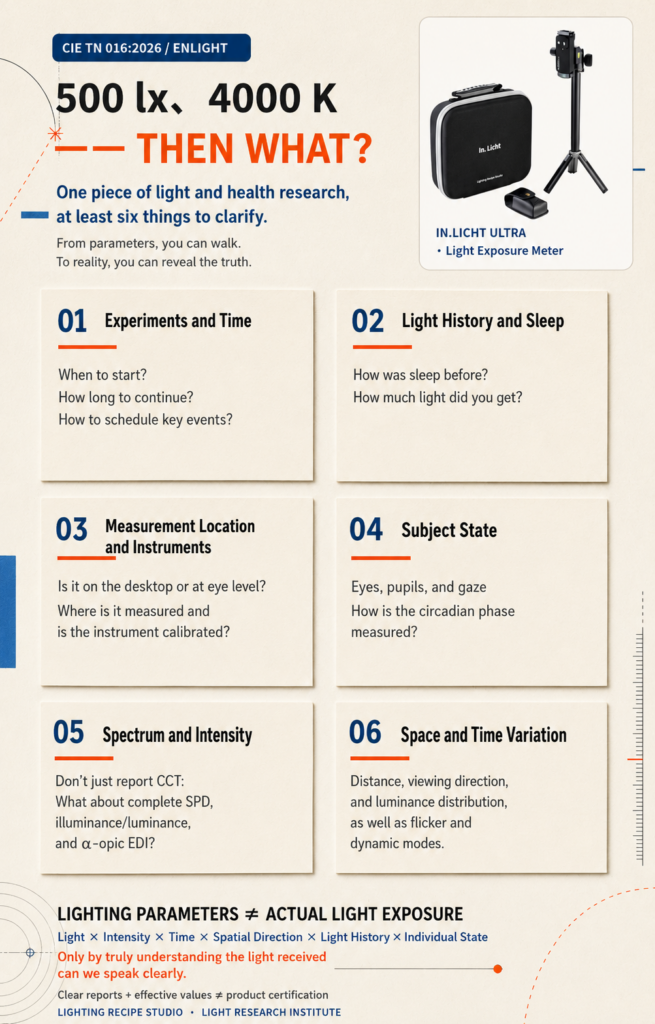
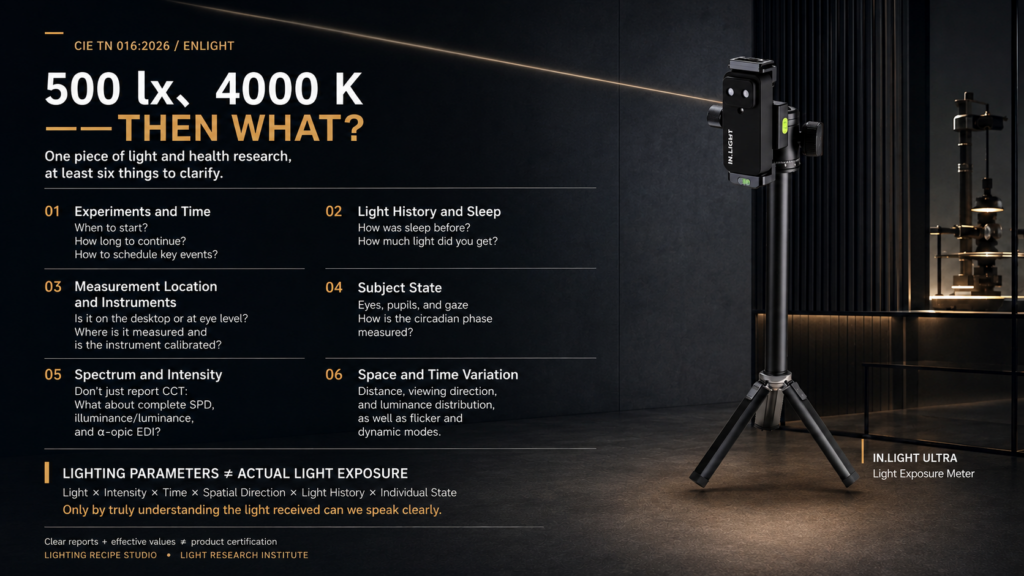
的 25 reporting items in the ENLIGHT checklist can be broadly divided into two domains: study conditions 和 light characteristics. For readers in the lighting industry, they can be understood as six categories of information.
1. Experimental and Timing Conditions
This category includes the experimental setting, the timeline of key events, and the timing and duration of the light intervention.
The physiological effects of light are highly time dependent. Light delivered in the morning, during the daytime, or immediately before bedtime cannot be regarded as the same biological stimulus, even when its physical parameters are identical.
2. Prior Light Exposure and Sleep Status
This includes participants’ sleep–wake or activity patterns before entering the laboratory, their previous light exposure history, and the light environment immediately preceding the intervention.
Human responses to a given light exposure depend not only on the light being presented at that moment but also on prior light exposure and sleep history.
3. Measurement Location, Direction, and Instrumentation
This category specifies whether measurements were made on a horizontal or vertical plane, the position and orientation of the sensor, and the model and calibration status of the measurement instrument.
Although these may appear to be routine experimental details, they determine whether the recorded values accurately represent the light actually received by the participant.
A measurement of 500 lx on a workplane does not automatically correspond to 500 lx entering the eye.
4. Participant Characteristics
This includes ocular health and visual function, pupil status, and the timing of the light intervention relative to the participant’s sleep schedule or circadian phase.
Measurements taken at eye level provide an important proxy for ocular light exposure, but they are not equivalent to the retinal light dose actually received by each individual. Pupil size, age, ocular media transmittance, and individual differences in photosensitivity all influence the ultimate biological response.
5. Spectral, Photometric, and Color Characteristics
This category includes illuminance/luminance, spectral irradiance/radiance distributions, α-opic irradiance/radiance, α-opic Equivalent Daylight Illuminance (EDI) and Equivalent Daylight Luminance (EDL), as well as chromaticity, correlated color temperature (CCT), peak wavelength, bandwidth, and color rendering properties.
This further illustrates that CCT describes the appearance of light but cannot, by itself, characterize its biological effects on humans. Likewise, the term “full spectrum” cannot substitute for a complete spectral power distribution (SPD) together with α-opic quantification.
6. Spatial and Temporal Characteristics
This includes the position of the light stimulus relative to the participant, viewing distance, whether the light is viewed directly or indirectly, the stimulus size within the visual field, and its temporal properties such as flicker frequency, waveform, and modulation pattern.
For tunable-white, multi-channel, and dynamic lighting systems, reporting only a nominal CCT or a single static operating condition is clearly insufficient to reconstruct the actual light intervention.
Taken together, these categories define the true light-dose conditions in a human intervention study:
Light dose = Spectrum × Intensity × Time × Spatial geometry and direction × Prior light exposure history × Individual physiological state.
3. A Luminaire’s Specifications Are Not the Same as a Person’s Light Dose
This is perhaps one of the most important messages that CIE TN 016 offers to the lighting industry.
The spectral power distribution (SPD) emitted at a luminaire’s aperture is not the same as the SPD reaching the eye. Likewise, horizontal workplane illuminance is not equivalent to the amount of light that actually enters the eye.
Once light leaves the luminaire, it is modified by viewing distance, angle, obstructions, surface reflectance, spatial distribution, and the observer’s viewing direction before ultimately determining the eye’s actual light exposure.
As a result, the same luminaire installed in different spaces—or even the same person looking in different directions within the same space—may experience substantially different melanopic Equivalent Daylight Illuminance (mel-EDI) at the eye.
Similarly, two lighting scenarios may have identical illuminance and correlated color temperature (CCT), yet differ in their spectral power distributions (SPDs) and, consequently, their α-opic stimulation.
TN 016 does not require every study to measure eye-level exposure at a fixed height. However, it explicitly includes the measurement plane, measurement location, and viewing direction in its reporting checklist, requiring these details to be documented whenever applicable.
This elevates actual ocular light exposure from a frequently overlooked experimental detail to a core requirement for research reproducibility.
For the lighting industry, this also carries an important implication: healthy lighting cannot stop at the relationship between luminaire specifications and control commands.
What must ultimately be established is a complete chain linking:
Light source and control state → Spatial distribution of light → Actual ocular light exposure → Human physiological and psychological responses
If any link in this chain is not accurately characterized or documented, the health-related conclusions drawn from the subsequent stages inevitably become less reliable and less interpretable.
4. Its Impact Extends Well Beyond Scientific Publications
Although CIE TN 016 is primarily intended for scientific research, its influence is unlikely to be confined to the formatting of research papers. Its implications extend across the entire lighting ecosystem.
For Research Institutions
The conditions of a light intervention should be comprehensively planned from the earliest stages of study design and grant proposal development—not reconstructed later when preparing a manuscript for publication.
More transparent reporting improves the reproducibility of experiments, facilitates the identification of potential confounding factors, and increases the likelihood that datasets can be incorporated into systematic reviews and meta-analyses.
For Measurement Instrument Manufacturers
In the future, valuable research data will consist of far more than a single number displayed on an instrument.
Raw spectral power distributions (SPDs), α-opic metrics, measurement location and orientation, timestamps, instrument serial numbers, calibration status, and algorithm versions will all become essential components of data traceability.
For Luminaire, Light Source, and Lighting Control Manufacturers
For tunable-white, multi-channel, and dynamic lighting systems, it will no longer be sufficient to provide only a nominal correlated color temperature (CCT), an initial lumen output specification, or a static photometric file.
Instead, a verifiable relationship must be established between the control commands, channel operating states, the resulting SPD, and the actual ocular light exposure experienced within the space.
For Lighting Designers and Healthy Building Professionals
Calculated design values are not equivalent to the light exposure that occupants actually receive.
Meeting workplane illuminance requirements does not necessarily mean that eye-level melanopic Equivalent Daylight Illuminance (mel-EDI) achieves the intended target.
Design, commissioning, operational control, and on-site verification should therefore be integrated into a single closed-loop workflow.
For Product Claims and Marketing
Any claims related to sleep, circadian regulation, alertness, mood, or cognitive performance will increasingly need to satisfy more rigorous evidentiary standards.
A single set of luminaire specifications, one short-term measurement, or an isolated correlation study is unlikely to provide sufficient evidence for robust causal claims.
TN 016 will not become a product regulation overnight. However, it is likely to steadily raise the evidentiary threshold for research collaborations, peer review, product validation, and health-related marketing claims.
5. Equally Important: What TN 016 Does Not Specify
The more influential a document is, the more important it becomes to avoid overinterpreting its scope.
First, TN 016 is a guidance document, not a mandatory international standard. As a CIE Technical Note, it explicitly states that its recommendations are advisory rather than normative and are not intended as mandatory requirements.
Second, it is a reporting checklist—not a scoring system for research quality. Thoroughly documenting that a particular experimental condition was not controlled does not automatically make a study well designed. It does, however, enable readers to correctly assess the study’s scope, limitations, and potential sources of confounding.
Third, it does not prescribe target values. TN 016 does not specify how much melanopic Equivalent Daylight Illuminance (mel-EDI) should be achieved during the daytime, evening, or before sleep, nor does it establish pass/fail criteria for luminaires, lighting systems, or measurement instruments.
Fourth, there is currently no such thing as “CIE TN 016 certification” or an “ENLIGHT-certified product.” A more accurate description would be that a particular study or measurement system supports the recording and reporting of light exposure in accordance with the ENLIGHT/CIE TN 016 recommendations.
Fifth, the document is intended primarily for laboratory-based human light intervention studies and should not be interpreted as a building lighting design guideline. Real-world environments involve daylight, mixed lighting, occupant behavior, and long-term exposure patterns that require additional field studies and continuous monitoring methods to characterize adequately.
Finally, although eye-level mel-EDI provides a more accurate description of the external light stimulus reaching the eye, a single measurement cannot by itself demonstrate a health outcome. Human responses to light still require rigorous experimental design and should be validated using complementary evidence, including physiological measurements, biomarkers, behavioral outcomes, and assessments of brain function.

6. From “Measuring the Luminaire” to an Evidence Chain Linking Light Source, Space, Ocular Exposure, and Human Response
適用於 光配方研究院(Lighting Recipe Studio, LRS), the release of CIE TN 016 further reinforces a direction we have long advocated: healthy lighting should not stop at characterizing the light source itself. Instead, it should establish a complete evidence chain that connects the light source and its control state, the spatial distribution of light, the actual light exposure at the eye, and ultimately human physiological and behavioral responses.
To support this evidence chain, the In. Licht product family is being developed with complementary measurement and validation capabilities at different levels:
- In. Licht Ultra provides reference characterization of spectral power distributions (SPDs), α-opic quantities, and lighting conditions under different optical fields and control states.
- In. Licht Pro enables on-site and time-series monitoring of eye-level illuminance, correlated color temperature (CCT), and melanopic Equivalent Daylight Illuminance (mel-EDI).
- In. Licht Well is designed for long-term monitoring of ambient lighting conditions and proxy measurements of ocular light exposure at fixed locations, while simultaneously recording environmental covariates such as indoor air quality.
Looking ahead, the industry’s priority should not be to introduce ever more sophisticated-looking metrics. Rather, it should be to integrate measurement location, measurement direction, timestamps, instrument calibration records, algorithm versions, scene commands, and lighting control states into a unified reporting workflow.
Every dataset should be able to answer a series of fundamental questions:
- Where was the measurement taken?
- In which direction was it measured?
- When was it measured?
- What were the lighting source and control settings at that moment?
- What light actually reached the participant’s eyes?
Only when these details can be preserved, exported, compared, and verified in real-world environments does measurement become more than the production of a single number—it becomes the foundation of cumulative scientific evidence.
Conclusion: The Lighting Industry Does Not Lack Concepts—It Lacks Accumulating Evidence
The field of healthy lighting has no shortage of concepts, nor does it lack metrics.
What remains genuinely scarce is evidence that can be reproduced, compared, independently verified, and accumulated over time.
CIE TN 016:2026 does not offer the industry a simple answer. Instead, it poses a more fundamental challenge:
Being able to measure something does not mean its effectiveness has been demonstrated. But if we have not even measured the light that people actually receive, meaningful validation is impossible.
When light sources, control systems, spatial light distribution, ocular light exposure, and human-factor research are connected through a single traceable evidence chain, healthy lighting can begin to move beyond marketing narratives and become firmly grounded in scientific research, lighting design, architecture, clinical practice, and public health.
At 光配方研究院(Lighting Recipe Studio, LRS), we look forward to working with research institutions, lighting manufacturers, lighting control companies, measurement instrument partners, and healthy building organizations to advance this vision. Our goal is to ensure that data generated in light-and-health research become genuinely usable, comparable, and verifiable—so that good light is no longer merely a claim, but something that can be measured, validated, and consistently delivered.
 English
  Chinese (Taiwan)
  Chinese (China)
  German