Acceptance Is Not a One-Time Lux Measurement: How to Close the Design–Commissioning–Verification Loop
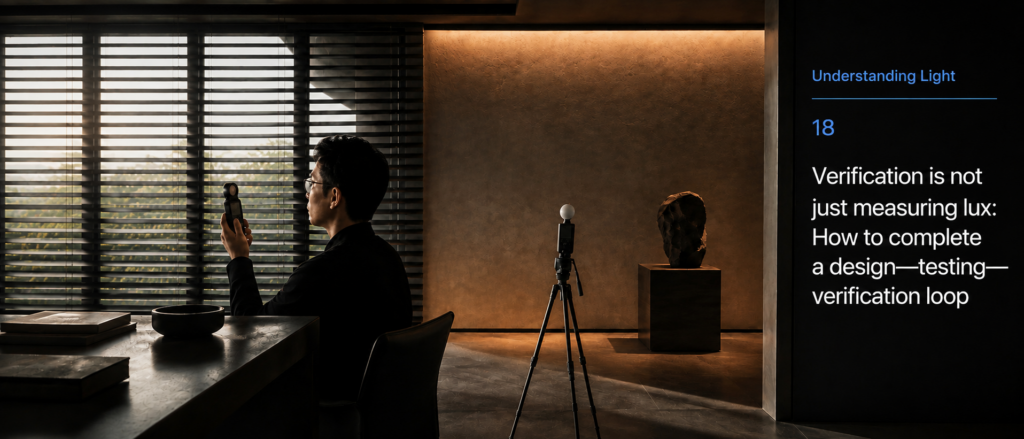
Turning “design intent” into evidence that can be retested and sustained in operation
Author | Lawrence Lin
Chairman, GLGA | Board Member, GLG | IWBI WELL Light Concept Advisor | Founder & CEO, LRS
On the day a project is completed, all the lights are switched on, workplane illuminance is measured, and the acceptance form is signed. Three months later, the schedule has been modified by the facility team, the blinds remain closed most of the time, several sensors are offline, and the nighttime scene is no longer being used. The health-oriented lighting specified on paper has quietly become ordinary lighting.
Acceptance of an integrated lighting system is not a snapshot taken at a single point in time. It is a verification of an operating logic. Design, installation, commissioning, measurement, occupant feedback, and ongoing review are all essential. Missing any one of these links can cause the intended outcome to fail.
Before Acceptance: Lock Down the Baseline
The final drawings should document the luminaires, drivers, control addresses, scene schedule, measurement points, and target values. Any equipment substitution must trigger a review of spectral characteristics, photometric distribution, and dimming performance. Field measurement instruments should have documented calibration information, and measurement personnel should follow consistent orientations, timing, and recording formats.
For spaces where daylight contributes to the lighting environment, weather or blind conditions should be defined in advance. When weather cannot be controlled, daylight and electric-light conditions can be recorded separately rather than directly comparing readings taken on different days.
During Commissioning: Check the System Scene by Scene
Testing should go beyond rated full-output operation. Daytime, evening, pre-sleep, nighttime safety, cleaning, and maintenance scenes should all be checked.
Verify workplane illuminance, eye-level mel-EDI, glare observation points, color characteristics, minimum stable dimming levels, and temporal light modulation. At the same time, test sensors, manual overrides, power-loss recovery, and shading integration.
When a deviation is found, the team should be able to trace whether it was caused by the luminaire, driver, installation angle, surface reflectance, daylight, or control logic. Simply “turning the system up a little” often masks the real problem.
After Handover: Verify Real-World Use
Handover documentation should be understandable to the facility team: why each scene exists, which parameters should not be changed arbitrarily, and what needs to be remeasured after equipment replacement.
After the system has been in operation for a period of time, key eye positions and scenes can be spot-checked, control logs reviewed, and occupants interviewed about glare, insufficient light, frequent changes in lighting levels, or difficulties operating the system.
Subjective human feedback cannot replace measurement, and measurement cannot replace human experience. Together, they form a more complete body of operational evidence.
A Minimum Closed-Loop Checklist
During the requirements stage, define people, time, and activities. During the design stage, calculate visual and α-opic metrics. During procurement, lock down data and interfaces. During the mock-up stage, validate extreme operating conditions. During construction, document changes. During commissioning, test each scene. During operation, provide training, collect feedback, and conduct remeasurement.
The purpose of this chain is not to create more paperwork. It is to ensure that every health-related claim has a source, defined conditions, and an accountable owner.
What We Can Say Now / What We Cannot Yet Say
What we can say: Through traceable measurement points, scenes, equipment data, and operational review, it is possible to demonstrate that a system meets its design targets under specified conditions.
What we cannot yet say: A single post-construction measurement can prove long-term health outcomes, or that the system will remain compliant under every future operating condition.
Three Things You Can Do Today
- Upgrade the acceptance form from an “equipment checklist” to “scene + measurement point + conditions + result + responsible person.”
- Include control logic, calibration information, and critical parameters in the operations manual.
- Schedule a remeasurement and occupant follow-up 3–6 months after handover.
Evidence label: Engineering practice / Open question.
An on-site closed loop can verify performance implementation; long-term health outcomes still require appropriate research designs.
References
- CIE PS 001:2024:https://cie.co.at/publications/cie-position-statement-integrative-lighting-recommending-proper-light-proper-time-3rd
- CIE S 026:2018:https://www.cie.co.at/publications/cie-system-metrology-optical-radiation-iprgc-influenced-responses-light-0
- CIE TN 016:2026:https://www.cie.co.at/publications/comprehensive-checklist-reporting-light-characteristics-laboratory-based-human-studies
- ISO/CIE 8995-1:2025:https://www.iso.org/standard/76342.html

 English
  Chinese (Taiwan)
  Chinese (China)
  German