From the CIE L41 tutorial: Calibration and the Need for Industry-Wide Standards Consensus
By Lawrence Lin
The lighting industry has undergone a profound transformation in light-source technology.
From incandescent lamps and fluorescent lighting to LEDs, we have changed how light is generated, improved luminous efficacy, and expanded our capabilities in dimming, colour tuning and spectral control.
At the same time, the measurement methods that underpin product evaluation and engineering acceptance must continue to evolve.
Once a lux meter has been calibrated, will it deliver the same accuracy when measuring different LED light sources?
If two instruments produce different readings at the same site, how should we determine which result to trust?
What does a calibration certificate actually tell us, and what are its limitations?
These questions affect the credibility of product specifications, the verifiability of project delivery, and the consistent application of industry standards.
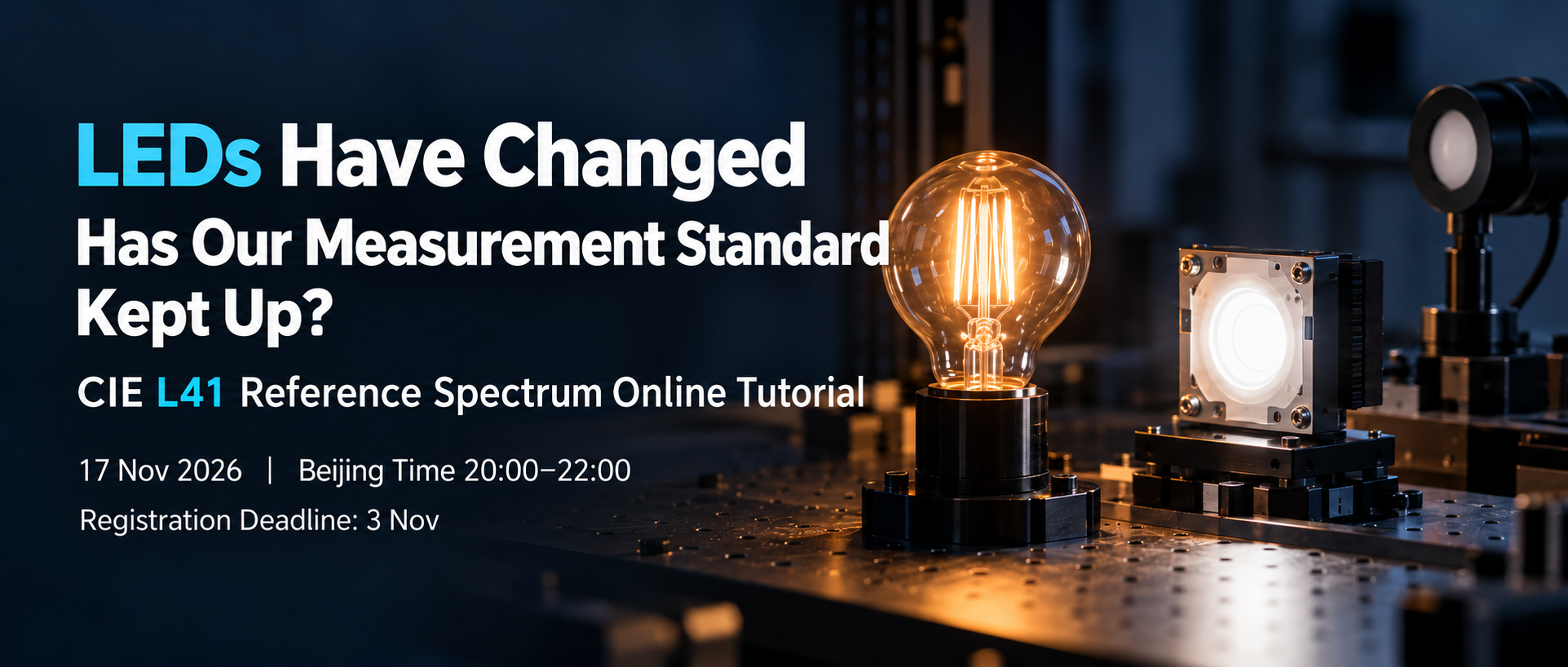
On 17 November 2026, the International Commission on Illumination (CIE) will host an online tutorial on the L41 reference spectrum.
This provides an opportunity to invite colleagues across the industry to consider a fundamental question:
As light-source technology evolves, how can we ensure that measurement, calibration and standards evolve with it?
01 — Traditional Calibration Meets LED Spectra
For many years, photometer calibration has widely used a reference spectrum based on CIE Standard Illuminant A.
Illuminant A represents the typical spectral characteristics of an incandescent tungsten-filament lamp and provides an important foundation for the transfer and comparison of photometric quantities.
A distinction is necessary here:
- A reference spectrum is mathematically defined.
- A standard light source used in a laboratory is a physical realisation of that reference.
- Actual calibration also relies on traceable reference standards, specified measurement conditions and an appropriate assessment of measurement uncertainty.
Taking a lux meter as an example, calibration involves comparing the instrument’s indication with the reference illuminance to determine its deviation and, where necessary, applying an adjustment.
However, calibration results are always obtained under specific conditions.
When the light-source spectrum, illuminance level or angle of incidence changes, the instrument’s performance may also change.
One issue deserves particular attention in the LED era:
The calibration source and the actual light source being measured may have significantly different spectral distributions.
Incandescent lamps have a continuous spectrum.
Common white LEDs, by contrast, typically have a blue peak combined with a broad phosphor-emission band. Spectra also differ among LED technologies.
Consequently, the relationship between traditional calibration conditions and actual measurement applications requires more thorough evaluation.
02 — Why Can Measurement Errors Remain After Calibration?
Illuminance is calculated by weighting light at different wavelengths according to the human eye’s photopic spectral luminous efficiency function, V(λ).
Traditional filtered lux meters use a combination of a detector and optical filters to approximate this response.
In practice, however, the instrument’s spectral response rarely matches V(λ) perfectly.
Some wavelengths may be overestimated, while others may be underestimated.
Under the calibration source, the overall deviation can be compensated for to some extent through a calibration factor.
When the spectrum changes, the contribution of each wavelength to the measurement also changes, potentially altering the effectiveness of that compensation.
This is why we need to pay attention to spectral mismatch error.
The principle can be understood as follows:
Calibration establishes the relationship between an instrument and a reference quantity under specified conditions.
Actual measurements must also establish whether that relationship remains applicable to the light source being measured.
Therefore, we cannot assume that an instrument has the same accuracy under every LED spectrum simply because it has been calibrated.
Nor should we immediately conclude that one instrument is inaccurate simply because two instruments produce different readings.
Measurement position, direction, source stability, angular response and calibration conditions all need to be examined.
03 — L41 Provides a New Common Reference
In 2023, the CIE published Technical Report CIE 251:2023, LED Reference Spectra for Photometer Calibration.
The report introduces the CIE L41 reference spectrum to supplement Standard Illuminant A. It also provides methods for evaluating spectral quality when selecting physical LED standard sources.
This approach has a research foundation.
A related study published in Metrologia in 2018 analysed the spectra of 1,516 LED products and compared the performance of different candidate reference spectra for calibration.
Under the study conditions, a candidate spectrum with a correlated colour temperature of approximately 4103 K reduced the average spectral mismatch error in LED measurements by roughly half compared with using Illuminant A.
This result must be interpreted carefully.
It represents an average improvement across the study’s sample and conditions.
It does not mean that every instrument or every LED will achieve the same degree of improvement.
L41 also has a specifically defined spectrum. It cannot be replaced by an arbitrary LED with a similar colour temperature.
Similar colour temperatures do not necessarily mean identical spectra.
Furthermore, changing the calibration reference spectrum does not change the instrument’s own spectral response. Nor does it automatically resolve issues such as low-light noise, nonlinearity, temperature drift or angular response.
The value of L41 lies in providing a more suitable common reference for photometer calibration in the LED era.
04 — Moving Beyond “Having a Certificate” to Clearly Defined Measurement Conditions
In my view, the significance of this work also lies in encouraging the industry to address a fundamental question:
What conditions and information should accompany a measurement result?
Instrument manufacturers
Beyond publishing accuracy specifications, manufacturers should progressively clarify the applicable spectral conditions, illuminance ranges and verification conditions.
Validation under different LED spectra and mixed daylight environments can help users understand the capabilities and limitations of their instruments.
Testing and calibration laboratories
Depending on their needs, laboratories can evaluate the introduction of L41-related capabilities and use interlaboratory comparisons to investigate the practical performance of different calibration approaches.
Certificates and reports should also help users understand the scope and limitations of the results.
Lighting companies and designers
When comparing measurements on site, teams should first control measurement position, direction and light-source conditions before analysing differences in instrument response and calibration.
Simply comparing two displayed numbers is not enough to support a complete technical judgement.
Industry associations and standards professionals
Further discussion is needed on how to establish clearer links between product testing, laboratory calibration and on-site acceptance testing.
These efforts can help existing measurement traceability systems serve today’s light sources and applications more effectively.
05 — Healthy Lighting Requires More Comprehensive Verification
As the industry begins to focus on metrics such as melanopic equivalent daylight illuminance (mel-EDI), we need to recognise that different measurement quantities have different verification requirements.
Illuminance is weighted according to V(λ), whereas mel-EDI uses a different spectral weighting function.
Even if an illuminance reading is accurate for a particular light source, that does not automatically establish that mel-EDI is equally accurate.
Chromaticity, colour rendering and flicker metrics also have their own measurement requirements.
The progress represented by L41 is therefore important, but it should not be interpreted as a universal calibration solution for every optical measurement.
A more comprehensive future framework needs to address the following questions for each measurement:
- What quantity is being measured?
- Which method is used to obtain the result?
- Under which spectra and operating conditions has the method been validated?
- How is measurement uncertainty assessed?
- How should decisions be made when results are close to an acceptance limit?
As product claims become increasingly diverse, the conditions for measurement and verification must also be described more specifically.
06 — An Online Tutorial Worth the Industry’s Attention
CIE Online Tutorial on the CIE L41 Reference Spectrum
Date: 17 November 2026
Time:
- Beijing / Taipei time: 20:00–22:00
- Central European Time (CET): 13:00–15:00
Format: Online via Webex
Registration deadline: 3 November 2026
What will the tutorial cover?
- Fundamentals of photometry and traditional reference sources
- Spectral mismatch in the LED era
- Development of the L41 reference spectrum
- Practical applications in calibration, measurement and simulation
- Implementation in laboratory and industrial workflows
- Expert questions and discussion
The tutorial is suitable for calibration and testing laboratories, metrology institutions, instrument manufacturers, and professionals involved in LED measurement and applications.
A bundled registration option that includes the CIE 251:2023 publication is also available.
Please refer to the official CIE page for the applicable fees, membership eligibility and payment requirements.
Registration and course details:
https://r31364.eventcloud.hu/cieonline2026
07 — Building Consensus on Shared Evidence
I hope this tutorial can serve as a starting point for continued industry dialogue.
Industry associations can organise focused technical discussions.
Laboratories and instrument manufacturers can conduct comparative studies using representative LED light sources.
Standards working groups can review where existing methods need to be supplemented to better reflect real-world applications.
These efforts may not immediately produce new clauses in formal standards, but they can generate reproducible data and help build consensus on a shared body of evidence.
The advancement of the lighting industry requires product innovation, as well as the measurement capabilities needed to support that innovation.
Make calibration conditions more transparent.
Make application verification more comprehensive.
Ensure that standards are interpreted consistently in laboratories and in the field.
When we say that a light source is more energy-efficient, more comfortable or better suited to human needs, the industry should be able to explain the evidence behind those claims and ensure that the results can withstand independent verification.
That is why I recommend this CIE tutorial.
Lawrence Lin
Founder, Lighting Recipe Studio
Chairman, Good Light Group Asia
Board Member, Good Light Group
This article provides an introduction to the tutorial and an overview of its technical background. For L41-related calibration procedures and specific requirements, please refer to the official CIE 251:2023 publication. Course arrangements are subject to the latest official CIE announcements.

 English
 Chinese (Taiwan)
 Chinese (China)
 German