Why Aren’t Lux and CCT Enough?
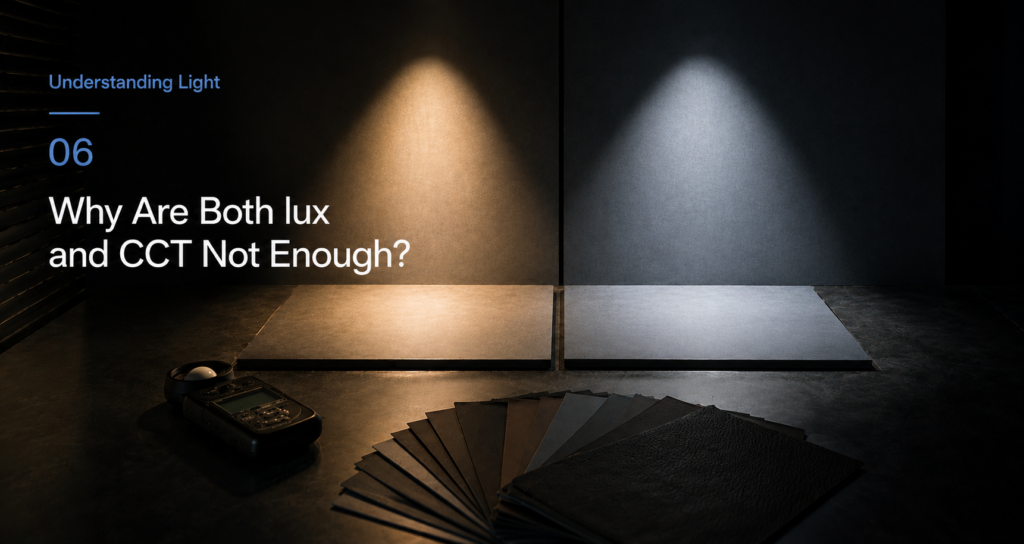
Two useful metrics, but they cannot answer every question
Author | Lawrence Lin
Chairman, GLGA | Board Member, GLG | IWBI
WELL Light Concept Advisor | LRS Founder & CEO
During a design review, a lighting consultant said, “The workplane has 500 lx and a CCT of 4000 K, so it already meets the health requirements.”
This statement sounds complete, but it actually answers only part of the question: approximately how much visual illuminance is present on the workplane, and whether the overall appearance of the light is relatively cool or warm.
Lux and correlated color temperature (CCT) are both important, but they are not a universal language for human light exposure. When discussing integrated lighting, we also need to consider spectrum, direction, time, and metrics suitable for non-visual pathways.
What Does Lux Measure?
Illuminance is weighted according to the human photopic spectral sensitivity function V(λ), making it suitable for describing the amount of light needed for visual tasks. It has long been used for workplane illuminance, roadway lighting, and indoor lighting standards, and remains an indispensable fundamental metric in lighting engineering.
The issue is that the melanopsin-related pathway has a different spectral sensitivity from V(λ). Two light sources with the same visual illuminance can therefore produce different levels of melanopic stimulation.
So lux is not wrong—it is simply answering a different question.
What Does CCT Measure?
Correlated color temperature describes how closely the color appearance of a light source resembles that of a blackbody radiator at a given temperature. It helps us communicate whether light appears warm white or cool white, but it does not describe the complete spectrum.
Different LED formulations can have the same CCT while producing different color-rendering characteristics, melanopic proportions, and blue-light hazard-weighted results.
Treating CCT as a measure of “health dose” is like judging the nutritional value of food based solely on its color. It provides some information, but not enough.
The Most Intuitive Comparison
Imagine two spaces, A and B. Both have 500 lx on the workplane and both are specified as 4000 K.
In Space A, most of the light comes from side windows and a large luminous ceiling, making the visual field in the direction of the person’s gaze relatively bright.
In Space B, narrow-beam downlights are used. The workplane is bright, but the walls in front of the person are relatively dark.
The visual task may be completed equally well in both spaces, but the amount of light reaching the eyes from the direction of gaze could be very different.
Looking further at the spectrum, the two systems could also have different mel-DER values. Only by measuring or calculating the spectral irradiance at the eye position can we properly characterize these differences.
What We Can Say Today / What We Cannot
What we can say: Lux is appropriate for visual illuminance, while CCT is appropriate for describing color appearance. When discussing ipRGC-related stimulation, α-opic metrics defined by CIE S 026 should be used.
What we cannot say: 500 lx or 4000 K, by themselves, are sufficient conditions for health, alertness, or improved sleep.
Three Things You Can Do Today
- Keep illuminance and CCT, but supplement them with spectral information and melanopic metrics measured at the eye position and in the direction of gaze.
- When comparing products, make sure the measurements were obtained under the same dimming level, temperature, distance, and geometric conditions.
- In design presentations, clearly state whether each metric is addressing a visual, color-appearance, or circadian-related question.
Evidence label: Established consensus.
Different metrics serve different purposes and cannot substitute for one another.
References
- CIE S 026:2018 — https://www.cie.co.at/publications/cie-system-metrology-optical-radiation-iprgc-influenced-responses-light-0
- ISO/CIE 8995-1:2025 — https://www.iso.org/standard/76342.html
- CIE PS 002:2025 — https://www.cie.co.at/publications/cie-ps-0022025-cie-position-statement-colour-quality-metrics-2nd-edition
In the next article, we will explain two of the most commonly used—and most frequently miswritten—metrics, mel-EDI and mel-DER, in detail.

 English
  Chinese (Taiwan)
  Chinese (China)
  German