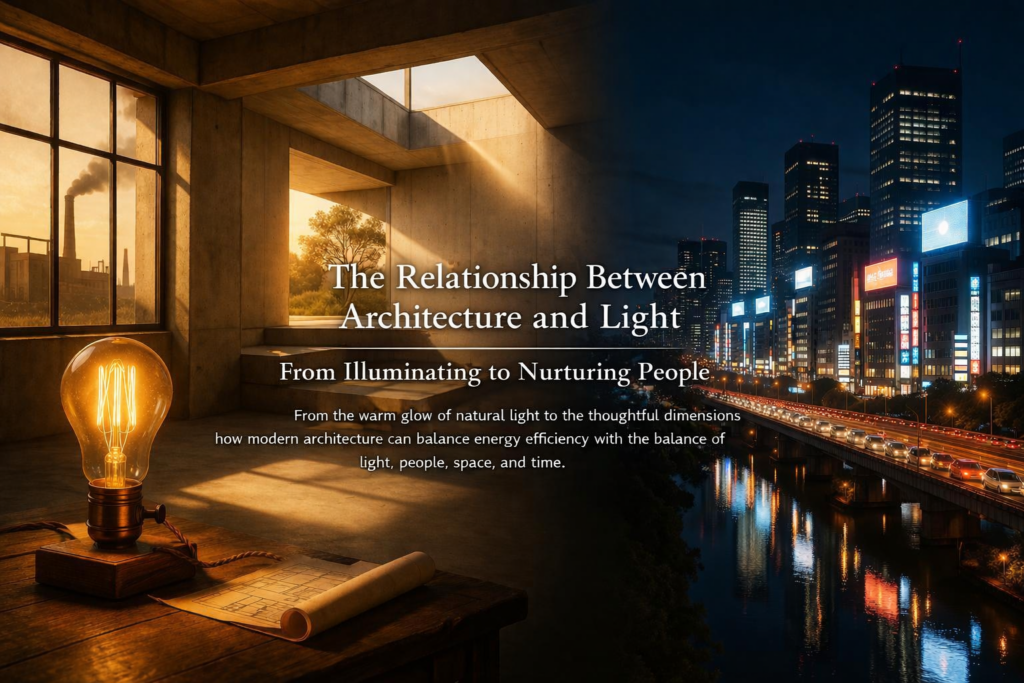
When we talk about sick buildings, why do we so often forget light?
To some extent, the history of modern architecture is also a history of humanity taming the night.
From the moment Thomas Edison brought the incandescent lamp into mass production, light was, for the first time, truly detached from flame and sunset. It became something controllable, deployable, and reproducible—an infrastructure.
From that moment on, architecture was no longer just a shell for shelter. It gained the ability to extend time, shape behavior, and reorganize the rhythm of life.
Light transformed space from something dependent on daytime into a 24-hour human domain.
Later, the architectural master Le Corbusier described light as the fourth dimension of space.
This statement is powerful not because it is poetic—but because it is precise.
What truly shapes spatial perception has never been limited to walls, floors, and ceilings. It is also about how light enters, lingers, bends, and disappears.
Without light, space is merely volume.
With light, space gains hierarchy, direction, emotion, order—even soul.
For a long time, architecture and lighting shared an ambitious goal: not just to illuminate space, but to enhance it.
Light made architecture visible, gave materials texture, clarified order, and gave cities expression at night. It was once an extension of civilization—and one of architecture’s most powerful and humane languages.
But today, we seem to be at a turning point that deserves caution.

When Energy Efficiency Becomes the Only Truth, Architecture Forgets Who It Serves
Over the past decade, energy efficiency has become an almost unquestionable orthodoxy in architecture.
Energy saving is important. Carbon reduction is necessary.
The problem is not energy efficiency itself—but whether we have unconsciously mistaken the means for the end.
As a result:
- Lighting power density keeps being compressed
- Daytime interiors are designed increasingly dim, as if meeting minimum standards equals success
- Meanwhile, cities at night grow ever brighter—facades, signage, media screens competing until darkness itself loses its right to exist
This creates a paradoxical reality:
- During the day, we give people too little light
- At night, we give people too much light
Daytime should support clarity, alertness, and focus.
Nighttime should reduce stimulation, preserve darkness, and restore circadian balance.
Yet today, many buildings do the opposite.
- In offices: fatigue, eye strain, low mood
- In hotels: rest disrupted by wrong CCT, glare, and light spill
- In hospitals: patients and staff exposed to mistimed and misdirected light
- In homes: children lack daylight but are overexposed to screens and artificial lighting at night
This is not a lack of technology.
On the contrary—it is the result of treating light merely as:
- an equipment issue
- an energy issue
- a decorative issue
…instead of a human issue, a temporal issue, and a health issue.
Sick Buildings Should Not Be Discussed Without Light
When we talk about Sick Building Syndrome, we naturally think of:
- air quality
- VOCs
- ventilation
- humidity
- mold
- filtration systems
All important. But light is often marginalized—as if good air alone makes a building healthy.
In reality, buildings that cause fatigue, insomnia, irritability, headaches, low productivity, and emotional imbalance often suffer from multiple issues:
- insufficient or mistimed light exposure
- glare and excessive contrast
- inadequate daytime vertical illuminance
- excessive nighttime stimulation
- thermal discomfort
- persistent noise
- misalignment between spatial rhythm and human activity
Sick buildings are not single-factor problems—they are multi-factor environmental syndromes.
If we accept that air can make people sick, why not light?
If noise can cause stress, why not improper lighting disrupt sleep and circadian rhythms?
If thermal comfort affects physiology, why not light regulate alertness, mood, hormones, and behavior?
If architecture exists to serve people, it cannot excel in one metric while failing in a more fundamental dimension.
What We Need Is Not More Lighting, But a New Understanding of Light
The core issue is not adding more fixtures or increasing lux levels.
What needs rebuilding is our framework for understanding light.
Light never exists in isolation. It is always intertwined with:
- People — age, schedule, sensitivity, health, task
- Space — office, education, healthcare, residential, transport, hospitality
- Time — morning, day, evening, night, shift work, jet lag
- Activity — focus, rest, socializing, healing, transition, reflection
So lighting design should move beyond:
- “Is it bright enough?”
- “Does it look good?”
- “Is it energy efficient?”
And instead ask:
In this space, at this time, for these people—what activity is being supported?
Is the light helping people—or draining them?
This is the real question for the future of architecture and lighting.
The Purpose of Architecture Is Not Energy Efficiency
This needs to be clearly restated: The purpose of architecture is not energy efficiency.
Energy efficiency matters—but it is not the fundamental purpose.
Architecture exists to provide:
- shelter
- order
- efficiency
- dignity
- health
- connection
- recovery
- rest
- life itself
If a building is extremely energy-efficient but makes people fatigued, anxious, insomniac, and unproductive—it may succeed on an energy spreadsheet, but fail at the human scale.
We cannot reduce human needs to secondary conditions.
We cannot let power density, minimum standards, and equipment parameters replace genuine care for people.
High-level architecture should achieve a more advanced balance between energy, environment, and human well-being.
Not a return to wastefulness—but a move toward precision, human understanding, and temporal awareness.
From “Lighting Design” to “Human-Centered Environmental Orchestration”
The future may no longer be about lighting design in the traditional sense, but about environmental orchestration.
This requires us to consider:
- How to truly support alertness and comfort during the day
- How to reduce stimulation and preserve rest at night
- How light integrates with daylight, shading, materials, thermal and acoustic environments
- How environments adapt dynamically to different users and activities
- How outcomes are measured and validated—not imagined
In other words, the question is no longer:
“Where do we place the lights?”
But:
“How does this environment serve human physiology and behavior across the day?”
Light should not be the final layer of decoration.
It must return to the beginning of architecture.
Not as an accessory—but as infrastructure.
Not as a supporting role—but as a foundation.
It’s Time to Put Light Back at the Center of Architecture
Our generation stands at an inflection point.
The previous era taught us how to use light efficiently.
The next era requires us to use light correctly.
The previous era pursued visibility.
The next must pursue:
- perceptibility
- usability
- recoverability
- long-term livability
When we re-examine sick buildings and the tension between energy and health, perhaps the real question is not:
“How much more energy can we save?”
But:
- Does this building truly understand people?
- Does its light align with human biology, time, and activity?
- Does it support life during the day—and respect darkness at night?
Because ultimately:
Architecture does not exist to prove how energy-efficient it is.
It exists to help people live better.
And light is not just about illuminating space—it is about bringing people back to the center of architecture.
 English
  Chinese (Taiwan)
  Chinese (China)
  German