Summary
When the entire industry is talking about healthy lighting, circadian lighting, and human-centric lighting, LED manufacturers who still only list luminous efficacy, CRI, color tolerance, and price in their datasheets are already half a generation behind.
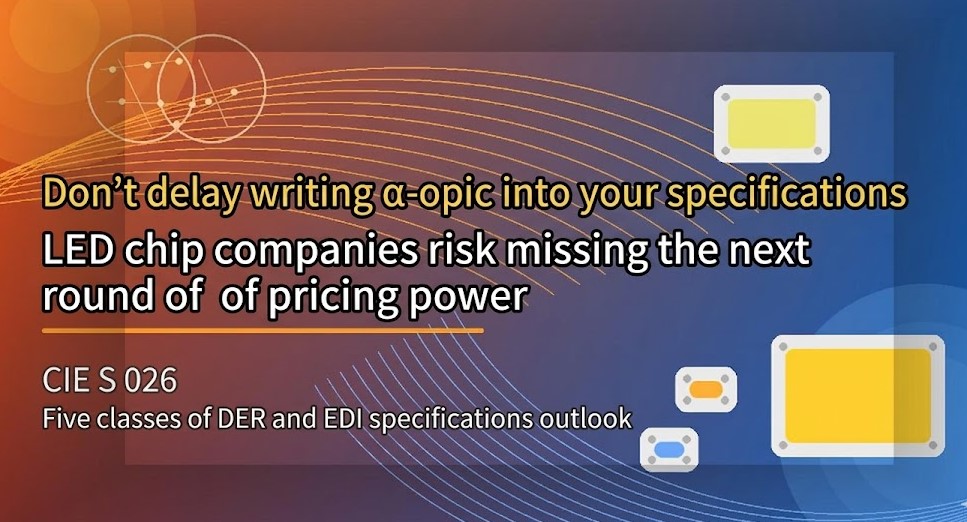
CIE S 026 doesn’t just introduce another term—it requires upstream component companies to establish a specification language that can describe how light affects humans.
The real key is not just melanopic metrics, but the full framework of the five α-opic DERs and EDIs. The next round of pricing power won’t be determined by who shouts the loudest, but by who first integrates this capability into datasheets, builds it into their toolboxes, and connects it to the application chain.
Over the past two years, I’ve felt increasingly strongly that: Many LED companies talk about healthy lighting, but their datasheets are still stuck in the previous era.
What are they still comparing?
- Luminous efficacy
- CRI
- R9
- SDCM
- Price
A bit further, they start discussing TM-30, low-frequency flicker, and light quality. These are all correct, but still not enough.
Because if the industry is saying that light not only allows people to see, but also affects circadian rhythm, alertness, mood, sleep, recovery, and even long-term health—then why do many upstream LED datasheets still use a language that almost entirely ignores humans?
That is the core problem.
It’s not whether CIE S 026 is important. It’s not whether melanopic or α-opic metrics are difficult. It’s that if upstream component companies themselves don’t yet have the ability to translate how light affects humans into deliverable, calculable, comparable, and designable datasheet language, then much of the healthy lighting industry is still just slogans.
This may sound harsh, but I think it’s time to speak firmly.

1. Many companies misunderstand: CIE S 026 is not just a marketing talking point
Many companies now know about melanopic EDI, add α-opic metrics in presentations, and some even want to put these directly into LED datasheets. The direction is correct. But many implementations clearly show a lack of real understanding of CIE S 026.
The biggest mistake is treating it as just another premium parameter for marketing. This is dangerous.
CIE S 026 is not a new marketing badge or a certification label to stick on a package. It is essentially a metric language weighted by retinal photoreceptors, pushing the description of “light for humans” from a vague concept to a framework that can be precisely calculated.
Once you treat it as a measurement language, you realize: It’s not just about adding a melanopic number to a datasheet.
It forces LED upstream companies to answer a fundamental question: Are you selling merely a light-emitting semiconductor, or a spectral engine that can be invoked by physiological models?
The difference is huge.
2. Correct the fundamental misunderstanding: EDI is not just melanopic
I’ve noticed that even many industry insiders still hold a vague understanding: They think DER involves the five α-opic metrics, but EDI seems mainly just melanopic EDI. This is common in practice but technically incomplete.
According to the original logic of CIE S 026, it’s clear: Not only DER has five types, EDI itself also has five types.
Corresponding to the five retinal photoreceptor channels:
- S-cone-opic
- M-cone-opic
- L-cone-opic
- Rhodopic
- Melanopic
Each theoretically has:
- α-opic irradiance
- α-opic DER
- α-opic EDI
In other words, EDI is not a single value, but a set of values.
Because in recent applications like circadian rhythm, WELL, daytime alertness, and nighttime suppression, melanopic EDI has been most frequently highlighted, the market has gradually come to believe that EDI ≈ melanopic EDI.
This misunderstanding may seem like a terminology issue, but in LED datasheet logic, it directly leads to misrepresentation. Simplifying EDI to a single melanopic metric compresses CIE S 026’s full five-dimensional framework into a single-line narrative.
This is exactly what I most want to avoid.
3. What the LED industry fears most is not complexity, but “pretending it’s simple”
One of the LED industry’s greatest capabilities is engineering complex problems. When LEDs replaced traditional lighting, it wasn’t because LEDs were simple—they were highly complex.
They have electrical characteristics, thermal behavior, lumen depreciation, color drift, binning, package differences, driver coupling, system efficiency, lifetime models, and reliability risks.
The industry matured because a common language was built to transform this complexity into specifications and tools usable by customers, engineers, FAE, and designers.
This is the true brilliance of the LED industry.
So, if α-opic, EDI, and DER enter the component ecosystem, my position is clear: Don’t fear complexity. Fear oversimplifying the five-dimensional system into a single value for marketing.
That’s not simplification. That’s dumbing it down.
Because if upstream companies simplify multi-dimensional photobiological metrics into “higher melanopic = more advanced,” two things will happen:
- Marketing will over-hype.
- Applications will misuse it.
Ultimately, the credibility of both companies and the healthy lighting field suffers.
4. DER and EDI play fundamentally different roles for LED manufacturers
Let me put this more directly: If you are an LED chip manufacturer, what should truly be prioritized in the main datasheet is the five α-opic DERs; EDI, on the other hand, should be presented as a conditional, normalized result.
Why?
Because DER is closer to what? It is closer to the intrinsic properties of the LED’s spectrum itself.
Once the SPD is defined, the DER is basically set. It is a source-level spectral characteristic.
And what about EDI? EDI is not an absolute constant independent of conditions. It is an expression of equivalent daylight illuminance based on a given photopic illuminance.
To put it plainly: DER is more like a raw material property; EDI is more like a converted result under specific usage conditions.
It’s the same as you cannot treat the center illuminance of an LED at a certain distance as an intrinsic property of the chip.
Similarly, you should not package an EDI value that does not specify its conditions as the LED’s absolute capability.
So, if a datasheet says: melanopic EDI = 86 lx
but does not specify that this is:
- Corresponding photopic illuminance
- SPD resolution used
- Measurement conditions (If / Tj)
- Whether it’s normalized
- Whether it’s a source-level conversion
Then this number, strictly speaking, is technically questionable.
Not because EDI cannot be listed, but because presenting EDI without specifying the conditions is, in itself, incomplete.
5. What upstream companies truly lack is not a new parameter, but a fifth model
I want to explain this in a more systematic way. Today, mature LED companies have basically already established four sets of models:
First set: Electrical model
If, Vf, power consumption, drive range, dimming characteristics.
Second set: Thermal model
Tc, Tj, thermal resistance, derating curves, thermal failure risks, lifetime boundaries.
Third set: Optical model
Luminous flux, CCT, chromaticity coordinates, binning, CRI, TM-30, color shift, spectrum.
Fourth set: Reliability model
LM-80, maintenance factor, package stability, failure rate, environmental adaptability.
However, today, if a company truly wants to move toward “healthy lighting,” “circadian lighting,” and a “high-quality spectral value chain,” it must add a fifth set:
Fifth set: Physiological spectral model
This is the real requirement that CIE S 026 places on upstream LED manufacturers. It’s not about adding a slide of α-opic to your PPT. It’s about starting to build capabilities like:
- Five α-opic DERs
- Five α-opic EDIs
- Their relationship with the SPD
- Their dependence on current, junction temperature, aging, and binning
- How they feed into mixed light, dimming, scene algorithms, and downstream application design
This is what it means to be a company that truly understands CIE S 026. Not just one that says, “Our products support healthy lighting.”
6. How a leading LED company writes datasheets
Let me give a very practical benchmark. In the future, when judging whether an LED chip company is truly ahead, don’t first look at whether their presentations mention human-centric lighting.
First, look at how they write their datasheets. I believe a company that is genuinely moving forward will structure it in at least three layers.
Layer 1: Establish the five α-opic DERs in the main datasheet
This is the core foundation. It’s not just about writing melanopic.
Step by step, you should establish standard outputs for:
- S-cone-opic DER
- M-cone-opic DER
- L-cone-opic DER
- Rhodopic DER
- Melanopic DER
Because this is the most basic respect for CIE S 026. You can’t claim to be doing α-opic measurements but end up only providing the single most convenient number for marketing.
Layer 2: EDI can be listed, but it must be “conditional EDI”
For example:
- Melanopic EDI @ 100 lx
- Melanopic EDI @ 300 lx
- Or even the five α-opic EDIs @ 100 lx / 300 lx / 500 lx
This approach is much more reasonable. Because it acknowledges that EDI is a result calculated based on photopic illuminance, rather than pretending it’s an absolute value independent of conditions.
Layer 3: Connect α-opic values with electrical-thermal drift, aging, and binning
This is what truly differentiates a company. If your α-opic values don’t change with If, Tj, or aging, there are only two possibilities:
- Either your product is unrealistically violating physics,
- Or you haven’t really started modeling yet.
Therefore, future higher-level datasheets should start including:
- α-opic DER vs. current
- α-opic DER vs. junction temperature
- α-opic shift after aging
- α-opic distribution by bin
At this point, α-opic truly transforms from a concept into a deliverable capability.
7. Beware the “melanopic worship”
I can actually understand why the market quickly focuses on melanopic. Because it’s the easiest to talk about. And it’s the easiest to connect with applications like daytime alertness, nighttime suppression, WELL, and circadian rhythm.
But I want to be very honest: If the entire industry ends up reducing CIE S 026 to a single competition of “whose melanopic is higher,” we are just repeating the old lm/W race of the past, only with a trendier term.
This is not an industry upgrade. This is just a slogan upgrade. Because a true light environment is never about a single channel. And real human responses can never be summarized by a single value.
So I strongly advocate one thing: In communication, you can start with melanopic; but at the technical foundation, you must return to the complete framework of the five α-opic channels.
Otherwise, you will inevitably see a bunch of products with “high melanopic but poor overall light quality,” or marketing claims that “overpromise physiological effects based on a single value.”
That is not the future I want to see.
8. This is not a technical detail—it’s the next round of pricing power for upstream companies
Many people might read this article as a purely technical topic. I don’t see it that way. I believe this is actually a matter of industry influence and discourse power.
Over the past decade, how did upstream LED companies capture value? It wasn’t about who told the best story. It was about who controlled:
- Better packaging capabilities
- More stable binning
- More mature reliability models
- More complete application support
- More efficient specification language
Now, in the era of CIE S 026, this game hasn’t changed. Only the dimension of competition has been upgraded.
In the future, truly high-value LED chip companies won’t just be able to say, “We have this wavelength, this formulation, this CRI.” They will be able to say: Our LED is not only efficient, color-accurate, and reliable; its five α-opic characteristics are definable, repeatable, computable, and integrable into system design.
Once you reach this level, what you’re selling is no longer just a chip. What you’re selling is: A spectral capability that downstream applications can directly invoke. And this is what truly supports the next wave of premium value.
9. Don’t rush to claim “healthy lighting”—first write the datasheet right
If I were to give LED chip manufacturers the most direct advice, I would say: Don’t rush to shout “we understand healthy lighting” at your booth. First, go back and look at your datasheet.
If your datasheet can still only describe:
- How bright
- How efficient
- How white
- How high the CRI
- How low the color deviation
But cannot describe:
- What the five α-opic characteristics of this LED are
- How DER and EDI are defined
- How they couple with current, junction temperature, and aging
- How downstream customers can integrate it into scenes and human models
Then you are still some distance away from being a true “healthy-light component company.” Not because your technology isn’t sufficient. But because your industry language hasn’t been upgraded.
And I believe, the next wave of companies that will truly gain discourse power won’t be the ones shouting slogans first,
but the ones who first take this language—and write it into the datasheet, build it into the toolbox, integrate it into the application chain, and turn it into deliverable capability.
This is the real significance of CIE S 026 for upstream LED manufacturers. It’s not about printing a few extra parameters. It’s about rewriting the rules.
Conclusion
In the future, customers aren’t just buying lumens.
They’re buying whether an LED can be accurately integrated into human models.
 English
  Chinese (Taiwan)
  Chinese (China)
  German