By Lawrence Lin
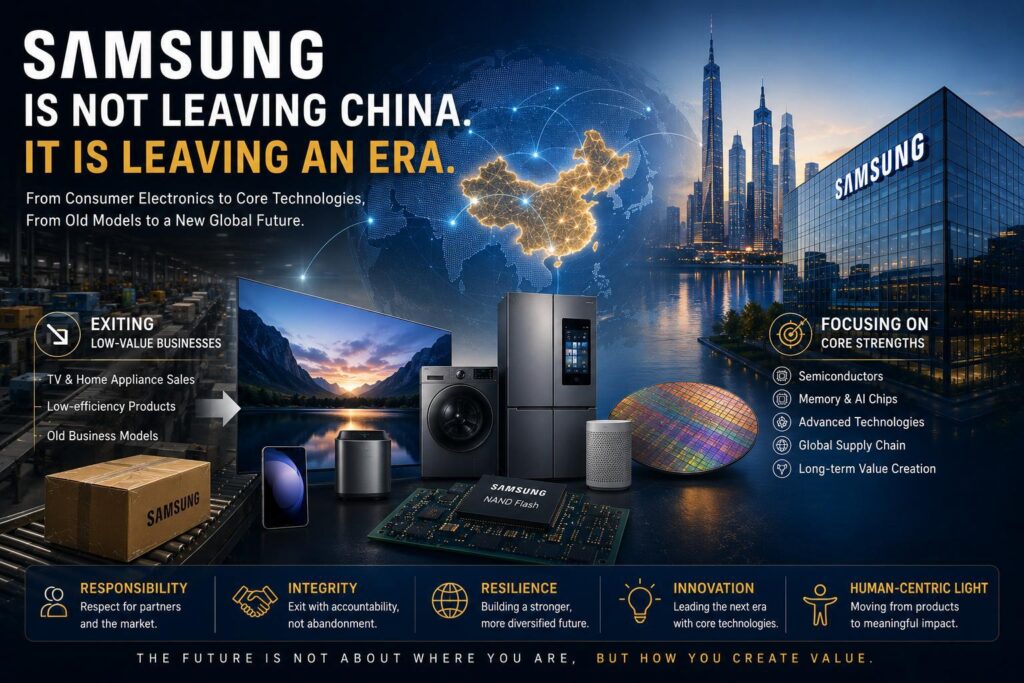
Recently, Samsung Electronics announced that it would discontinue sales of certain consumer electronics products in mainland China.
Many headlines quickly framed this as: “Samsung exits China.”
But that interpretation is overly simplistic.
What Samsung is actually doing is far more important: It is transitioning from a “China-centered manufacturing model” toward a globally diversified supply-chain strategy.
And behind this decision lies a much bigger shift — one affecting not only Samsung, but also global manufacturing, consumer electronics, semiconductors, and even the lighting industry.
1. Is Samsung Really Leaving China?
Not really. Samsung is not withdrawing entirely from China.
What it is reducing or exiting includes:
- Certain TV and home appliance sales businesses
- Low-efficiency consumer electronics segments
- Manufacturing models heavily dependent on China
But Samsung still maintains:
- Smartphone and component sales in China
- Semiconductor and memory operations
- Its Xi’an NAND Flash facility
- Partnerships with Chinese brands
- Chinese supply-chain procurement networks
换句话说:
Samsung is not exiting China. It is exiting business models that no longer provide strategic competitiveness.
Those are two very different things.
2. What Samsung Is Really Abandoning
What Samsung is truly walking away from is:
The old foreign-brand advantage in China’s mature consumer electronics market
For nearly two decades:
- Korean brands
- Japanese brands
- Western brands
benefited from:
- Technological leadership
- Brand premium
- Quality perception
- Global scale
inside China.
But China has fundamentally changed.
3. China Is No Longer an “Emerging Market”
It is now a hyper-competitive ecosystem. Samsung smartphones were once No.1 in China.
Then came:
- Huawei
- Xiaomi
- OPPO
- vivo
- Honor
The issue was not that Samsung suddenly lost its technology edge.
The deeper issue was this:
Chinese companies became extraordinarily strong in supply chains, cost structure, distribution, speed, localization, and product iteration.
This was the turning point. China is no longer simply “the world’s factory.”
It has become:
- A platform integrator
- An ecosystem builder
- A scenario creator
- A global supply-chain organizer
And that is why many international brands — despite still having strong technologies — struggle to maintain leadership in China’s mainstream markets.
4. The Lighting Industry Has Already Experienced This
The lighting industry went through a very similar transition years ago.
Brands such as:
- GE Lighting
- OSRAM Lighting
- PHILIPS Lighting
- Zumtobel Lighting
- Cooper Lighting
once held strong brand and technology advantages in China.
But Chinese lighting companies rapidly built strength in:
- Manufacturing efficiency
- Supply-chain density
- ODM/OEM execution
- Distribution penetration
- Delivery speed
- Engineering responsiveness
Meanwhile, companies like Signify (formerly Philips Lighting) chose to continue investing in China — but under a completely different competitive model.
Today, competition is no longer mainly about:
- Efficacy
- 比显指
- Brand
Instead, it is increasingly about:
- System capability
- Controls
- Software integration
- Data
- AI
- Human-centric applications
- Spatial intelligence
5. A Personal Story About Samsung
I have always carried a deep impression of Samsung from one particular experience.
Years ago, during my collaboration with MLS, we were manufacturing lighting products for Samsung’s LED division. At that time, even before the first shipment was officially delivered, Samsung suddenly decided: To exit the finished lighting products business.
Internally, it was certainly a shock.
Because it meant:
- Development costs
- Supply-chain planning
- Production schedules
- Market preparation
all had to be restructured.
But what impressed me most was not the exit itself. It was the way Samsung handled it.
They did not:
- Avoid responsibility
- Delay communication
- Push risks downstream to suppliers
Instead:
They communicated formally and responsibly with partners, purchased all completed products, and then—systematically destroyed them.
That experience left a deep impact on me. Because for the first time, I truly understood:
A global company can admit defeat, but still refuse to leave irresponsibly.
Many companies talk about “corporate culture.” But real corporate culture often becomes most visible during retreat, failure, or exit.
That experience taught me something I still remember today:
You can lose.
You can withdraw.
But you should never leave irresponsibly.
And I believe this is something many rapidly expanding companies today should seriously reflect upon.
6. Samsung’s Real Concern Is Not China
It is:
Geopolitics and supply-chain resilience
Samsung’s most critical businesses today are:
- Semiconductors
- AI memory
- Advanced chips
- Packaging technologies
- Displays
All of which are deeply entangled in:
- US–China technology competition
- Semiconductor controls
- AI infrastructure competition
- Global supply-chain security
This is why Samsung has been:
- Expanding Vietnam
- Expanding India
- Investing in the United States
- Diversifying manufacturing footprints
This is not simply “de-Chinaization.”
It is: A strategy to build a more resilient global supply chain.
7. What Does This Mean for Taiwan?
For Taiwan, this trend is both a warning and an opportunity.
Warning
If companies continue relying mainly on:
- OEM models
- Manufacturing efficiency
- Cost advantages
while lacking:
- Platform capability
- Standards leadership
- System integration
- AI and data capability
- Scenario definition capability
they may eventually face the same structural pressure. This is already happening in LED and lighting.
Opportunity
At the same time, the world is increasingly searching for:
- Supply chains outside China
- High-trust technology partners
- Higher-value integrated solutions
This creates opportunities for Taiwan in areas such as:
- AIoT
- Health technology
- Sensing
- Photonics integration
- Smart controls
- Precision manufacturing
- Advanced semiconductors
Especially in the integration of: human factors + data + spatial intelligence
Taiwan still has enormous potential to differentiate itself.
8. What the Lighting Industry Should Really Learn
The biggest lesson Samsung offers the lighting industry is this:
The era of “just making lamps” is ending. The future value of lighting will not come only from hardware.
It will come from the ability to create lighting environments that are:
- Verifiable
- 可測量
- Adaptive
- Continuously optimized
Competition is shifting from:
- 产品规格
toward:
- Human-factor models
- Spatial models
- Sensors
- AI
- Data
- Controls
- Long-term operational validation
Because the market no longer simply needs spaces to be illuminated.
It needs light that genuinely supports: human biology, psychology, behavior, and wellbeing.
9. Final Thoughts: Samsung Is Not Leaving China — It Is Leaving an Era
If we reduce this story to: “Samsung failed in China,”
we miss the bigger picture.
What Samsung is really acknowledging is: The globalization model of the past 30 years is ending.
The old world optimized for:
- Lowest cost
- Centralized manufacturing
- Maximum scale efficiency
The new world optimizes for:
- Supply-chain resilience
- Regional diversification
- AI and data capability
- System integration
- Platform capability
- Human-centric value creation
And this transformation is not happening only to Samsung.
It is happening across:
- Semiconductors
- Consumer electronics
- Automotive
- Buildings
- 照明
- Health technology
and the entire global industrial landscape.
From that perspective:
Samsung is not exiting China. It is exiting the old era in which brand, scale, and globalization alone were enough to guarantee success.

 English
  Chinese (Taiwan)
  Chinese (China)
  German