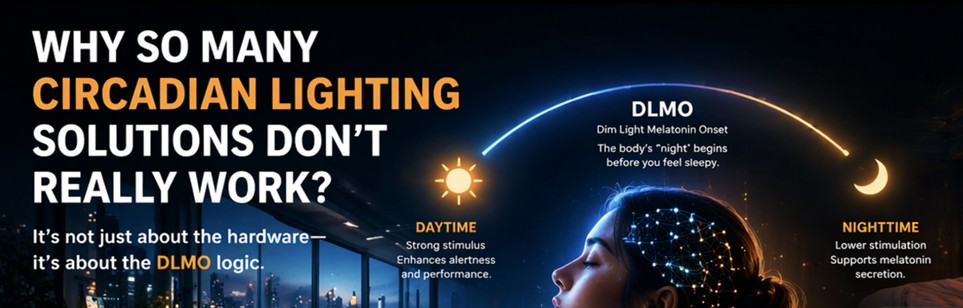
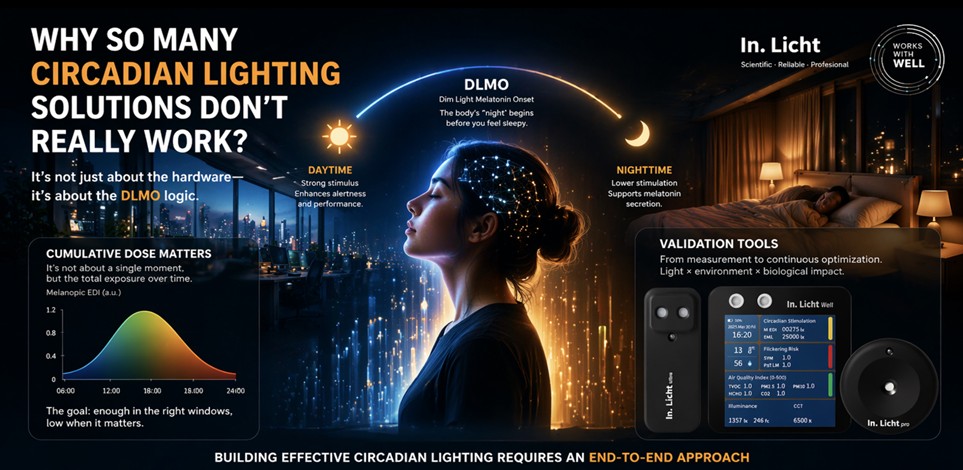
The issue is not just the hardware. It is the DLMO logic.
Abstract
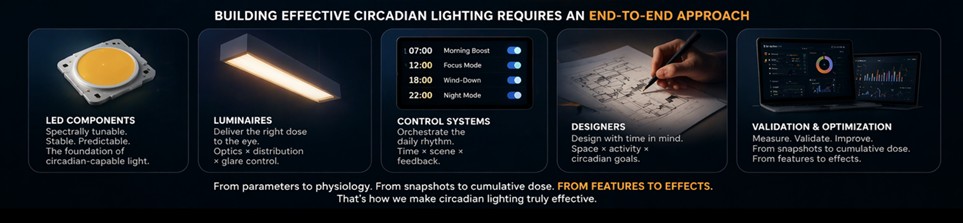
This article examines how LED component makers, luminaire manufacturers, control system providers, and lighting designers can build truly effective circadian lighting by following DLMO logic. It argues that the real challenge is not isolated parameters, but cumulative dose, eye-level delivery, and outcome validation.
Over the past few years, more and more companies have started talking about circadian lighting, sleep lighting, and healthy light.
But if we return to the underlying logic of DLMO — Dim Light Melatonin Onset — we quickly realize something important: truly effective circadian lighting is not simply about making light cooler during the day, warmer at night, or adding tunable white and dynamic scenes.
The real issue is this:
What kind of total light exposure does a person receive over the course of a day, at the eye, in the right timing windows, and does that exposure actually change physiology and behavior in a meaningful way?
That is why I increasingly believe that the next real competition in circadian lighting will not be about who can tune more parameters. It will be about who can build an integrated solution around hardware + scenes + cumulative dose + validation.
1. Why DLMO changes the definition of circadian lighting
DLMO matters because it does not simply describe whether someone sleeps well.
It helps answer a more fundamental question:
When does the body’s internal night actually begin?
In sleep medicine and circadian science, DLMO is widely used as a key phase marker of the central circadian clock, and it is often used to optimize the timing of bright light and melatonin interventions. Melatonin typically begins to rise about 2–3 hours before habitual sleep onset, and DLMO marks that transition.
This means circadian lighting should not be defined merely as “healthy-looking lighting.”
It should be judged by whether it can answer questions like:
Does it provide enough effective circadian stimulus during the day?
Does it reduce stimulation at the right time in the evening?
Does it avoid suppressing melatonin when the body is preparing for sleep?
Does it help stabilize or shift circadian phase in the intended direction?
In other words, the true objective is not a single snapshot parameter.
It is the daily exposure trajectory.
I prefer to summarize this in two words: cumulative dose.
2. The most common reason circadian lighting fails: it ignores cumulative dose
When companies discuss circadian lighting, the first things they usually mention are:
spectrum
CCT
dynamic dimming
pre-set scenes
All of these matter. But on their own, they are not enough. The circadian system does not decide its response from a single glance.
It is shaped by accumulated time cues across the day:
Was morning light strong enough and early enough?
Was daytime exposure sustained and effective?
Did stimulation drop at the right time in the evening?
Was night-time exposure sufficiently reduced, or was the system repeatedly disturbed?
The 2022 expert recommendations in PLOS Biology clearly state that healthy adults should receive relatively high melanopic EDI during the day, significantly lower levels in the 3 hours before bedtime, and as little as possible during sleep. These recommendations are based on vertical eye-level exposure, not just workplane illuminance.
The industry implication is clear: Circadian lighting cannot stop at “what is the fixture doing right now?”
It also has to answer:
How much effective circadian stimulus did this user actually receive today?
In which timing windows did it occur?
Was there unnecessary stimulation at the wrong time?
Is the total exposure profile supporting entrainment, phase advance, maintenance, or disruption?
If a company cannot answer these questions, then many so-called circadian lighting solutions are still just adjustable white lighting.
3. What LED component makers need to upgrade first
Some people think DLMO is far removed from LED package manufacturers.
I think the opposite.
If the upstream logic does not evolve, the downstream ecosystem will struggle to build truly effective circadian solutions.
1) Move from “efficacy + CCT + CRI” to a dual visual + non-visual language
Most LED data sheets still focus on:
efficacy
CCT
比顯指
binning
lifetime
electrical performance
These remain essential. But they are no longer sufficient for the circadian era.
Upstream suppliers should increasingly provide:
spectral power distribution
melanopic / α-opic relevant quantities
non-visual performance under different spectral mixes
spectral stability under dimming
circadian consistency under different drive conditions
Because designers and control platforms are no longer just creating white light.
They are building time-based light recipes.
If LED suppliers cannot provide stable, traceable, and model-friendly spectral information, downstream players will struggle to implement circadian strategies with precision.
2) Move from “one universal LED” to “programmable spectral capability”
The future is not about one fixed optimum point. It is about spectral combinations that can be shifted over time, with predictable non-visual impact.
That means component makers should begin thinking in terms of:
spectral mixes suited for morning phase-advancing stimulus
daytime performance-supportive stimulus
evening wind-down modes
low-disruption night pathways
That is no longer the traditional logic of selling a light source. It is the beginning of selling a programmable circadian foundation.
4. What luminaire manufacturers must really do: deliver dose to the eye
Circadian lighting does not happen on a specification sheet. It happens at the human eye.
So for luminaire manufacturers, the real challenge is not just enabling tunable white.
It is ensuring that the intended dose reaches the eye in a controllable and useful way.
1) Move from plane-based lighting to eye-level lighting
Circadian effectiveness is more closely related to actual eye exposure than to horizontal workplane illuminance. The major recommendations increasingly emphasize melanopic exposure at the eye.
This means luminaire design must increasingly consider:
optical direction
emitting surface position
the balance between glare control and effective circadian delivery
direct / indirect / semi-indirect proportions
seated, standing, and reclined eye positions
簡而言之: The goal is not just to illuminate the room. It is to deliver the right circadian dose to the eye.
2) Move from one luminaire logic to time-based luminaire roles
A more mature circadian lighting system may not rely on one luminaire doing everything.
Instead, it may include:
stronger morning/daytime stimulus luminaires
transitional evening luminaires
low-disruption night luminaires
bedroom or hotel pathway lighting
dual-logic luminaires for care tasks versus rest protection
This is especially important in real-world environments. Research in ICU settings shows that visual task needs and circadian goals are not naturally aligned, and that dynamic, zoned, and time-based solutions are more realistic than static ones.
For luminaire companies, this means product families should move from “selling by room type” to “selling by time-task logic.”
5. Why control systems matter more than ever
I have said this for years: in the HCL and circadian era, control systems will be revalued.
Because circadian lighting is not fundamentally a static hardware problem.
It is a time orchestration problem.
1) Move from scene switching to circadian scripting
Traditional control systems are mostly valued for:
scheduling
dimming
CCT control
occupancy sensing
energy savings
scene recall
But once we apply DLMO logic, the system has to answer more:
When should the morning stimulus begin?
How quickly should it ramp?
How should daytime cumulative dose be maintained?
When should evening reduction begin?
How should night-time visual needs be preserved while minimizing circadian disruption?
This is no longer just “having scenes.”
It is building physiology-aware time scripts.
2) Control systems must begin to account for cumulative exposure and feedback
This is one of the biggest future dividing lines.
Advanced circadian controls should not only know the current output value.
They should increasingly be able to:
estimate cumulative effective exposure over time
adjust electric light based on daylight contribution
respond to occupancy and activity type
estimate real user exposure
calibrate strategy with measurements and feedback
In other words, the system should know more than “the room is currently 4000 K and 300 lux.”
It should increasingly understand: How much useful daytime signal has this person already received today, and how much circadian margin remains for the evening?
That is a much more DLMO-aligned system logic.
6. Designers are becoming “time experience orchestrators”
If LED component makers define the spectral raw material, luminaires determine delivery, and control systems determine temporal behavior, then designers ultimately determine how all of this becomes human experience.
This is why I believe the role of the designer is being fundamentally upgraded.
1) Design must move beyond “how bright and how beautiful”
It must also ask:
At what time should this space support alertness?
At what time should it support restoration?
At what time must stimulation be reduced?
Do different users in the same space have different circadian needs?
How do visual comfort, operations, maintenance, and circadian goals coexist?
That changes the design starting point.
2) Designers must move from parameter thinking to exposure trajectory thinking
The strongest designers in the next phase will not only specify:
3000 K / 4000 K
300 lx / 500 lx
UGR / CRI
They will increasingly specify:
7:00–9:00: rapid morning stimulus build-up
10:00–15:00: sustained daytime signal
after 18:00: marked reduction in eye-level melanopic exposure
after 22:00: only low-disruption pathway lighting
distinct strategies for bed, desk, social, washroom, and transit activities
That is much closer to a DLMO-aware design language.
7. Hardware and scenes must be designed together
Many companies still follow this sequence: First build the product.
Then look for a “healthy lighting” use case. In circadian lighting, that order is often backwards.
A more appropriate logic is: Define the scene objective first, then define the hardware requirement
Scene 1: Office
The goal is not simply high illuminance.
It is sufficient daytime stimulus, limited evening carry-over, and good visual performance.
That leads to hardware needs such as:
strong morning/daytime eye-level exposure
日光協同
low glare without losing useful stimulus
spectral and control capability for evening reduction
Scene 2: Bedroom / Hotel
The goal is not to create a “sleep lamp” gimmick. It is to reduce melatonin suppression opportunities while preserving necessary function.
That leads to hardware needs such as:
very low-disruption night lighting
low-stimulus bathroom and pathway lighting
evening transition modes
morning wake-up modes
Scene 3: Healthcare / Senior living / Wellness
The goal is to balance care tasks, resident rest, and staff circadian needs.
That means hardware and controls must support:
zoning
scheduling
role-based logic
task-based logic
traceable validation
So future circadian lighting products cannot be defined independently of scenes.
Hardware must be designed for the scene, and the scene must be supported by the hardware.
8. Why I keep emphasizing validation
Because one of the biggest risks in this field is that many claims sound persuasive, but the outcomes may not be real.
From a DLMO perspective, circadian lighting should not be judged only by whether it is dynamic.
It should be judged by whether it changes the intended outcome.
At least three layers need validation
1) Output validation
Is the system actually delivering what was designed?
actual SPD
actual illuminance
actual eye-level exposure
actual time profile
actual stability across dimming and tuning
2) Dose validation
Did the user actually receive the intended cumulative dose?
enough morning stimulus?
enough daytime accumulation?
timely evening reduction?
sufficiently low night-time exposure?
3) Outcome validation
Did that exposure trajectory actually change anything meaningful?
alertness
comfort
sleep quality
circadian stability
task performance in target applications
This is why the ICU dynamic lighting study is valuable. It did not stop at comparing lighting configurations. It also looked at visual comfort and biological markers such as melatonin and cortisol. The authors rightly note the sample-size limitations, but the direction is important:
circadian lighting ultimately has to return to outcomes.
9. Why validation toolchains matter
If the industry is serious about cumulative dose and real outcomes, we can no longer rely only on intuition and one-off impressions.
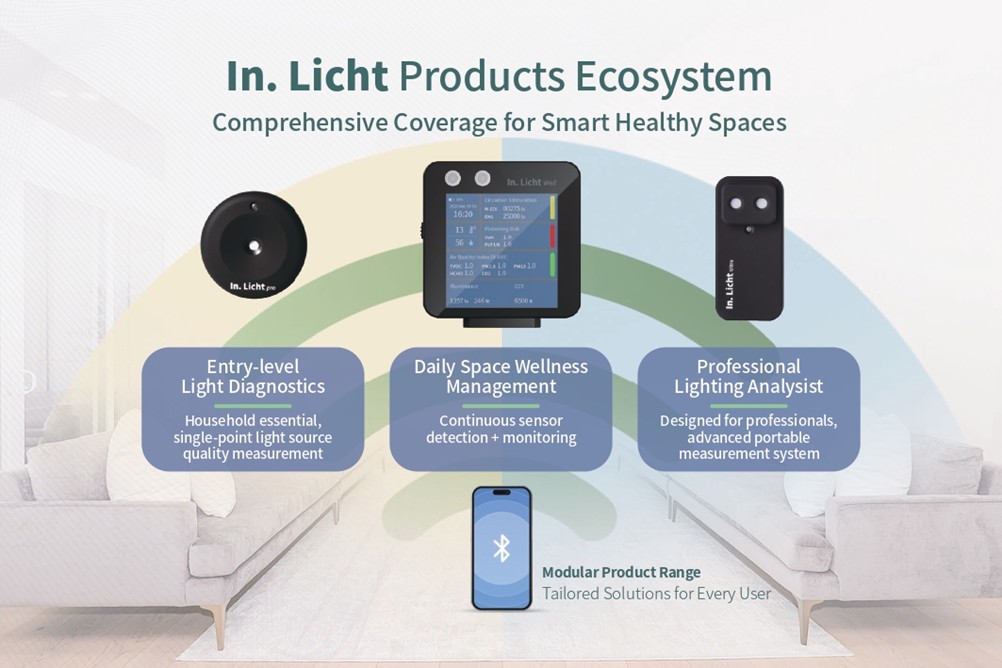
That is one reason we have continued building the In.Licht toolchain.
In.Licht Pro
Better suited for field diagnosis, inspections, and practical project communication.
It helps teams see the basic light facts more clearly.
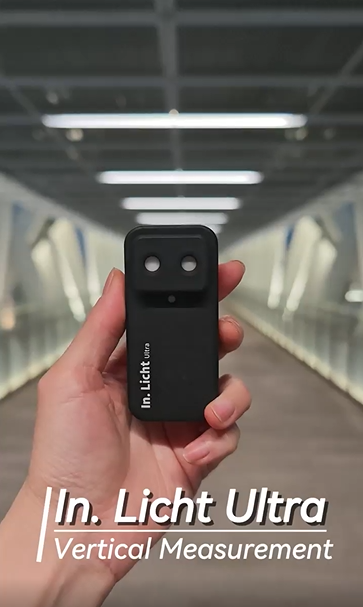
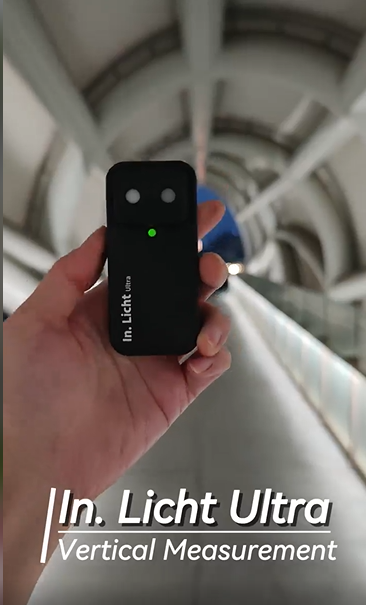
In.Licht Ultra
Better suited for R&D, quality control, comparison, and deeper spectral analysis.
It helps teams understand why two lights that look similar may behave very differently.
In.Licht Well
Better suited for continuous monitoring and operational management.
It helps move from “measure once” to long-term optimization, integrating EML, M-EDI, and broader environmental factors into one workflow.
Together, they support a much more useful workflow: see the facts → understand the mechanism → build cumulative dose logic → validate → optimize
⸻
10. Who will win next?
I increasingly believe that the winners in the next phase will not simply be the companies that talk most about HCL or healthy light.
They will be the ones that build real capability around:
programmable and model-ready spectral foundations
luminaires that deliver dose effectively to the eye
control systems that orchestrate physiological timing
design methodologies that integrate time, space, and activity
field workflows that measure, validate, and improve continuously
At the center of this are two ideas:
cumulative dose
outcome validation
The companies that can build products and projects around those two ideas will be much closer to the real value of next-generation circadian lighting.
Conclusion: circadian lighting is not just another mode
If we rethink the industry through the lens of DLMO, we see that circadian lighting is not simply a new “sleep mode” added to conventional lighting.
It is a more fundamental shift:
LED components become the foundation of temporal light recipes
luminaires become dose delivery devices
controls become time orchestration systems
design becomes time experience design
validation becomes outcome validation, not just brightness checking
That is how I understand circadian lighting.
And that is why I believe the real future value lies not in one isolated product, but in a methodology that integrates:
In recent years, the industry has talked a lot about healthy lighting—about spectra, color temperatures, and various parameters—and has implemented quite a few tunable white solutions.
But to be blunt: If the discussion still revolves around light sources and fixtures, the lighting industry hasn’t truly entered the HCL era yet.
Because the next step—what will really be valuable—is no longer just a single LED, a single fixture, or even a set of prettier parameters. It’s about:
How control systems are orchestrated
How sensors perceive the environment
How scene programs are executed
How spatial and human-centric models are established
At its core, HCL isn’t about creating a few scenes, drawing a color temperature curve, or slapping the word “healthy” on product packaging.
\What it truly tests is: Can you transform light from a static product into a system that dynamically responds over time, across spaces, activities, and people?
The value of next-generation lighting is shifting from “selling lamps” to “selling system outcomes.” And this, truly, marks a new watershed moment for the industry.
The Next Stage of HCL Is No Longer Just About Light Sources and Fixtures
The real differentiators now are control, sensing, scenes, and the “space × human” model capability.
Preface: Why Talking About Light Sources and Fixtures Alone Is No Longer Enough
As we discussed earlier, if light source companies are still unwilling to provide complete spectral data, and fixture companies are still focused only on luminous efficacy, cost, CRI, and color temperature—the old language of lighting—they will struggle to truly embrace next-generation lighting.
This is not to say that light sources and fixtures are unimportant. On the contrary, they remain critical—they are the foundation, the platform, the starting point.
The issue is:
Even the best spectrum, if it cannot vary over time, remains just a static output.
Even the best fixture, if it cannot respond according to space, activity, or people, remains just sophisticated hardware.
But people are not static. Spaces are not static. Activities are not static. And the needs throughout a day are even less static.
An office during the day should not operate under the same lighting logic as a hotel room at night. Morning meetings, focused work, meals, rest, and pre-sleep transitions cannot be managed by a single brightness curve.
So the real question is no longer: “Is this lamp good?”
It is: “Can this system deliver the right light, at the right time, to the right people, in the right space?”
This is the true challenge of the HCL era.
Making Better Lamps Is No Longer Enough. The Next Step Is to Turn Light Into a System.
1. The Essence of HCL Is Not That Lamps Change, but That Light Can Adapt to People, Time, and Space
Today, when many people hear “HCL,” their first associations are still:
Tunable color temperature
Smart dimming
Circadian or rhythm-based scenes
Tunable white
These are not wrong—but they are only the surface.
The core of HCL has never been “lamps change.” The true question is: Can light adapt according to the relationship between people, space, time, and activity?
At least four variables are involved:
1. Space What kind of space is this? Office, healthcare, education, senior care, hotel, residential, retail, or exhibition? Different spaces have different functions, durations of stay, visual tasks, and natural light conditions—so their lighting requirements naturally differ.
2. Activity What is happening here? Reading, meetings, rehabilitation, dining, relaxation, waiting, inspection, or preparing for sleep? Different activities require different lighting tasks. Sometimes support for focus is needed, sometimes minimizing distraction, sometimes recognition, sometimes comfort, and sometimes circadian rhythm and recovery.
3. People Who is in this space? Young office workers, children, elderly, patients, night-shift workers, hotel guests, or short-term visitors? Different people differ not only in physiological conditions, but also in tolerance, sensitivity, and goals. True human-centric lighting cannot be addressed with a single static scene.
4. Time What time is it? Morning, daytime, evening, night, or late night? Is it a weekday or weekend? Winter or summer? How much natural light is coming in today? Even in the same space, light output should vary over time.
Thus, the true goal of HCL is to establish a mapping system: Which person, at what time, in which space, performing which activity, needs what kind of light?
This is the starting point of the methodology.
The Essence of HCL Is Not Dimming or Color Tuning, but Establishing the “Person–Space–Time–Activity” Mapping.
2. Control Systems: The Next Step Is Not Just “Controlling Lamps,” but “Operating Light Environments”
Many lighting control systems today are still stuck in the previous generation mindset:
On/off switching
Dimming
Scheduling
Grouping
Panel integration
Energy-saving control
These are valuable, of course—but if that’s all they do, the system is still far from meeting HCL requirements.
In the HCL era, the true role of a control system is not to control devices, but to operate the light environment. In other words, it should function like a lighting operating system, not just a high-end switch panel.
At a minimum, it should have four capabilities:
1. Orchestration Not just creating a few fixed scenes, but breaking a space into light strategies across different times, tasks, and zones.
2. Responsiveness Adjust dynamically based on occupancy, daylight, schedules, behavior, and events—rather than following a single fixed curve.
3. Computation Convert factors such as illuminance, color temperature, spectrum, vertical eye-level lux, time of day, and duration of stay into control logic.
4. Collaboration Integrate with blinds, curtains, HVAC, meeting systems, workstation platforms, building management systems, and even wearable devices.
In short, the future competition for control systems will not just be about protocols or UI aesthetics. The real value lies in who can elevate light from the “device layer” to the “human-centric environment layer.”
Next-Generation Lighting Control Does Not Just Control Lamps—it Operates the Light Environment.
3. The Value of Sensors Is Not Just Detecting “Presence or Absence,” but Enabling Spaces to Understand People
Today, many projects still have a basic understanding of sensors:
Turn on the light when someone is present, turn it off when no one is there.
Dim when there is daylight, brighten when there isn’t.
This is not wrong, but it only achieves automation—it does not truly address human-centric needs. In the HCL era, sensors should not be merely energy-saving accessories; they should serve as the “senses” of the lighting environment system.
I see sensors as falling into at least five categories:
1. Spatial Status Is anyone present? Where are they? How long will they stay? Are they stationary or moving? Is it a single person or a group?
2. Light Environment How much natural light is present? What is the vertical illuminance at eye level? Is the background brightness distribution balanced? Is it too bright at night? Is there a risk of glare?
3. Temporal Input What time is it? When are sunrise and sunset? Is it a night-shift period? Should the system enter a low-interference mode?
4. Scene Triggers Is a meeting starting? Is a class beginning? Is cleaning underway? Is a guest preparing for sleep? Is there a night patrol?
5. Advanced Human-Centric Input For example: personal preferences, wearable device data, sleep status, fatigue signals, health goals, etc.
The key shift here is: sensors are not making lights smarter—they are giving spaces the ability to understand people.
In the future, the true high-value capability will not be a single sensor, but the fusion of multiple sources of information.
Sensors Do Not Make Lights Smarter. Sensors Give Spaces the Ability to Understand People.
4. Scene Programs Are Not Presets—they Are the Operating Mechanism of “Light Recipes”
Many manufacturers today claim to offer scene programs, but in reality, these are often just a few presets:
Meeting mode
Reading mode
Nightlight mode
Presentation mode
This may be basic smart lighting, but it does not qualify as HCL. Truly mature scene programs are not a single button—they are a light program that adapts over time, activity, occupancy, and goals.
They should include at least three layers:
1. Basic Visual Layer Ensure visibility, safety, comfort, and glare-free conditions—meeting fundamental visual task requirements.
2. Circadian Support Layer When should daytime stimulation be enhanced? When should nighttime disturbance be minimized? When should vertical eye-level illuminance be prioritized? When should high stimulation be withdrawn?
3. Experience and Branding Layer “Healthy lighting” does not mean every space should look the same. Hospitals, hotels, offices, retail, and education spaces should each have distinct experiential languages.
Thus, a true scene program is not just: “5000K in the morning, 3000K at night.”
Instead, it is a system that accounts for:
Different strategy templates for different space types
Response logic for different activities
Target curves for different times of day
Compensation mechanisms for seasonal and daylight variations
Bias designs for different occupant types
Manual overrides that do not disrupt overall objectives
簡而言之: scene programs are not just a few parameter sets—they are the operating logic of how light serves people in a space.
Scene Programs Are Not Just a Few Presets—they Are the Operating Logic of Light Recipes in a Space.
5. Methodology Step 1: How to Build a “Space Model”?
Talking about methodology cannot stay at the level of slogans. To truly implement HCL, you first need to establish a space model.
I see at least five steps:
1. Space Zoning Break the space into zones: circulation areas, stay areas, task areas, transition areas, display areas, and low-interference nighttime areas. These should not share the same control logic.
2. Perspective Layering Don’t focus only on horizontal illuminance. What truly relates to human perception often includes: vertical eye-level illuminance, brightness distribution across the field of view, background contrast, and visual-direction stimuli.
3. Temporal Layering Work hours, rest periods, cleaning times, opening hours, closing hours, and nighttime transitions—these should not rely on a single lighting scheme.
4. Task Layering Reading, meetings, dining, reception, rehabilitation, rest, night patrol—different tasks have vastly different requirements for visual comfort, alertness, atmosphere, and circadian support.
5. Validation Layering Design values, system output values, on-site measurements, and user feedback should form a closed loop.
Thus, a space model is not just the drawings—it is a framework that connects design, control, measurement, verification, and optimization.
6. Methodology Step 2: How to Build a “Human-Centric Model”?
If the space model answers: “What light does this space need?”
Then the human-centric model answers: “What light does this person need at this moment?”
A caution: human-centric models are easy to overcomplicate. Many people immediately jump to AI, personalization for thousands of individuals, or “do everything.”
The first step does not need to be so complex. A practical approach should start with grouping.
Layer 1: Group Model Office workers, elderly, children, patients, night-shift nurses, hotel guests—establish typical strategies for each group first.
Layer 2: Context Model Morning meetings, focused work, recovery, leisure, pre-sleep, night patrol, short visits—use activities and contexts to drive control logic.
Layer 3: Individual Preference Model Allow individuals to make local adjustments without compromising overall health objectives.
This is the proper evolution path for a mature system: Start with groups, then contexts, and gradually move toward individualization.
A Practical Human-Centric Model Does Not Start with All-Knowing AI. It Starts with Groups, Then Contexts, and Gradually Moves Toward Individualization.
7. The Real Industry Opportunities Are Moving Upstream and to Higher Layers
This wave of opportunity does not belong solely to fixture manufacturers. In fact, the higher-margin, higher-barrier, and harder-to-replace segments may not even reside in the lamps themselves.
1. Control System Companies Those who can upgrade lighting control from “device control” to “human-centric environment control” are more likely to shape the next-generation market discourse.
2. Sensor Companies The future product is not just a sensor, but meaningful human-centric input capability.
3. Fixture Companies Fixtures will evolve from “controlled endpoints” into intelligent nodes that can sense, compute, validate, and collaborate.
4. Software and Algorithm Companies The real scarcity is not stacking parameters, but translating standards, scenes, spaces, and human needs into executable control logic.
5. Design and Consulting Firms The value of high-end lighting consultants will not just be making a space look beautiful—it will be delivering space strategies, scene scripts, validation frameworks, and operational logic together.
6. Owners and Operators This is not about buying another set of equipment—it is about redefining space quality, brand experience, and operational efficiency.
Ultimately, in the next wave, the truly valuable elements are not just products, but: Models + Control + Validation + Operations
The Next Wave of Value Is Not Just Products—it Is Models, Control, Validation, and Operations.
8. The Next Steps for the Industry: Six Essential Actions
1. Stop Selling Only Lamps—Start Selling “Results” Future discussions cannot revolve solely around efficacy, color temperature, or CRI. The conversation must include scene capabilities, circadian support, spatial strategies, validation ability, and operational value.
2. Don’t Focus Only on Horizontal Illuminance Design and verification must incorporate vertical eye-level illuminance, brightness distribution, and the temporal dimension.
3. Establish Standardized Templates: “Space Type × Activity × Time of Day” This prevents every HCL project from starting from scratch and ensures solutions go beyond surface-level preset scenes.
4. Integrate Control, Sensors, Fixtures, and Design Early Coordination should start at the conceptual stage, not just when the project is on-site. A mature solution defines models and interfaces from the beginning.
5. Include Measurement and Verification in Delivery Without on-site measurement and operational verification, much of HCL remains just a story.
6. Integrate Lighting into Building Systems Lighting can no longer operate in isolation from blinds, HVAC, meeting systems, workstation management, and building platforms.
Conclusion: In the HCL Era, the Real Competition Is Not “Who Can Make Lamps,” but “Who Understands People Better”
I have always believed that the most exciting development in the lighting industry is not pushing a single parameter higher, but the industry finally recognizing one truth:
Light is not an isolated product. It is a relationship between people, space, time, and activity.
In the HCL era, what is truly valuable is no longer a single LED, fixture, or panel. The real value lies in who can integrate:
Light source capabilities
Fixture capabilities
Control capabilities
Sensor capabilities
Scene capabilities
with spatial and human-centric models to form a fully operable, verifiable, and optimizable system.
When that happens, lighting will no longer just sell lamps. It will:
Keep people alert during the day, and calm at night
Make spaces more comfortable
Enable buildings to truly serve people
這是 real opportunity in the HCL era.
Closing
If you are a light source company, fixture manufacturer, control system provider, sensor company, design consultancy, or building owner/operator, the question you should ask is no longer: “Do I have an HCL product?”
Instead, it is: “Do I have the system capabilities needed for the HCL era?”
The next competitive advantage will not come from slightly brighter lamps or higher parameters. It will come from who can earliest connect the full chain:
Light Source → Fixture → Control → Sensor → Scene → Space → Human
This is not just a product upgrade. It is a fundamental methodological reconstruction of the lighting industry.
About Light Recipe Studio
Light Recipe Studio has long focused on human-centric lighting, healthy lighting, emotional lighting, and quantitative verification of light environments. Its core mission is not merely to discuss “what light to provide,” but to go further:
Which person, at what time, in what space, performing which activity, needs what kind of light?
Our focus is not on individual fixtures or single parameters. Instead, we take a holistic methodological approach—from spectrum, timing, scenes, and control, to spatial models and human-centric models—while continuously advancing core technology R&D, system methodologies, and patent development.
Currently, the Institute has completed multiple patents and ongoing research in areas including:
Light recipe algorithms
Emotional lighting
Spatial and human-centric modeling
Measurement, verification, and system-level application
Our goal is not just product upgrades, but to help the industry move from “selling lamps” to “selling systems,” and from conceptual discussions to verifiable, implementable, and licensable next-generation lighting capabilities.
We are actively engaging with:
Fixture manufacturers
Control system providers
Sensor companies
Spatial design teams
Owners/operators in real estate, healthcare, hospitality, and office spaces
…to explore collaboration in areas such as:
Technical R&D partnerships
Patent licensing and technology transfer
Co-creation of system solutions
Scene verification and demonstration project implementation
Brand and product line upgrades
Consulting cooperation
If you share our belief that the real competition in next-generation lighting is not higher parameters, but complete system capabilities, modeling capabilities, and verification capabilities, we welcome you to engage with us and help drive this next wave of lighting industry advancement.
We've detected you might be speaking a different language. Do you want to change to: