2025 Taiwan Lighting Environment Award Winner | On-site Measurement Review
Aesthetics are necessary, but so is data. A compelling narrative matters, but the real test is whether the project can withstand on-site measurement.
A lighting award-winning project is not worth discussing only because its night scene looks attractive or photographs well. More importantly: does it genuinely ensure safe walking, visual comfort, clear wayfinding, controlled glare, and verifiable performance in real conditions?
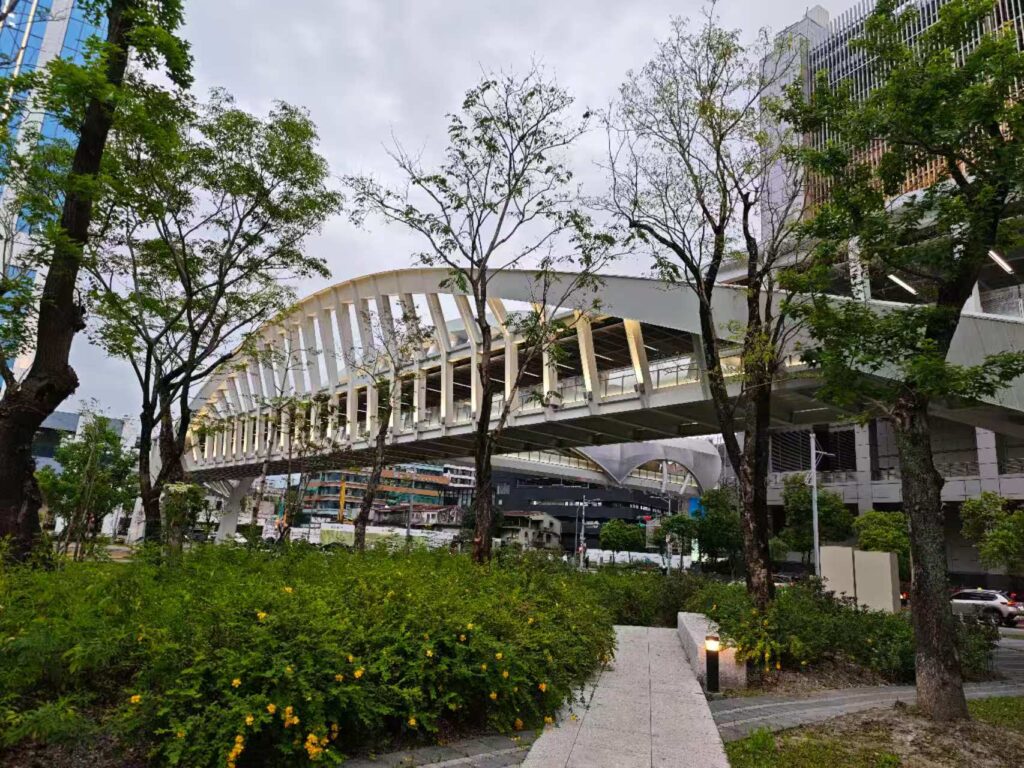
This evaluation focuses on the 2025 Taiwan Lighting Environment Award-winning project: the Nangang Multi-level Connectivity Platform.
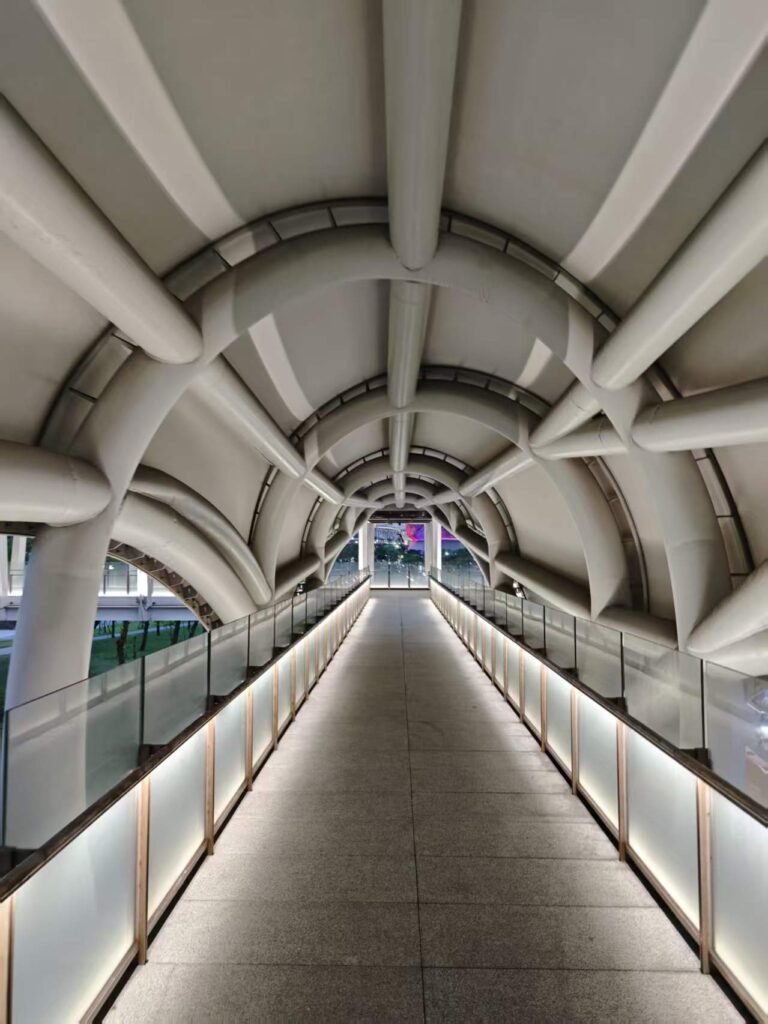
It is a particularly valuable case study because it does not simply “brighten” a bridge. Instead, it transforms an urban transport connector into a legible, walkable nighttime public space with a sense of urban landmark identity.
1. Core Value: Not Brighter, but More Controlled
In many public lighting designs—especially pedestrian bridges, elevated walkways, underground passages, and transit-adjacent spaces—the typical approach is: more luminaires equal greater safety, and higher illuminance equals better security.
However, real-world experience often shows the opposite. Excessive brightness can cause discomfort; exposed light sources can generate glare; excessive contrast can impair visual adaptation; and even if the ground appears bright, the perceived visual field may become chaotic and unstructured.
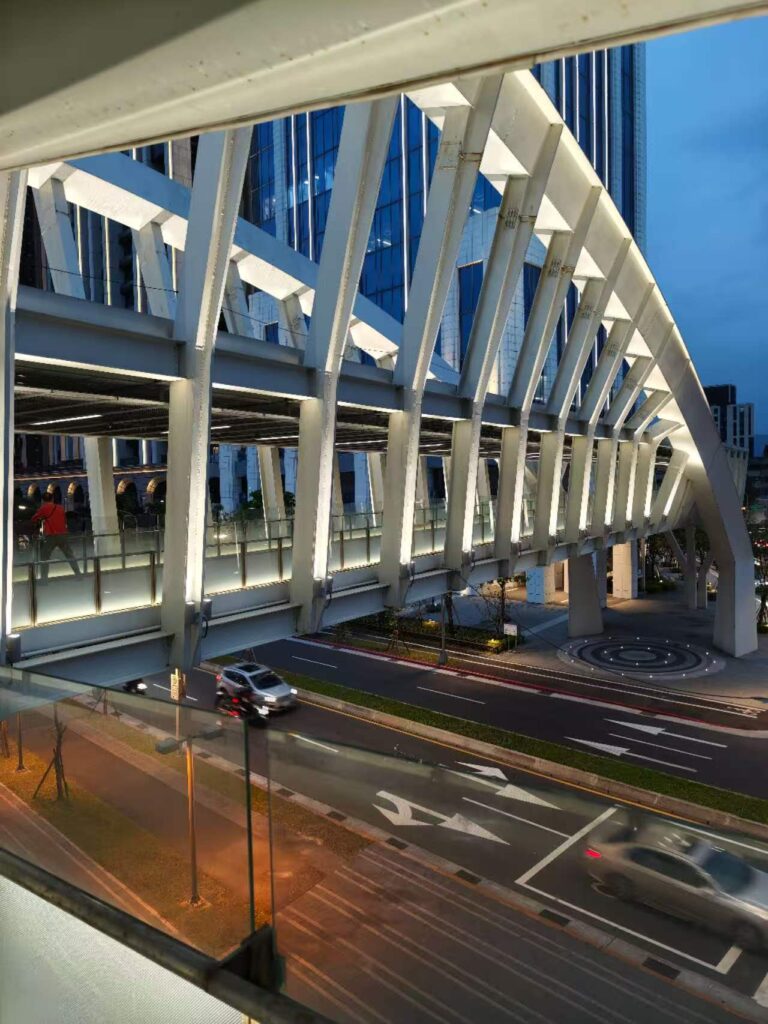
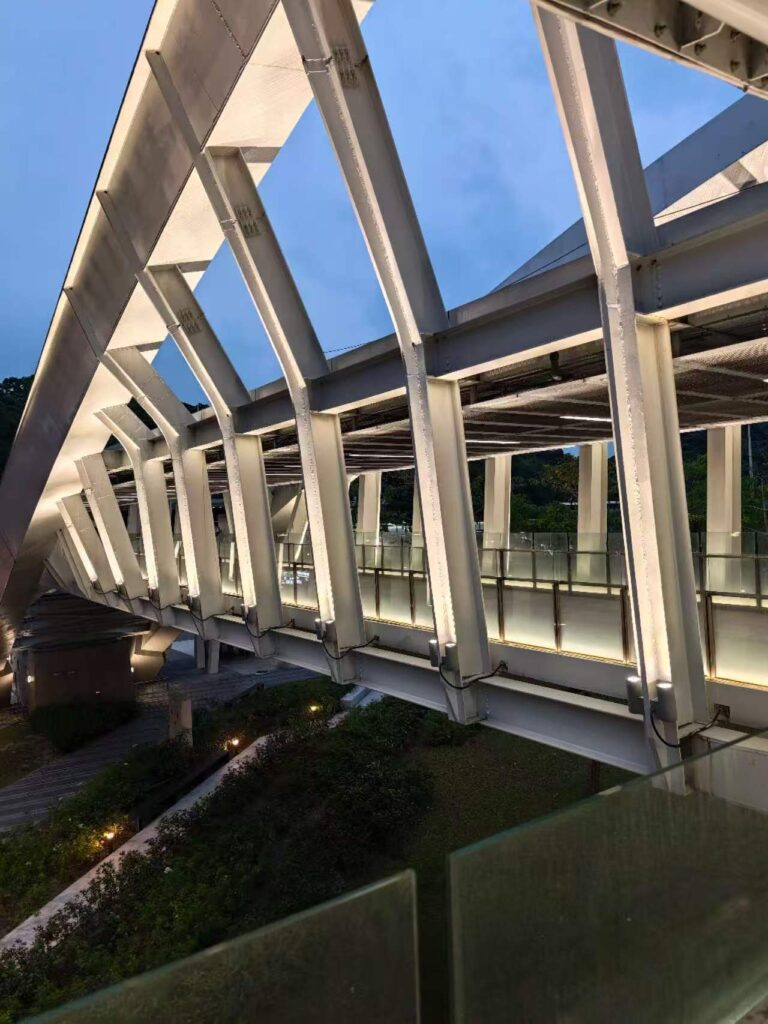
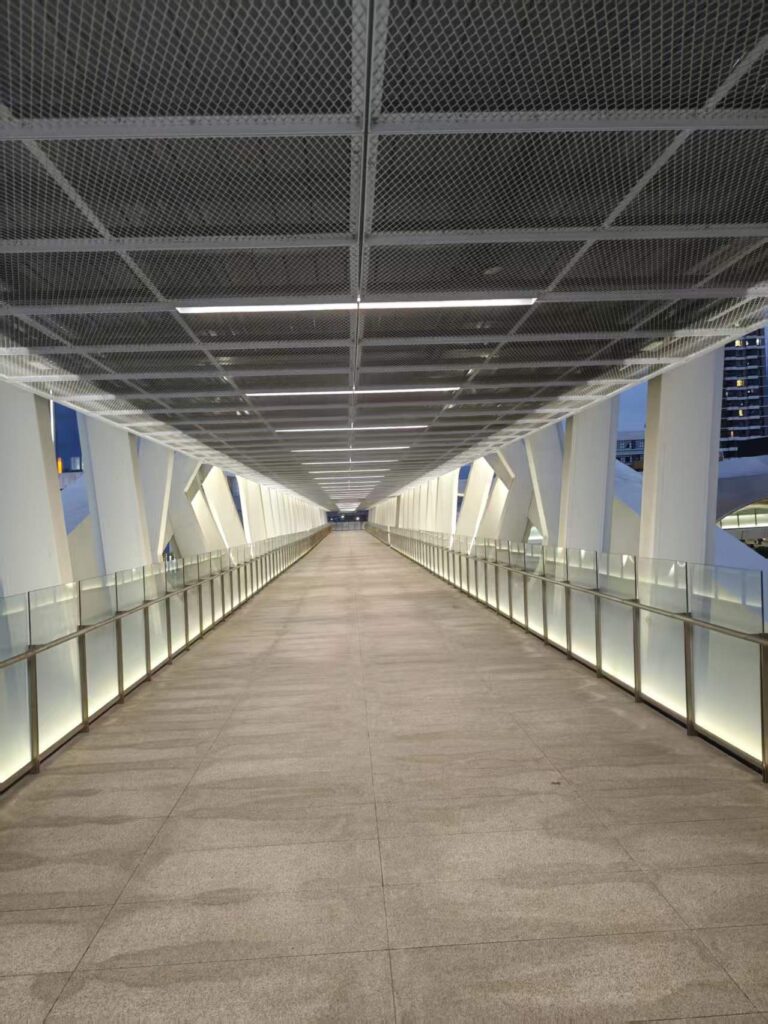
The more mature aspect of the Nangang Multi-level Connectivity Platform lies in its approach: it does not rely on heavy downward lighting to flood the ground. Instead, it uses structural elements, railing boards, façade reflections, light shielding, and linear guidance to construct a softer, continuous, and controlled nocturnal spatial experience.
This is essential because at night, pedestrians do not need high lux at a single measurement point—they need a stable luminance order across their entire field of view.
2. On-site Measurement Data: Low Illuminance, Yet Spatial Legibility Achieved
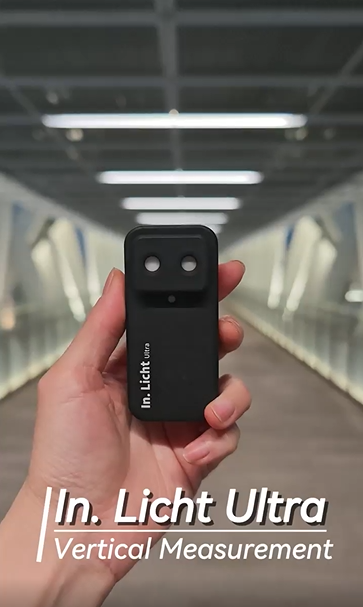
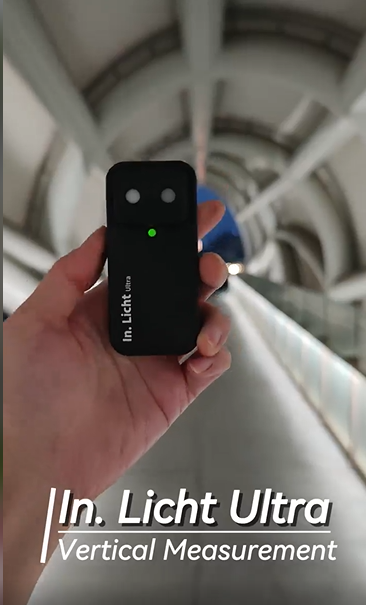
Based on In. Licht Ultra field measurements, one representative dataset is as follows:
| Metric | Measured Value | Initial Interpretation |
|---|---|---|
| Illuminance | 12.1 lux | Not high, but acceptable for nighttime circulation if distribution is uniform and glare is controlled |
| CCT (Correlated Color Temperature) | 3911K | Close to 4000K; neutral with a slight warm tone, suitable for transit-connected spaces |
| CRI / Ra | 88.1 | Good overall color rendering |
| R9 | 43 | Moderate red rendering; not a critical issue but has room for improvement |
| x / y | 0.389 / 0.396 | Stable chromaticity, close to the neutral white region |
| Foot-candle | 1.12 fc | Approximately equivalent to 12.1 lux |
Another measurement point shows:
| Metric | Measured Value |
|---|---|
| Illuminance | 17.0 lux |
| CCT (Correlated Color Temperature) | 3992.7K |
| CRI / Ra | 92.4 |
| R9 | 64 |
This indicates that there are still variations between different locations, but the overall design direction remains consistent: it is not a high-illuminance scheme, but rather a low to medium-low illuminance design that emphasizes light distribution and spatial reflection.
An illuminance level of 12–17 lux would be far from sufficient in office, reading, or commercial display environments; however, in the context of outdoor nighttime pedestrian connectivity spaces, such standards cannot be applied using indoor lighting criteria.
For this type of space, more important questions include: Is the pathway clearly legible? Are boundaries identifiable? Are steps, corners, railings, and entrances visible? Are there any glaring light sources? And when moving from dark to bright areas or vice versa, can the human eye adapt smoothly?
From visual observation, the railing panels, bridge structure, and ground edges are continuously articulated. Light is not merely cast onto the ground; instead, it reveals the contours of the space. This is precisely what makes the design more worthy of discussion than conventional public lighting approaches.
3. Correlated Color Temperature: Around 4000K, Clear but Not Harsh
Measured CCT ranges from approximately 3911K to 3993K, close to 4000K. This is a relatively appropriate choice for transit-oriented public spaces.
It does not create the overly relaxed or yellowish perception often associated with 3000K, nor does it introduce the harshness and visual tension commonly seen in 5000K+ cool white light. For environments such as station connections, urban transfer corridors, and pedestrian platforms—where orientation and legibility are essential—around 4000K maintains a clear, clean, and publicly legible visual character.
However, this does not mean 4000K is a universal standard. In contexts adjacent to residential areas, hotels, waterfronts, or leisure spaces—or during late-night operation hours—zoning or time-based control should be considered. For example, maintaining clarity during peak hours while reducing brightness or shifting to a warmer tone at night can better balance public safety with environmental comfort.
This reflects a broader direction for future urban lighting: not a fixed color temperature applied uniformly, but dynamic adaptation based on people, space, time, and activity needs.
4. Color Rendering: Overall Good, but Red Reproduction Still Has Room for Improvement
In terms of CRI and TM-30, the color rendering performance of this project is generally acceptable to good.
| Metric | Value |
|---|---|
| CRI / Ra | 88.1 |
| Re | 82.7 |
| R9 | 43 |
| TM-30 Rf | 86.9 |
| TM-30 Rg | 96.6 |
Another set of measurement points is:
| Metric | Value |
|---|---|
| CRI / Ra | 92.4 |
| Re | 88.8 |
| R9 | 64 |
| TM-30 Rf | 88.3 |
| TM-30 Rg | 96.5 |
First, Ra is approximately 88–92, indicating that overall color rendering is quite good. For a public circulation space, this is already clearly better than many outdoor lighting systems that prioritize only cost and efficiency.
Second, TM-30 Rf is about 86.9–88.3, indicating stable color fidelity; Rg is around 96.5–96.6, meaning color saturation is not artificially boosted. Visually, this results in a restrained, clean appearance without excessive vividness or unnatural color rendering.
Third, R9 ranges from about 43–64, showing that red color rendering capability is from moderate to acceptable. For general pedestrian environments, this is not a critical issue; however, if the area requires better facial recognition, public art presentation, nighttime landscape for vegetation, commercial street vibrancy, or a higher-quality urban night interface, R9 could be further improved.
This also reminds us that CRI is not everything. A high Ra does not mean all colors are rendered well. In future evaluations of public lighting, TM-30, R9, spectral distribution, and actual spatial use cases should be considered together, rather than relying solely on a single Ra value.
5. Circadian rhythm and nighttime health: low m-EDI is reasonable
This measurement also includes human-centric lighting (HCL) indicators related to biological rhythm:
| Metric | Value |
|---|---|
| CAF | 0.55 |
| EML | 8.07 |
| m-EDI | 7.32 lux |
| S/P Ratio | 1.68 |
| CS | 0.01 |
The other set of measurement points shows:
| Metric | Value |
|---|---|
| CAF | 0.60 |
| EML | 12.45 |
| m-EDI | 11.29 lux |
| S/P Ratio | 1.78 |
| CS | 0.02 |
These data indicate that its stimulation of the human circadian rhythm at night is very low. For outdoor public circulation spaces at night, this is actually appropriate.
Daylight lighting should help people stay alert, synchronize their biological rhythm, and improve vigilance. Night lighting, on the other hand, should ensure safe passage while minimizing disruption to sleep and the surrounding nocturnal environment.
Therefore, the key is not to increase m-EDI, but to ensure:
- adequate visual safety
- no excessive glare
- no excessive blue-light stimulation
- no attempt to “daylight-ify” nighttime public space
This project is relatively restrained in that sense. It allows people to see clearly, but does not try to turn night into day. This is a commendable approach.
6. Flicker: SVM is controlled, but we should not rely on a single metric
Regarding flicker performance, the supplementary data shows:
| Metric | Value |
|---|---|
| SVM | 0.44 |
| Percent Flicker | 99.9% |
| Flicker Index | 0.50 |
| Frequency | 17,910.49 Hz |
Another set of measurement points is:
| Metric | Value |
|---|---|
| SVM | 0.27 |
| Percent Flicker | 99.9% |
| Flicker Index | 0.33 |
| Frequency | 13,930.38 Hz |
The data set is well suited for public communication and education. When people see a percent flicker value of 99.9%, the immediate reaction is often: is this dangerously high? That interpretation is overly simplistic.
Flicker risk cannot be evaluated by percent flicker alone. It must be considered together with frequency, waveform, modulation depth, SVM, PstLM, and the actual usage context.
Here, SVM ranges from 0.27 to 0.44, indicating that the perceptible flicker risk is relatively well controlled. At the same time, the measured frequency is approximately 14–18 kHz, which is far beyond the range of human visual perception. This means that even with a high percent flicker value, most users are unlikely to experience visible flicker in normal conditions.
However, this does not mean flicker can be ignored. In public environments, there are multiple real-world scenarios to consider: smartphone camera capture, vehicular vision, fast movement, walking while reading, elderly users, children, individuals with flicker sensitivity, and performance under different dimming levels and driver conditions.
A more rigorous interpretation would therefore be:
from the perspective of SVM and high-frequency operation, the visible flicker risk is relatively controlled; however, the high percent flicker and flicker index still justify further verification under multiple dimming levels and across different luminaire positions.
This also highlights why on-site measurement is essential. Relying only on manufacturer datasheets cannot fully predict real-world temporal light output once drivers, dimming systems, wiring conditions, and control logic are all integrated in an actual installation.
7. The most valuable aspect: replacing “light stacking” with “light order”
What stands out in this project is not a single outstanding metric, but the overall design logic.
It does not reduce public safety to “brighter is better.”
It does not turn bridge lighting into a visually aggressive light show.
It avoids exposing light sources directly in primary sightlines.
It prevents chaotic patches of brightness and darkness in pedestrian space.
Instead, it:
- uses linear lighting along railings to define walking boundaries
- uses structural lighting to articulate rhythm in the bridge geometry
- relies on reflected light to reduce direct glare
- maintains low illuminance to preserve nighttime scale
- uses neutral CCT to keep spatial clarity
- controls output to reduce environmental disturbance
This reflects a more advanced public lighting strategy: not filling space with luminaires, but placing light only where it is functionally necessary. Not maximizing ground brightness, but stabilizing human visual perception. Not optimizing for photographs, but for real pedestrian experience—safe, natural, and unobtrusive.
8. Remaining technical validation gaps
A single or even several measurement snapshots are still insufficient to fully define lighting quality. For a complete assessment of an award-level project, the following datasets should ideally be included:
- Multi-point illuminance and uniformity across entrances, exits, mid-span, corners, stairs, escalators, railing zones, glass reflection zones, and under-bridge shadow areas.
- Vertical illuminance at eye level, which better represents facial recognition, spatial perception, and visual comfort.
- Luminance distribution and glare risk, especially reflections from glass railings and sightline intrusion from luminaires.
- Weather condition variability, particularly rain, wet surfaces, and haze—critical in humid climates.
- Time-based control behavior, including peak hours, late night operation, and adaptive dimming strategies.
- Full flicker validation, across different fixture types, dimming levels, circuits, and including SVM, PstLM, percent flicker, flicker index, and frequency.
With these additional datasets, the project could move beyond a “visually successful installation” and become a reference case for measurable, verifiable, and optimizable public lighting design.
9. A broader industry reminder: awards must enter a verification era
The broader implication is not limited to this single project. It points to a structural shift in the lighting industry:
Lighting awards should no longer be based primarily on imagery, narrative, or conceptual design intent.
Future evaluation of “good lighting” should be able to answer, at minimum:
- Is the space actually comfortable in real use?
- Is glare truly controlled?
- Is illuminance sufficient without excess?
- Does the spectrum match spatial and temporal context?
- Is color rendering appropriate for functional needs?
- Has flicker been properly validated?
- Does the system minimize environmental and human disruption over time?
These questions cannot be answered by perception alone, nor by drawings, nor by luminaire specifications. They require field measurement, user validation, contextual calibration, and longitudinal observation.
10. Conclusion: maturity in public lighting is not brightness—it is understanding people
The value of the Nangang Elevated Walkway system lies not in achieving maximum brightness, but in demonstrating a more mature principle: public lighting does not need to win by intensity.
A mature urban lighting system balances safety, comfort, energy efficiency, low glare, low environmental impact, and verifiability.
Its significance is not that it “looks good,” but that it shows how light can:
- serve movement
- organize space
- reduce visual strain
- respect nighttime conditions
- and be meaningfully measured and evaluated
In this sense, the project’s true value is not that it makes the city brighter, but that it makes light more orderly.
And that is exactly the capability future public lighting systems will require.
Aesthetics matter. Data matters. Narrative matters. But ultimately, real-world performance must stand up to measurement.

 English
  Chinese (Taiwan)
  Chinese (China)
  German