From colored-light products to “emotional navigation systems”—how should the lighting industry evolve?
Abstract
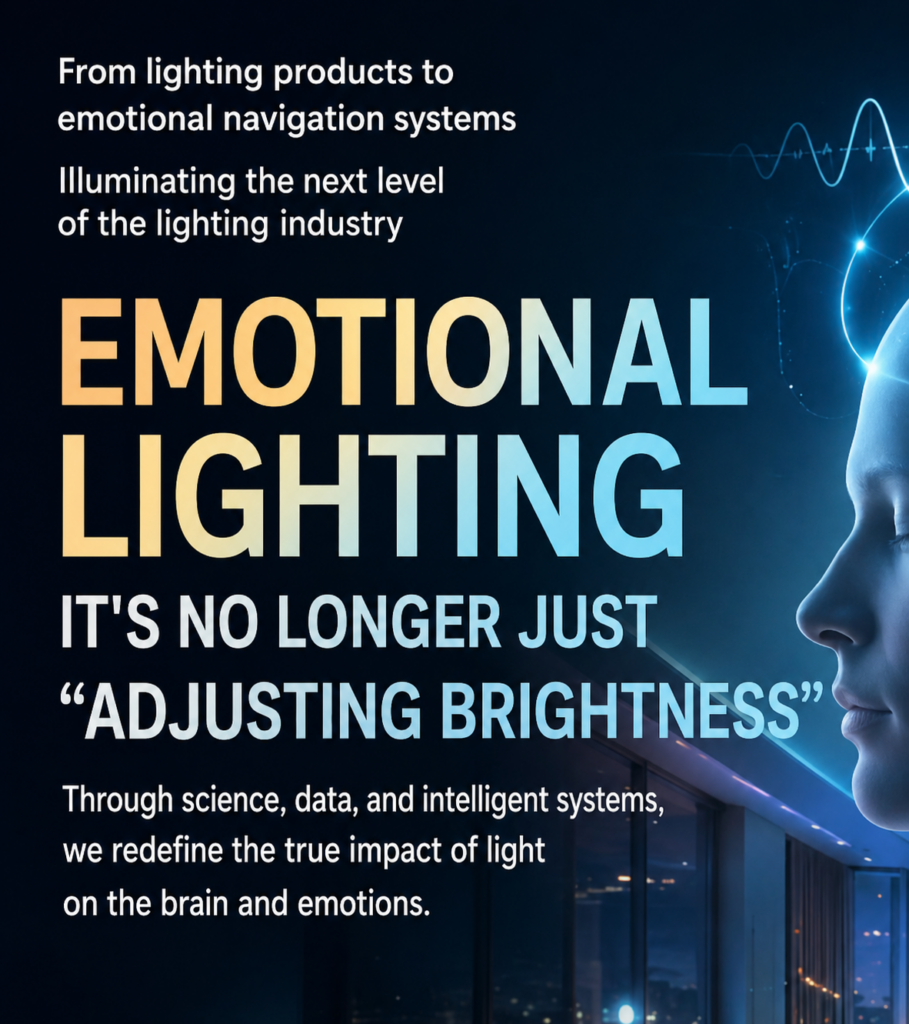
“Emotional lighting” has become a popular topic in recent years, yet most products still remain at the stage of color tuning, atmosphere creation, and storytelling. They are still far from truly influencing human states. Effective emotional lighting should not merely output colored light; it should evolve into a measurable, verifiable, feedback-driven, and iterative closed-loop system integrating light × human × brain.
This article explores the underlying logic of emotional lighting from perspectives such as circadian rhythm, alertness, the limbic system, reward mechanisms, EDI/DER, and PBM. It also proposes a more meaningful direction for the industry: future lighting products should not just sell luminaires, but move toward adaptive emotional navigation systems.
Introduction
In recent years, concepts like “pastel lighting,” “emotional lighting,” “ambient lighting,” “color therapy,” and “dopamine spaces” have gained significant popularity.
However, if we are honest, most so-called emotional lighting products in the industry are still far from truly influencing human states.
Many products are highly capable of changing colors and telling compelling stories; yet they often do not know:
- Whether the user is more relaxed or more irritated at that moment
- More alert or more fatigued
- Comforted or overstimulated
In other words, most “emotional lighting” today is essentially lighting with visual styling, rather than evidence-based human-centric systems with a closed-loop validation process.
And this is precisely the gap the industry must address next.
1. Why most “emotional lighting” today is not yet professional
The conclusion first: If emotional lighting is to produce real effects, it cannot remain at colored light output—it must evolve into a stimulus–perception–feedback–adjustment system.
Because “emotion” has never been something controlled by a single color button.
It involves at least four layers:
- Layer 1: Visual perception
A space that appears warmer, softer, lighter, or more dramatic will certainly influence subjective preference. - Layer 2: Physiological arousal
The same light can make a person more alert—or more fatigued; more focused—or more irritable. - Layer 3: Circadian effects
The key factors are not just color, but also timing, duration, dose, direction, and prior light exposure history.
The CIE’s 2024 position statement reiterates that “the right light at the right time” should be characterized using the CIE S 026 α-opic framework, rather than relying solely on CCT or traditional illuminance. - Layer 4: Stable emotional experience
Feelings such as happiness, relaxation, safety, and healing are rarely caused by a single color. They are shaped by multiple factors, including sleep quality, alertness level, stress state, circadian alignment, reward system activity, and environmental security.
Therefore, being able to adjust RGB does not mean one understands emotional lighting.
2. Why colored lighting often “feels right” but isn’t necessarily effective
Because most colored-light products control output, but not dose. Common industry practices include:
- Preset scenes (happy orange, healing blue, meditation purple, energetic red)
- App-based interaction
- Pairing with music, scent, or marketing narratives
- Assuming users will “feel better”
The core issue is not aesthetics—it is the lack of measurement and validation.
If an emotional lighting system does not know the user’s:
- Current alertness
- Stress level
- Fatigue
- Sleep condition
- Sensitivity to stimuli
- Emotional stability
…it cannot determine what light should be delivered, nor whether the intended effect has been achieved.
Research on light interaction with the brain’s limbic system suggests a valuable direction. Instead of relying only on subjective questionnaires, it explores extracting brain-state indicators—such as anxiety tendency, depression tendency, tension level, sleep index, brain fatigue, external/internal focus, and hemispheric dominance—through frontal EEG, algorithms, and database modeling.
These metrics may not yet constitute industry standards, but they point to a critical shift: If emotional lighting is to advance, devices must evolve from “emitting light” to “measuring humans.”
3. How light actually influences emotion (beyond “dopamine”)
A common claim today: “This light stimulates dopamine and makes people happy.”
This is overly simplistic. A more rigorous statement is: Light does not directly “create happiness.” Instead, it alters the emotional baseline through:
- Retinal input
- Circadian synchronization
- Sleep homeostasis
- Activation of alertness systems
- Indirect modulation of brain regions related to emotion and reward
Over the past two decades, research has shown:
- Nighttime light, especially short-wavelength stimuli, significantly suppresses melatonin
- The spectral sensitivity of this effect differs from that of the visual system, indicating non-visual photoreception beyond rods and cones
- Melanopic EDI is a strong predictor of nighttime melatonin suppression
In other words, the foundation of emotional lighting is not merely “color psychology,” but a continuous system: Light → Eye → Brain → Circadian Rhythm → Emotion
4. Three terms the industry should stop conflating
To avoid conceptual confusion:
- Orexin – regulates wakefulness, motivation, and goal-directed arousal
- Serotonin (5-HT) – associated with mood stability and daytime state
- Dopamine – linked to reward prediction, novelty, and motivation
If emotional lighting is to move toward interdisciplinary collaboration, these terms must be used precisely from the outset.
5. Don’t treat dopamine as an ever-increasing “happiness knob”
Terms like “dopamine lighting” or “dopamine spaces” are fine as marketing labels—but not as scientific models.
Dopamine is better understood as a signal of:
- Reward prediction error
- Novelty
- Motivation and exploratory behavior
When stimuli exceed expectations, dopamine responses increase. But once stimuli become predictable and repetitive, the effect diminishes and may even fade into the background. This has direct implications:
- Short-term stimulation ≠ long-term value
- Feeling “excited” ≠ being sustainably “happier”
Mature emotional lighting should prioritize:
- Circadian alignment
- Daytime activation
- Minimal nighttime disruption
- Sleep recovery
- Stress regulation
- Emotional stability
- Resilience
6. Light and emotion involve more than dopamine
Light’s influence extends beyond the reward system:
- Orexin → wakefulness, motivation, goal-oriented activation
- Serotonin → mood stability, daytime function, seasonal mood variation
A classic Lancet study showed that serotonin production in the brain correlates positively with daily light exposure. Thus, a more evidence-based statement is not: “This light makes you release happiness hormones.”
But rather: Appropriate light exposure—at the right time, dose, direction, and spectrum—supports a better emotional baseline through circadian, alertness, sleep, and neural pathways.
Light does not directly create happiness; it creates the conditions under which happiness, stability, recovery, and focus are more likely to occur.
7. Why the limbic system matters for lighting
Emotion does not occur in luminaires or color palettes—it occurs in the brain.
Recent research combining fMRI and EEG has explored how different lighting conditions affect emotional brain regions, proposing a Limbic System Score (LSS) to quantify interactions between parameters such as CCT, CRI, flicker, illuminance variation, and exposure time.
Key observations include:
- Excitement peaks around 3000–4000K
- Happiness peaks around 4000K
- Higher CCT (~5700K) tends to suppress emotional activation
Additional findings suggest relationships between specific brain regions and CCT thresholds, for example:
- Calcarine → minimal negative emotion response around 4000K
- Frontal Superior → strongest emotional excitation around 4400K
- IFG & MCC → highest stability around 4200K
These are not yet universal standards, but they demonstrate: Emotional lighting is measurable—not purely subjective.
More importantly, this work shifts emotional experience from narrative into a quantifiable, modelable, and iterative “light recipe language.”
8. From EDI / DER to PBM: building a true “stimulus language”
For emotional lighting to become verifiable and scalable, the industry must move beyond vague descriptors like “warmer” or “softer.”
Three key concepts:
- EDI (Equivalent Daylight Illuminance)
Describes effective stimulus at the eye.
The key question is not just “how bright,” but how much effective stimulus the eye receives. - DER (Daylight Efficacy Ratio)
Compares non-visual effectiveness under equal visual brightness, enabling cross-product comparison. - PBM (Photobiomodulation)
Requires full parameterization:- Wavelength
- Intensity
- Energy density
- Exposure time
- Pulse structure
- Thresholds
- Safety limits
Effective light is not about “looking right”—it is about reaching the correct dose window.
9. PBM’s key lesson: every stimulus has thresholds
- Too little → ineffective
- Too much → potentially inhibitory
Thus, future emotional lighting must incorporate:
- Threshold definition
- Dose modeling
- Safety boundaries
- Closed-loop validation
10. Emotion is not switching—it is navigation
Lighting should not force a direct jump from “nervous” to “happy.” A more realistic pathway:
- nervous → neutral
- neutral → relaxed
- relaxed → happy or alert
This reflects actual human regulatory processes. Therefore, advanced emotional lighting is not a fixed scene library—it is a path-planning system.
It must answer:
- Where is the user now?
- What is the target state?
- What path is appropriate?
- How long should transitions take?
- What stimulus intensity is optimal?
- When should stimulation be reduced or increased?
- When should intervention be avoided entirely?
11. The inevitable future: adaptive emotional navigation systems
Next-generation systems will:
- Continuously assess user state
- Dynamically adjust lighting strategies
- Optimize transitions over time
Like navigation systems:
- Determine current position
- Select the optimal route
- Adjust in real time
Not forcing the same “shortest path” every time.
12. Beyond luminaires: defining a system-level architecture
Future value lies not in hardware alone, but in integrating:
- EDI / DER
- Temporal programming
- Spatial distribution
- Directional control
- Stimulus dosing
- State sensing
- Feedback correction
- Path optimization
Lighting becomes: A programmable, measurable, verifiable, and navigable human-centric system—not just a product.
Conclusion
The next step in emotional lighting is not better color control—it is deeper human understanding.
Color is not wrong. Atmosphere is not wrong. “Dopamine spaces” and “healing light” are not wrong. But stopping at color imagination is insufficient.
The industry must move toward real research on: Light → Human → Brain → Emotion
Both healthy lighting and emotional lighting must converge toward:
- Measurement
- Understanding
- Validation
- Human-state optimization
Ultimately, emotional lighting should not simply “paint spaces with trendy colors.” It should function like music:
- With rhythm
- Dynamics
- tonality
- and a definable symbolic system
- EDI / DER define what stimulus reaches the eye
- PBM defines thresholds and dosage
- Adaptive emotional navigation systems define how lighting regulates human states
At that point, lighting is no longer about selling colored light—It becomes a new paradigm of: devices, algorithms, and evidence systems that redefine how humans interact with light.
Postscript
If the industry is willing to seriously advance this field, I strongly recommend initiating a round of cross-disciplinary collaborative research, involving:
- Lighting companies
- Sensor technology firms
- Sleep medicine specialists
- Psychologists
- Neuroscientists
- Spatial designers
- Scenario/experience operators
Because the real barrier in emotional lighting is no longer luminaire development.
It is this: Are we willing to acknowledge that future lighting products must increasingly resemble human-centric technology systems?
Scientific Basis / Further Reading
- CIE, Position Statement on Integrative Lighting — Recommending Proper Light at the Proper Time, 3rd ed. (2024)
- CIE S 026:2018, System for Metrology of Optical Radiation for ipRGC-Influenced Responses to Light
- ISO/CIE TR 21783:2022, Integrative lighting — Non-visual effects
- Brown et al., PLOS Biology (2022), recommendations for indoor daytime/evening/night light exposure
- Brainard et al., Journal of Neuroscience (2001), action spectrum for human melatonin suppression
- Thapan et al., Journal of Physiology (2001), melatonin suppression and non-visual photoreception
- Lambert et al., The Lancet (2002), sunlight and brain serotonin turnover
- Korshunov et al., Frontiers (2017), dopamine and circadian regulation
- Huang et al., Dose-Response (2009 / 2011), biphasic dose response in PBM/LLLT
- de Freitas & Hamblin, Frontiers in Neuroscience (2016), review of PBM mechanisms

 English
  Chinese (Taiwan)
  Chinese (China)
  German