The most comfortable spaces are often not the brightest ones.
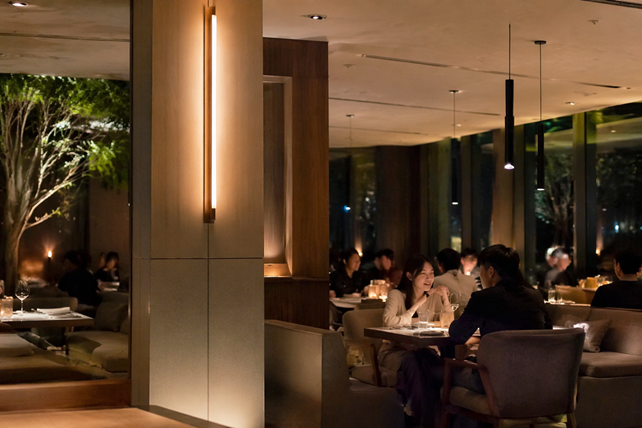
Some spaces don’t feel striking at first glance.
They don’t rely on dramatic lighting, exaggerated design language, or an intentionally amplified sense of presence. Nor are they the kind of places that instantly look great in photos.
But strangely, when you actually sit down and spend some time there, you begin to notice a rare kind of comfort:
You don’t feel tired.
You don’t feel restless.
You don’t feel the urge to leave.
In fact, you may even want to stay a little longer.
We’ve all likely been to places like this.
It could be a restaurant, a café, a hotel lobby, or simply an unremarkable reception area. It may not be luxurious or visually impressive, but once you enter, your body and attention gradually relax.
You may not immediately be able to explain why, but you can clearly feel it: the space is smooth, stable, and easy to stay in.
Very often, this sense of “being able to stay” doesn’t come from high-end finishes or expensive materials.
It comes from something else:
The light isn’t constantly disturbing you.
1. We are often misled by first impressions
Today, many spaces—especially under the influence of social media, showrooms, and display environments—are increasingly designed for immediate visual impact.
They need highlights.
They need contrast.
They need memorability.
Ideally, they create a “wow” moment the moment you walk in.
There’s nothing inherently wrong with this. Spaces need identity, and commercial environments need attraction. Design naturally carries the task of expression.
The problem is: what works at first glance doesn’t necessarily feel comfortable over time.
Some spaces are great for photos, but not for sitting.
Some feel powerful at first, but become tiring over time—your eyes fatigue, your attention drifts, and you may even feel inexplicably irritated.
Others feel “overdesigned” in every detail, yet never truly allow you to relax.
This reflects a broader issue today: too much emphasis on instant stimulation, and too little on the experience of staying.
But in most real scenarios, people don’t just glance and leave.
They sit, eat, talk, work, rest, wait, read—or simply zone out.
At that point, the value of lighting is no longer just about presence,
but whether it continuously drains people.
2. What truly determines comfort is not just brightness
When people talk about comfortable spaces, their first instinct is often brightness or color temperature.
But what actually determines whether people want to stay is more subtle—and more fundamental.
First, the stability of light.
This isn’t just technical stability, but perceptual stability. The lighting shouldn’t fluctuate, shouldn’t be unevenly distributed, and shouldn’t compete for attention across different areas.
When the eyes and nervous system don’t need to constantly adapt, people are more likely to settle.
Second, visual comfort and focal ease.
People don’t just look at a table or a single fixture. We look at people, walls, forward, and into the distance—our gaze constantly shifts across layers.
If the lighting causes the eye to jump between uncomfortable bright spots, or forces it to avoid glare, it becomes difficult to truly relax.
Third, avoiding overstimulation and distraction.
More highlights don’t mean better quality. More layers don’t mean more comfort.
Too many emphasized elements, decorative light sources, or overly expressive lighting gestures can make a space feel visually “noisy.”
This kind of noise isn’t auditory—it’s a constant visual disturbance.
Finally, whether the space forces you to “work” to see.
Many people don’t realize this: eye fatigue isn’t always caused by darkness.
More often, it comes from constant adjustment— adjusting focus, adapting to brightness changes, reallocating attention.
These small but continuous efforts accumulate, directly affecting whether people are willing to stay.
So truly comfortable lighting is not necessarily the brightest, nor the most dramatic. It’s the kind of light that doesn’t force people to constantly negotiate with the space.
3. The value of good lighting is that it helps people relax—without noticing
I’ve always felt that truly good lighting has an important yet often overlooked quality: It doesn’t necessarily impress you immediately, but it gradually allows you to relax.
This sense of relaxation is not about dimness, boredom, or lack of design.
It’s about not overwhelming your senses— so your attention can return to what actually matters: the activity, the people, the moment.
When lighting is done right, people feel less fatigue. You don’t need to squint, constantly adjust your vision, or feel that something is off without knowing why.
This low cognitive and visual load is critical across all environments—hospitality, offices, retail, and residential spaces.
When lighting is done right, people also feel less pressure.
Some spaces are actually well-designed, yet feel subtly tense. It could be overly intense highlights, excessive contrast, overly dark backgrounds, overly bright foregrounds, or a visual rhythm that feels too fast.
Over time, this leads to irritation, distraction, and the desire to leave.
When lighting is done right, it also reduces unnecessary distraction. Human attention is valuable.
A good space should allow people to focus on conversation, work, dining, thinking, or rest— not constantly be pulled around by the lighting.
And ultimately, what good lighting brings is not just that a space “looks good,” but something deeper:
People want to stay.
They want to engage.
They want to spend.
They want to work.
They want to relax.
They want to come back.
This is the real value that commercial, hospitality, and even residential spaces should care about.
4. Perhaps lighting should aim not for “wow,” but for “stay”
Over the years, after observing many spaces and working extensively with light, one thing has become increasingly clear to me:
Whether a space makes people want to stay may be more important than whether it impresses at first glance.
Because “wow” is momentary. But “staying” reflects whether a space truly serves people.
For commercial spaces, staying means dwell time, experience quality, interaction, and even conversion.
For hotels, it means relaxation, stability, and memory.
For offices, it means fatigue management, focus, and long-term comfort.
For homes, it directly relates to daily life, rhythm, and companionship.
So perhaps the real maturity of lighting is not about making it more intense, but making it more appropriate.
Not just attention-grabbing, but supportive of staying.
Not constantly asserting presence, but knowing when to step back.
Not making every element speak, but allowing the whole to become calm.
This shift may not appear dramatic, but it could mark the true beginning of higher-quality spaces.
What is the most comfortable space you’ve stayed in recently?
It may not be the most visually impressive— but it likely got the lighting right.

 English
  Chinese (Taiwan)
  Chinese (China)
  German