Taiwan’s Next Opportunity in Human-centric Environmental Technology
By Lawrence Lin
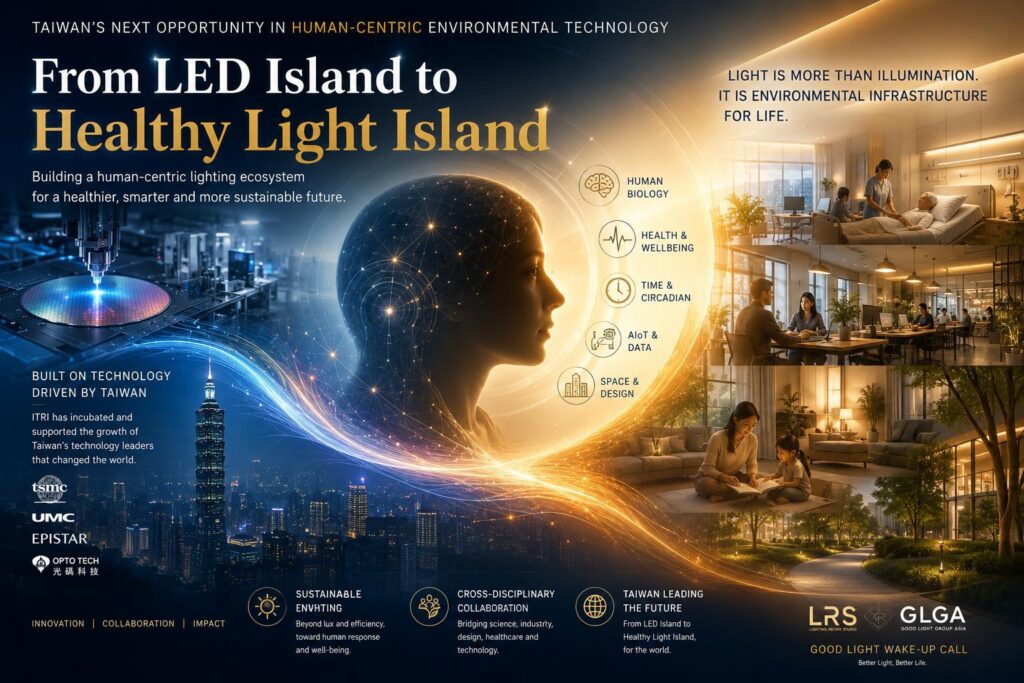
Taiwan has long been one of the world’s most important technology manufacturing bases.
From semiconductors to displays, from LEDs to ICT, Taiwan built an extraordinary industrial ecosystem based on engineering excellence, manufacturing discipline, and supply-chain integration.
Behind much of this transformation, ITRI (Industrial Technology Research Institute) played a foundational role.
Over the past decades, ITRI not only advanced core technologies in optoelectronics, semiconductors, displays, and lighting, but also helped incubate or support the growth of some of Taiwan’s most influential technology companies, including:
- TSMC
- UMC
- Epistar
- Opto Tech
This history matters. Because Taiwan’s next opportunity may once again emerge from the intersection of technology, manufacturing, and societal transformation.
But this time, the opportunity may not simply be about chips, displays, or energy efficiency. It may be about something far more human: Light as environmental infrastructure for health, wellbeing, cognition, and quality of life.
The Industry Is Changing
For the past twenty years, the lighting industry largely competed on:
- Efficiency
- Cost
- Reliability
- Scale
But the next phase is fundamentally different. The central question is no longer only: “How efficiently can we generate light?”
The real question is becoming: “How should light interact with human biology, behavior, emotion, and time?”
This is where lighting converges with:
- Neuroscience
- Circadian biology
- Healthcare
- AIoT
- Smart buildings
- Environmental data science
And Taiwan is uniquely positioned to participate in this transition.
Taiwan Already Has the Foundations
Taiwan today possesses nearly all the key building blocks required for a future healthy-light ecosystem.
1. Strong Optoelectronics & LED Infrastructure
Taiwan has decades of experience in:
- LED chips
- Packaging
- Drivers
- Optical systems
- Sensors
- Displays
- Micro LED
- Embedded electronics
This remains a major strategic advantage.
2. World-class ICT & AIoT Capabilities
Healthy lighting is no longer just about luminaires. It increasingly depends on:
- Sensors
- Edge computing
- Cloud platforms
- AI-driven adaptation
- Building integration
- Long-term environmental monitoring
In many ways, healthy lighting is becoming a branch of: Environmental intelligence.
3. Healthcare & Aging Society Needs
Taiwan is entering a super-aged society. This creates growing demand for solutions related to:
- Sleep quality
- Cognitive performance
- Mental wellbeing
- Long-term care
- Circadian support
- Shift-work adaptation
Light is gradually evolving from a decorative or energy-saving product into: A health-supportive environmental system.
4. Scientific & Clinical Research Capability
Taiwan also possesses strong academic and medical research resources, including:
- ITRI
- Academia Sinica
- National Taiwan University
- Yang Ming Chiao Tung University
- Major medical centers and hospitals
The challenge is not the lack of technology. The challenge is integration.
Taiwan’s Biggest Gap Is Not Technology
It Is a Shared Language
Today, much of the lighting industry still speaks in the language of:
- Korrelierte Farbtemperatur (CCT)
- CRI
- Lux
- Efficiency
- Smart controls
But globally, the conversation is rapidly shifting toward:
- melanopic EDI
- alpha-opic metrics
- circadian stimulus
- temporal light
- spatial light distribution
- human response modeling
In other words: The industry is moving from “lighting products” toward “human environmental systems.”
This requires an entirely new interdisciplinary framework connecting:
- Beleuchtung
- Architecture
- Neuroscience
- Healthcare
- AI
- IoT
- Environmental psychology
And this is precisely where Taiwan has an opportunity to lead.
From Product Manufacturing to Human-centric Platforms
I believe Taiwan’s next strategic opportunity is not simply building better lamps.
It is building:
Verifiable Human-centric Environmental Platforms
This includes:
Measurement & Verification
Not only measuring lux, but also:
- SPD
- melanopic EDI
- flicker
- glare
- spatial distribution
- temporal exposure
- biological light dose
Environmental Data Infrastructure
Building long-term datasets across:
- Offices
- Schools
- Hospitals
- Senior care
- Residential spaces
- Hospitality
- Smart cities
Adaptive AI-driven Lighting Systems
Future lighting systems should not remain static.
They should:
- Sense people
- Understand context
- Adapt dynamically
- Learn continuously
Moving from: “Smart lighting” to: Adaptive human-centric environments.
The Opportunity for Taiwan
Taiwan once became globally important through:
- PCs
- Semiconductors
- LEDs
- Displays
The next opportunity may not simply be another hardware revolution. It may be:
Human-centric Environmental Technology
And light may become one of the most important — yet underestimated — foundations of this transition. Because humans spend nearly 90% of their lives indoors. And light remains the only environmental factor capable of directly influencing:
- Vision
- Circadian biology
- Emotion
- Alertness
- Sleep
- Human perception of time and space
Taiwan already has many of the required capabilities. The next step is no longer just manufacturing.
The next step is creating: A measurable, verifiable, adaptive, and human-centered environmental ecosystem.
This is also why organizations such as GLGA (Good Light Group Asia), together with global initiatives like the Good Light Wake-up Call, are trying to help build bridges between:
- Science
- Standards
- Industry
- Gestaltung
- Healthcare
- Architecture
- Technology platforms
Because the future of lighting is no longer only about illumination. It is about understanding people.

 English
  Chinese (Taiwan)
  Chinese (China)
  German