From a luminaire data file to a collaborative system for healthy lighting environments
Many people may not know what an IES profile is.
But if you have ever worked with lighting design, luminaire selection, illuminance simulation, project verification, or even seen a designer simulate lighting in software, you have probably used it indirectly.
Simply put: An IES profile is like the “light distribution ID card” of a luminaire.
It records how a luminaire emits light: Where the light goes, how much light is emitted in different directions, what the beam distribution looks like, and how the luminaire performs in space.
When designers import this file into lighting design or spatial simulation software such as DIALux, AGi32, Relux, Kujiale, COOLUX, or other platforms, they can calculate: Illuminance, uniformity, glare risk, wall brightness, dark zones, and compliance with design requirements.
So although an IES profile may look like a small technical file, it is actually one of the lighting industry’s most important foundation languages.
Traditionally, it answers one question: How does this luminaire distribute light into space?
But in the era of healthy lighting, the real question is changing: What kind of light does a person actually receive in a specific space, at a specific time, while performing a specific activity?
That is where an upgraded IES profile becomes meaningful.
1. Traditional IES Profile Solves the Question: Where Does the Light Go?
Traditional IES profiles are extremely important.
Without them, designers would struggle to predict how a luminaire performs once installed in a real space.
They allow lighting design to move from experience-based judgment to calculated simulation.
For example:
Is a downlight narrow beam or wide beam?
Does a linear luminaire emit only downward light, or also side light?
Is an office luminaire evenly diffused, or is it bright in the center and weak at the edges?
Does a classroom, office, hotel lobby, or retail space meet illuminance requirements?
These questions depend on photometric data files such as IES profiles.
The core value of a traditional IES profile is: It allows the way a luminaire emits light to be read, simulated, and calculated by software.
But its limitation is also clear.
It mainly describes: How the luminaire emits light.
It does not fully describe: How people receive light.
2. In Healthy Lighting, Light Is Not Only on the Desk — It Enters the Eyes and the Body
In conventional lighting design, the most common calculation target has been: Horizontal illuminance.
In other words, how many lux are delivered to a desk, floor, or working plane.
This remains important for visual tasks.
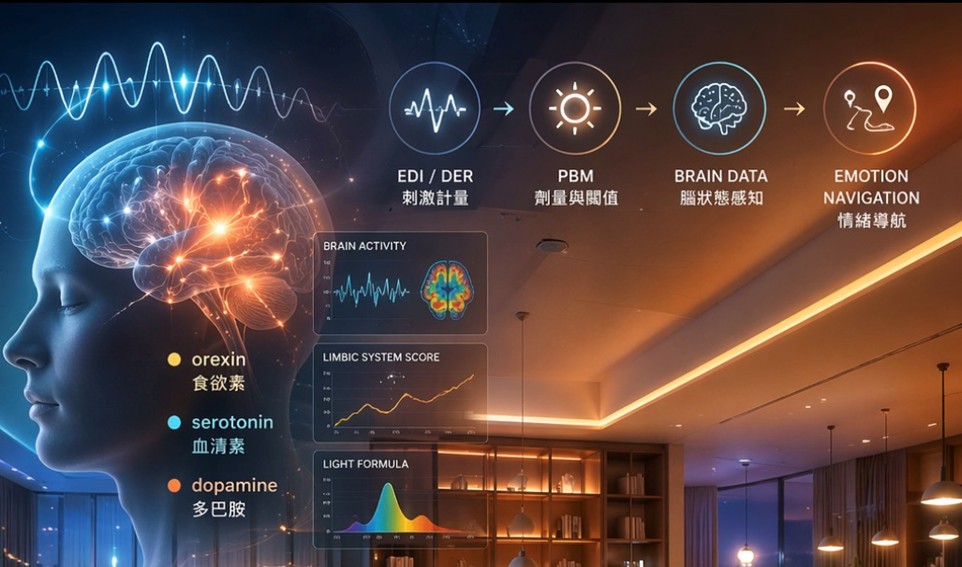
But healthy lighting requires a broader question: Does the right light, with the right spectrum, intensity, direction, and timing, enter the human eye and provide the appropriate biological signal?
This is where EDI / DER becomes important.
Einfach ausgedrückt:
EDI helps us understand the equivalent stimulus received by different biological light-response channels.
DER helps us understand how efficient a light source is in stimulating those channels compared with a reference source.
But healthy light cannot be reduced to one number.
In particular, melanopic EDI is useful for understanding circadian lighting, daytime alertness support, and lower nighttime biological disruption.
The same luminaire may produce very different human effects depending on: Space, position, viewing direction, time of day, activity, duration of exposure, and the person using the space.
Therefore, the next generation of profile should not contain only photometric data.
It should include:
EDI / DER
Spectral data
Spatial model
Eye-position model
Time model
Activity model
Human-factor model
Only then can healthy lighting move from a marketing claim to a system that can be designed, calculated, verified, and improved.
3. The Real Meaning of an Upgraded IES Profile: From Luminaire Data to Human Light Exposure Data
If a future upgraded IES profile can integrate EDI / DER, spatial models, and human-factor models, it will no longer be just a luminaire data file.
It will become a new foundation data structure for the industry.
A traditional profile says: How does this luminaire emit light?
An upgraded profile begins to ask: Can this luminaire, in this space, at this time, for this activity and this user, deliver the right light exposure?
This is a critical shift.
It means the core object of evaluation in lighting is moving: From luminaire performance, to spatial delivery, to actual human exposure.
This will redefine the roles of lighting designers, software companies, and measurement instrument companies.
4. For Lighting Designers: From Creating Beautiful Light to Delivering Verifiable Good Light
Lighting designers will be among the most important players in this transformation.
Traditionally, the value of an excellent lighting designer has been expressed through: Aesthetics, atmosphere, hierarchy, glare control, material expression, emotional tone, and compliance with illuminance levels.
These remain essential.
But in the future, the professional value of designers will be expanded.
Clients will increasingly ask:
Does this office truly support daytime focus?
Does this hotel room support nighttime relaxation?
Does this classroom provide sufficient daytime light exposure?
Does this senior-care environment support circadian stability?
Does this home reduce unnecessary biological stimulation before sleep?
These questions cannot be answered by aesthetics alone.
They cannot be answered by CCT alone.
Designers will need new tools to say: I am not only designing the visual effect of light. I am designing the quality of human light exposure.
New roles for designers
Future lighting designers may become:
Healthy lighting environment strategists
Human light exposure designers
Human-centric lighting consultants
Scene-based light recipe designers
Verification-oriented lighting system integrators
This expands the service boundary of lighting design.
New business value for designers
An upgraded IES profile may create new professional service opportunities:
Healthy lighting strategy consulting
EDI / DER simulation design
Circadian lighting scene design
Sleep-friendly residential lighting design
WELL / healthy building alignment services
Post-installation commissioning
Annual re-measurement and optimization services
This means designers are no longer only selling drawings or design schemes.
They can sell: Verifiable healthy lighting outcomes.
That is an important transition from aesthetic service to evidence-based professional service.
5. For Software Companies: From Illuminance Calculation Tools to Healthy Lighting Simulation Platforms
Software companies may be one of the biggest beneficiaries of this shift.
All new data models need software to carry them.
Traditional design software mainly calculates: Illuminance, uniformity, glare, light distribution, energy use, and basic scene effects.
But if an upgraded IES profile can include EDI / DER, spectrum, space, human factors, and time, software can evolve from a lighting calculation tool into: A healthy lighting environment simulation platform.
This is a major commercial upgrade.
New capabilities for software companies
EDI / DER simulation
Designers could directly see melanopic EDI at different seats, different eye positions, and different viewing directions.
Human-eye-view modeling
Instead of only simulating working planes, software could model seated eye height, standing eye height, elderly users, children, hospital beds, reading positions, and screen-work positions.
Time-based simulation
Healthy lighting is not a static rendering. It changes across morning, daytime, evening, nighttime, and late night. Software should simulate 24-hour light patterns, daylight plus electric light, automatic dimming strategies, pre-sleep low-disruption scenes, and shift-worker exposure strategies.
Activity-based simulation
A living room may support reading, watching TV, family interaction, evening relaxation, pre-sleep preparation, and morning activation. Software that connects activity models with light exposure will become far more valuable.
Verification loop
Future software should not stop at design-stage simulation. It should receive on-site measurement data and compare:
Design value vs measured value
Simulation value vs verification value
Initial condition vs operational condition
Ideal light environment vs actual light environment
This turns software from a design tool into a data platform for design, construction, verification, and operation.
New business value for software companies
This can create new revenue models:
Healthy lighting modules
EDI / DER calculation engines
WELL reporting and compliance tools
Human-factor simulation packages
Cloud-based light environment data services
Design–verification–operation platforms
API integration with sensors, controls, and measurement instruments
Software companies will no longer only sell design tools.
They may become the core data layer of healthy buildings and intelligent spaces.
6. For Measurement Instrument Companies: From Light Meters to Verification Infrastructure for Healthy Lighting
Measurement instrument companies will also face major opportunities.
If healthy lighting is to become verifiable, on-site measurement is essential.
Without measurement, there is no verification.
Without verification, there is no trust.
Without trust, there is no high-value healthy lighting market.
Traditionally, measurement instruments have focused on: Lux, CCT, CRI, chromaticity, flicker, spectrum, and luminous flux.
But the future question is not only whether a luminaire performs well. It is: Does the person in the space actually receive the right light?
New roles for measurement instrument companies
Measurement instrument companies may become:
Healthy lighting verification tool providers
On-site EDI / DER measurement gateways
Spatial light exposure data collectors
WELL / healthy building verification supporters
Field calibration partners for design software and control systems
Long-term monitoring sensor providers
This role is critical because all design models must eventually return to the real site.
New capabilities needed
Measure EDI / DER, not only lux
Instruments must calculate α-opic metrics, including melanopic EDI, from spectral data.
Measure spatial distribution, not only a single point
Healthy lighting requires data from different seats, eye positions, viewing directions, user postures, and time periods.
Measure accumulated exposure, not only an instant reading
Light has a time dimension. Too little daytime light and too much nighttime stimulation are both problems. Instruments and sensors should support exposure start time, accumulated exposure, daily light curves, 24-hour light environment records, and long-term operational stability.
Measure temporal light quality, not only spectrum
Flicker may be a luminaire problem, a control problem, a dimming problem, a spatial interaction problem, or a scene-transition problem. Future verification should consider spectrum, biological exposure, flicker risk, dimming stability, dynamic scenes, and long-term temporal quality.
New business value for measurement instrument companies
Practical opportunities may include:
Professional EDI / DER meters
WELL Light verification tools
Healthy residential lighting inspection kits
School / office / healthcare / senior-care testing packages
On-site commissioning tools for designers
Cloud-based report generation
Annual re-measurement and calibration services
Long-term monitoring modules connected to control systems
Healthy light inspection services for building owners
In the future, measurement instrument companies may not just sell devices.
They may sell: The trust infrastructure of healthy lighting.
7. A New Triangle: Designers, Software Companies, and Measurement Instrument Companies
In the traditional lighting industry, these three roles were relatively separate.
In the healthy lighting era, the three will become tightly connected.
A future closed-loop workflow may look like this:
Step 1: Designers define the healthy lighting strategy
For example: daytime activation, nighttime protection, sleep-friendly lighting, office performance, or circadian support for senior care.
Step 2: Software simulates EDI / DER + spatial + human-factor exposure
Design-stage prediction becomes more human-centered.
Step 3: Luminaires and control systems deliver targeted scenes
The system no longer delivers only power or illuminance, but targeted light exposure.
Step 4: Measurement instruments verify the real site
Measured EDI / DER, flicker, and spatial distribution confirm whether the design intent is achieved.
Step 5: Software compares measured values with design values
Models are calibrated, and deviations are corrected.
Step 6: Designers and building owners receive traceable reports
Healthy lighting becomes a verifiable deliverable, not just a promise.
Once this loop is established, healthy lighting gains a real foundation for industrialization.
8. The Biggest Business Shift: From Selling Products to Selling Verifiable Outcomes
The commercial meaning of an upgraded IES profile is clear: It allows the lighting industry to move from product price competition to outcome value competition.
In the past, the market often compared:
Who has the cheaper luminaire?
Who has higher efficacy?
Who has a better-looking product?
Who has more attractive specifications?
In the future, the market can compare:
Who can deliver better daytime light exposure?
Who can reduce nighttime biological disruption?
Who can make schools, offices, hotels, and senior-care environments more verifiable?
Who can provide a complete data chain from design to construction, verification, and operation?
This shifts lighting from hardware supply to light environment services.
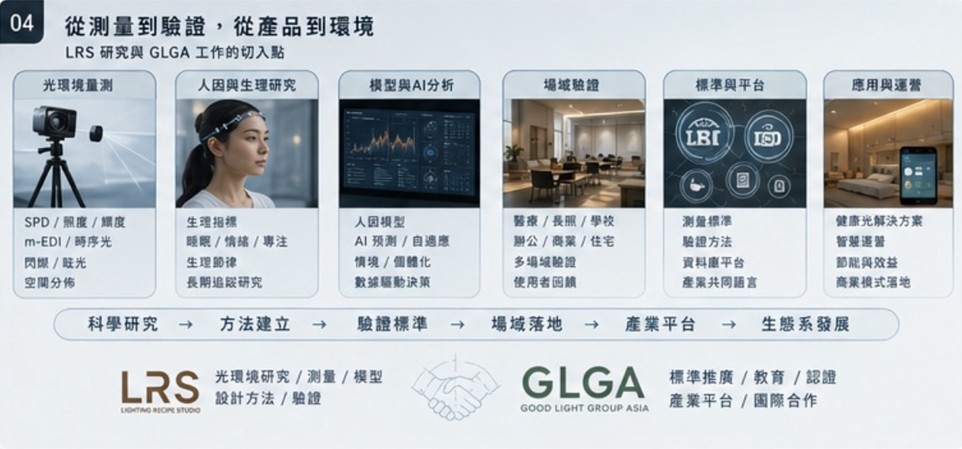
9. Strategic Meaning for GLGA / LRS
This direction is highly aligned with what GLGA and LRS are working to promote.
Good Light Wake-up Call is not about slogans. It is a call for the industry to recognize that good light must be designed, calculated, verified, and continuously improved.
The EDI / DER Working Group should not only discuss new metrics. Its deeper value is to connect LED makers, luminaire companies, design software providers, control systems, measurement instruments, and standards organizations around a shared data language.
In. Licht Ultra / Pro / Well can play a role not only as tools, but as field verification gateways within this future data chain.
deLIGHTED Talk Asia / GILE 2026 can become an important platform to bring this topic to the Asian and global lighting ecosystem.
Because this is not the product agenda of a single company.
It is a foundation question for whether the healthy lighting industry can truly become real.
10. Conclusion: Not Just Upgrading a File, But Upgrading the Logic of the Industry
An IES profile was originally the light distribution ID card of a luminaire.
But if it begins to include EDI / DER, spatial models, and human-factor models, it may become: The foundation data language of healthy lighting environments.
This means the lighting industry is beginning to change its core question.
In the past, we asked:
Is this luminaire bright enough?
Is this space bright enough?
In the future, we must ask: Does this person, in this space, at this time, for this activity, receive the right light?
That is the real starting point of healthy lighting.
The next generation of lighting competition will not only be about brighter luminaires, higher efficacy, or better appearance.
It will be about who can build a complete capability:
Designed by professionals.
Simulated by software.
Delivered by products and systems.
Measured on site.
Calibrated through data.
Understood by building owners.
That is how healthy lighting moves from concept to industry.
The meaning of an upgraded IES profile is not that it adds another data field.
It means the lighting industry is finally moving from: Describing light, to understanding people, space, time, and the human experience of light.
Every year on May 16, the International Day of Light is celebrated as part of an initiative led by UNESCO.
This day commemorates the first successful operation of the laser by Theodore Maiman in 1960. UNESCO established the International Day of Light not only to celebrate a scientific breakthrough, but also to remind the world that light influences science, medicine, energy, communications, art, education, and sustainable development.
But for the lighting industry, the International Day of Light carries another layer of meaning: Do we truly understand light?
For the past two decades, the language of lighting has been familiar: Brightness, wattage, energy efficiency, color temperature, CRI.
These parameters remain important. But today, we understand something more fundamental:
Light is not only about visibility. Light influences human circadian rhythms, emotions, attention, sleep, and health.
From “Illuminating Space” to “Serving People”
LED technology has transformed the lighting industry.
It has made light more efficient, controllable, compact, and scalable—ushering in an unprecedented era of applications.
But with this progress comes a critical gap:
We can produce more light, but that does not mean we understand light better.
At the same 500 lux level, one space may feel alert, comfortable, and safe—while another feels harsh, fatiguing, or even disruptive to sleep.
The difference is not simply illuminance.
It lies in a combination of factors such as: the spectral distribution of light, flicker, color quality, melanopic stimulation, circadian signaling, spatial distribution, timing of exposure, and the actual human activity taking place.
Mit anderen Worten: Light must be understood again—within the context of people, space, time, and activity.
In. Licht: From Perception to Measurement
This is the reason Lighting Recipe Studio (LRS) developed the In. Licht series.
We are not simply building a light meter.
We aim to establish a new way of understanding light environments: A system where light can be seen, measured, verified, and optimized.
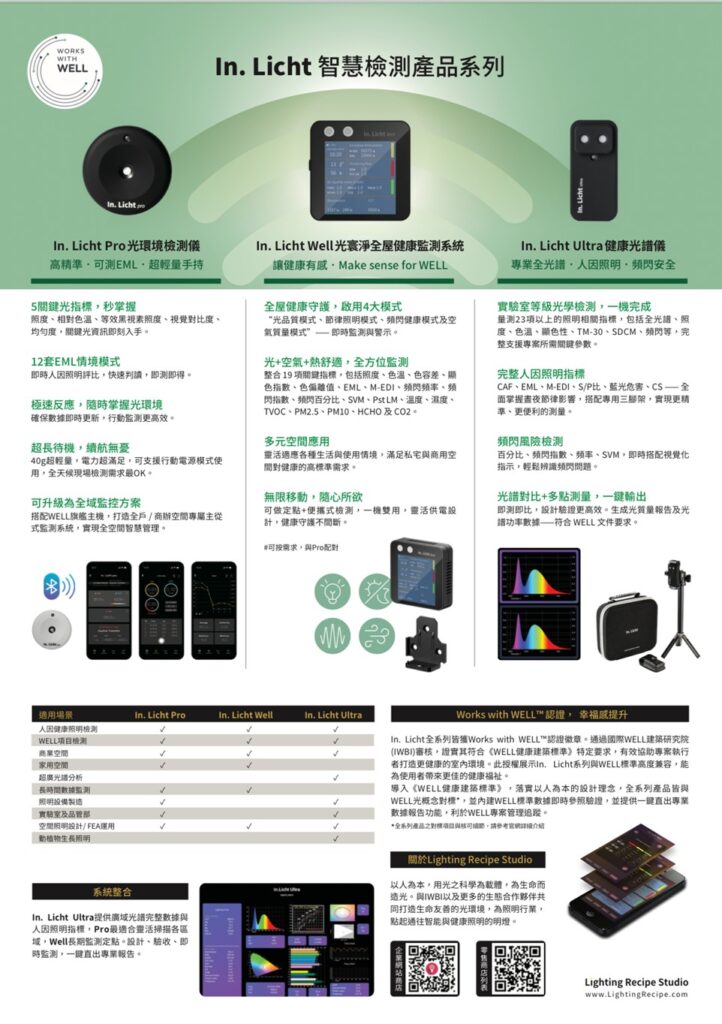
In. Licht Ultra
In. Licht Ultra can measure a wide range of professional lighting parameters, including spectral power distribution (SPD), TM-30, CRI, DUV, SDCM, flicker, EML, M-EDI, CAF, and S/P Ratio — making it a portable “mobile optical laboratory” that can be used anytime, anywhere.
In. Licht Pro
In. Licht Pro is designed in a compact and portable form, helping designers, engineers, and space users quickly understand key lighting environment metrics such as illuminance, color temperature, EML, contrast, and uniformity.
In. Licht Well
In. Licht Well takes this a step further by integrating lighting conditions, flicker, air quality, and thermal comfort into a unified healthy space monitoring system, supporting real-time sensing of 19 key environmental parameters.
But without measurement, verification, and traceability, these statements remain subjective—and easily reduced to marketing language.
Truly good lighting should be able to answer more precise questions:
Does it provide adequate circadian stimulation during the day? Does it avoid disrupting sleep at night? Is flicker controlled within safe limits? Is color rendering natural and accurate? Are illuminance, uniformity, and contrast appropriate for the space? Are human activities properly considered? Can lighting adapt across time and context?
This is why international standards such as WELL increasingly define light as a core component of healthy buildings.
In. Licht Ultra and In. Licht Well are also recognized under relevant IWBI “Works with WELL” frameworks, supporting validated human-centric lighting assessment and environmental monitoring.
International Day of Light: A Reminder to the Industry
International Day of Light reminds the world that:
Light is science. Light is technology. Light is civilization. Light is also the foundation of human quality of life.
But for today’s lighting industry, it is also a reminder:
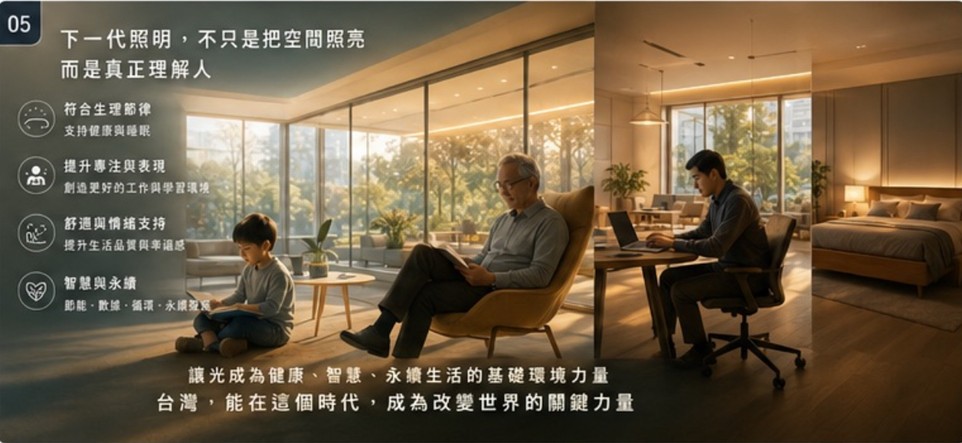
We must not only make light brighter. We must not only make light more efficient. We must make light more human.
From energy-efficient lighting to smart lighting, and now to human-centric lighting—the next evolution of the industry is not only technological.
It is cognitive.
A shift in how we understand light itself.
Re-Understanding Light with In. Licht
Light is never just brightness.
It is the foundation of vision, a signal for biological rhythm, the atmosphere of space, and a component of human health.
What In. Licht aims to do is not simply measure data.
It is to help designers, manufacturers, developers, researchers, and users build a new capability:
To understand light through data, to design light through science, and to deliver light through verification.
On this International Day of Light, we ask a simple but essential question:
Do we truly understand light?
Perhaps the answer begins with the willingness to re-measure the first beam of light—properly, scientifically, and meaningfully.
Beleuchtungsrezept Studio Wir erschaffen Licht für das Leben
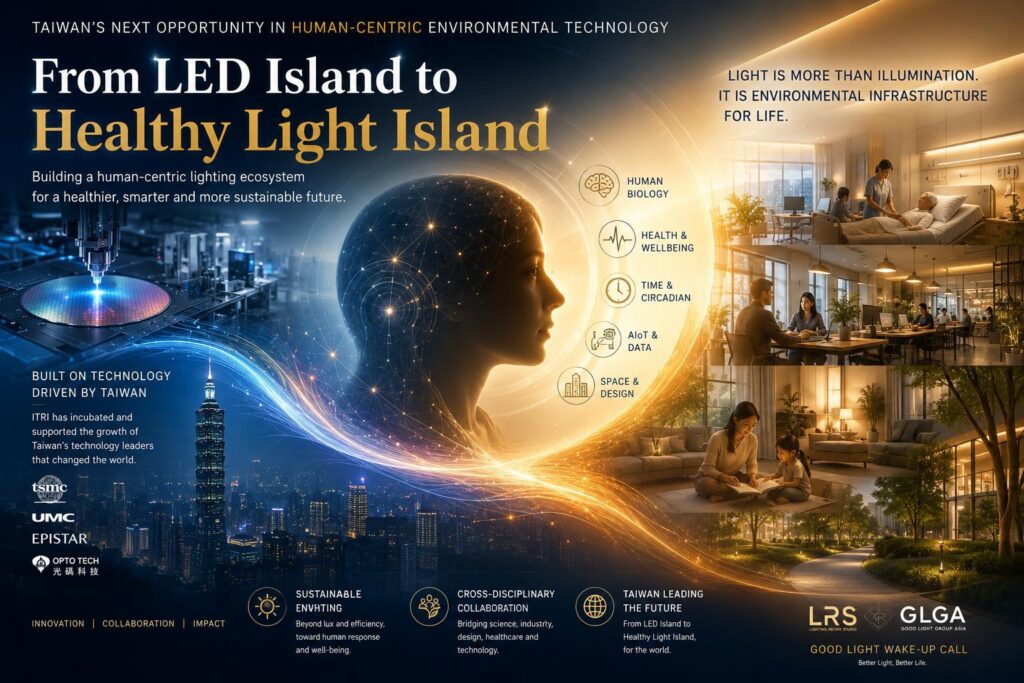
Taiwan’s Next Opportunity in Human-centric Environmental Technology
By Lawrence Lin
Taiwan has long been one of the world’s most important technology manufacturing bases.
From semiconductors to displays, from LEDs to ICT, Taiwan built an extraordinary industrial ecosystem based on engineering excellence, manufacturing discipline, and supply-chain integration.
Behind much of this transformation, ITRI (Industrial Technology Research Institute) played a foundational role.
Over the past decades, ITRI not only advanced core technologies in optoelectronics, semiconductors, displays, and lighting, but also helped incubate or support the growth of some of Taiwan’s most influential technology companies, including:
TSMC
UMC
Epistar
Opto Tech
This history matters. Because Taiwan’s next opportunity may once again emerge from the intersection of technology, manufacturing, and societal transformation.
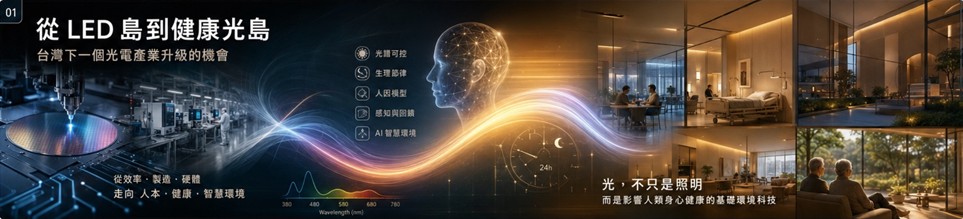
But this time, the opportunity may not simply be about chips, displays, or energy efficiency. It may be about something far more human: Light as environmental infrastructure for health, wellbeing, cognition, and quality of life.
The Industry Is Changing
For the past twenty years, the lighting industry largely competed on:
Efficiency
Cost
Reliability
Scale
But the next phase is fundamentally different. The central question is no longer only: “How efficiently can we generate light?”
The real question is becoming: “How should light interact with human biology, behavior, emotion, and time?”
This is where lighting converges with:
Neuroscience
Circadian biology
Healthcare
AIoT
Smart buildings
Environmental data science
And Taiwan is uniquely positioned to participate in this transition.
Taiwan Already Has the Foundations
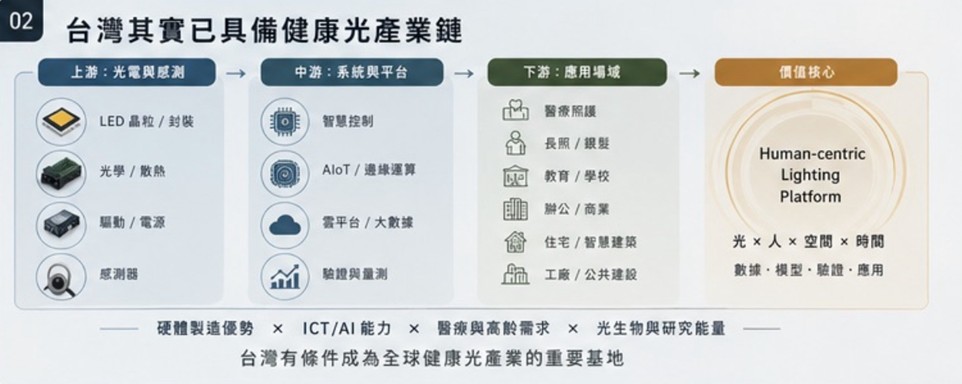
Taiwan today possesses nearly all the key building blocks required for a future healthy-light ecosystem.
1. Strong Optoelectronics & LED Infrastructure
Taiwan has decades of experience in:
LED chips
Packaging
Drivers
Optical systems
Sensors
Displays
Micro LED
Embedded electronics
This remains a major strategic advantage.
2. World-class ICT & AIoT Capabilities
Healthy lighting is no longer just about luminaires. It increasingly depends on:
Sensors
Edge computing
Cloud platforms
AI-driven adaptation
Building integration
Long-term environmental monitoring
In many ways, healthy lighting is becoming a branch of: Environmental intelligence.
3. Healthcare & Aging Society Needs
Taiwan is entering a super-aged society. This creates growing demand for solutions related to:
Sleep quality
Cognitive performance
Mental wellbeing
Long-term care
Circadian support
Shift-work adaptation
Light is gradually evolving from a decorative or energy-saving product into: A health-supportive environmental system.
4. Scientific & Clinical Research Capability
Taiwan also possesses strong academic and medical research resources, including:
ITRI
Academia Sinica
National Taiwan University
Yang Ming Chiao Tung University
Major medical centers and hospitals
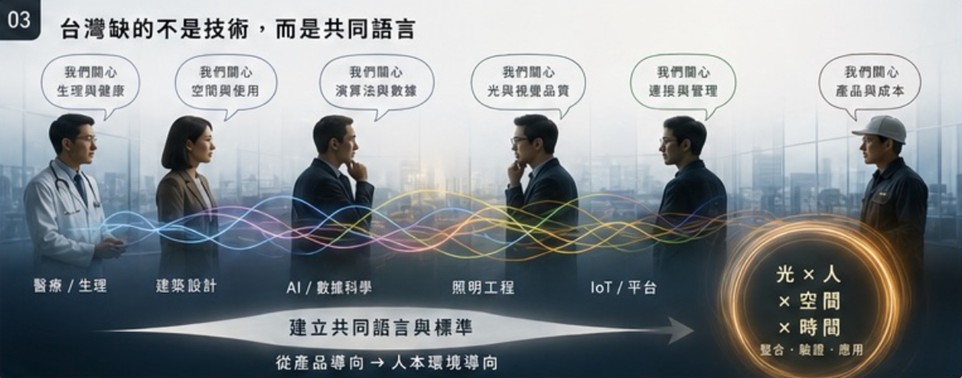
The challenge is not the lack of technology. The challenge is integration.
Taiwan’s Biggest Gap Is Not Technology
It Is a Shared Language
Today, much of the lighting industry still speaks in the language of:
CCT
CRI
Lux
Efficiency
Smart controls
But globally, the conversation is rapidly shifting toward:
melanopic EDI
alpha-opic metrics
circadian stimulus
temporal light
spatial light distribution
human response modeling
In other words: The industry is moving from “lighting products” toward “human environmental systems.”
This requires an entirely new interdisciplinary framework connecting:
Lighting
Architecture
Neuroscience
Healthcare
AI
IoT
Environmental psychology
And this is precisely where Taiwan has an opportunity to lead.
From Product Manufacturing to Human-centric Platforms
I believe Taiwan’s next strategic opportunity is not simply building better lamps.
It is building:
Verifiable Human-centric Environmental Platforms
This includes:
Measurement & Verification
Not only measuring lux, but also:
SPD
melanopic EDI
flicker
glare
spatial distribution
temporal exposure
biological light dose
Environmental Data Infrastructure
Building long-term datasets across:
Offices
Schools
Hospitals
Senior care
Residential spaces
Hospitality
Smart cities
Adaptive AI-driven Lighting Systems
Future lighting systems should not remain static.
They should:
Sense people
Understand context
Adapt dynamically
Learn continuously
Moving from: “Smart lighting” to: Adaptive human-centric environments.
The Opportunity for Taiwan
Taiwan once became globally important through:
PCs
Semiconductors
LEDs
Displays
The next opportunity may not simply be another hardware revolution. It may be:
Human-centric Environmental Technology
And light may become one of the most important — yet underestimated — foundations of this transition. Because humans spend nearly 90% of their lives indoors. And light remains the only environmental factor capable of directly influencing:
Vision
Circadian biology
Emotion
Alertness
Sleep
Human perception of time and space
Taiwan already has many of the required capabilities. The next step is no longer just manufacturing.
The next step is creating: A measurable, verifiable, adaptive, and human-centered environmental ecosystem.
This is also why organizations such as GLGA (Good Light Group Asia), together with global initiatives like the Good Light Wake-up Call, are trying to help build bridges between:
Science
Standards
Industry
Gestaltung
Healthcare
Architecture
Technology platforms
Because the future of lighting is no longer only about illumination. It is about understanding people.
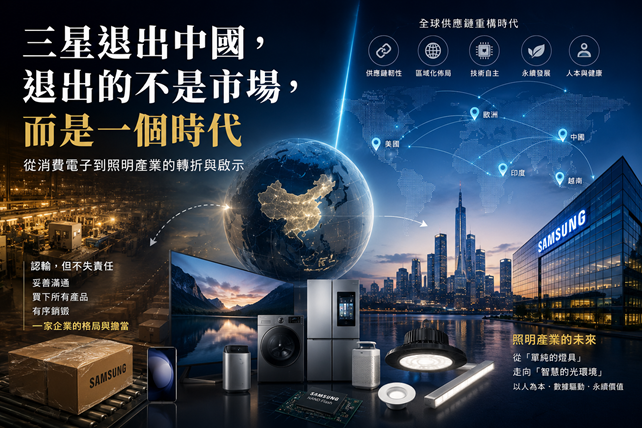
Recently, Samsung Electronics announced that it would discontinue sales of certain consumer electronics products in mainland China.
Many headlines quickly framed this as: “Samsung exits China.”
But that interpretation is overly simplistic.
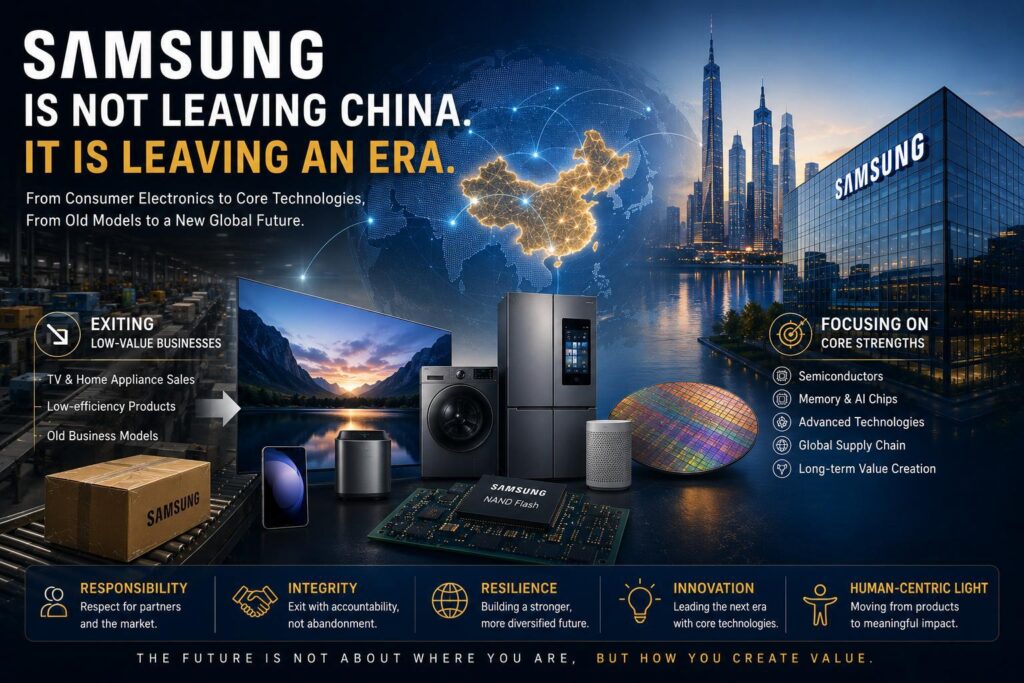
What Samsung is actually doing is far more important: It is transitioning from a “China-centered manufacturing model” toward a globally diversified supply-chain strategy.
And behind this decision lies a much bigger shift — one affecting not only Samsung, but also global manufacturing, consumer electronics, semiconductors, and even the lighting industry.
1. Is Samsung Really Leaving China?
Not really. Samsung is not withdrawing entirely from China.
What it is reducing or exiting includes:
Certain TV and home appliance sales businesses
Low-efficiency consumer electronics segments
Manufacturing models heavily dependent on China
But Samsung still maintains:
Smartphone and component sales in China
Semiconductor and memory operations
Its Xi’an NAND Flash facility
Partnerships with Chinese brands
Chinese supply-chain procurement networks
Mit anderen Worten:
Samsung is not exiting China. It is exiting business models that no longer provide strategic competitiveness.
Those are two very different things.
2. What Samsung Is Really Abandoning
What Samsung is truly walking away from is:
The old foreign-brand advantage in China’s mature consumer electronics market
For nearly two decades:
Korean brands
Japanese brands
Western brands
benefited from:
Technological leadership
Brand premium
Quality perception
Global scale
inside China.
But China has fundamentally changed.
3. China Is No Longer an “Emerging Market”
It is now a hyper-competitive ecosystem. Samsung smartphones were once No.1 in China.
Then came:
Huawei
Xiaomi
OPPO
vivo
Honor
The issue was not that Samsung suddenly lost its technology edge.
The deeper issue was this:
Chinese companies became extraordinarily strong in supply chains, cost structure, distribution, speed, localization, and product iteration.
This was the turning point. China is no longer simply “the world’s factory.”
It has become:
A platform integrator
An ecosystem builder
A scenario creator
A global supply-chain organizer
And that is why many international brands — despite still having strong technologies — struggle to maintain leadership in China’s mainstream markets.
4. The Lighting Industry Has Already Experienced This
The lighting industry went through a very similar transition years ago.
Brands such as:
GE Lighting
OSRAM Lighting
PHILIPS Lighting
Zumtobel Lighting
Cooper Lighting
once held strong brand and technology advantages in China.
But Chinese lighting companies rapidly built strength in:
Manufacturing efficiency
Supply-chain density
ODM/OEM execution
Distribution penetration
Delivery speed
Engineering responsiveness
Meanwhile, companies like Signify (formerly Philips Lighting) chose to continue investing in China — but under a completely different competitive model.
Today, competition is no longer mainly about:
Efficacy
CRI
Brand
Instead, it is increasingly about:
System capability
Controls
Software integration
Data
AI
Human-centric applications
Spatial intelligence
5. A Personal Story About Samsung
I have always carried a deep impression of Samsung from one particular experience.
Years ago, during my collaboration with MLS, we were manufacturing lighting products for Samsung’s LED division. At that time, even before the first shipment was officially delivered, Samsung suddenly decided: To exit the finished lighting products business.
Internally, it was certainly a shock.
Because it meant:
Development costs
Supply-chain planning
Production schedules
Market preparation
all had to be restructured.
But what impressed me most was not the exit itself. It was the way Samsung handled it.
They did not:
Avoid responsibility
Delay communication
Push risks downstream to suppliers
Instead:
They communicated formally and responsibly with partners, purchased all completed products, and then—systematically destroyed them.
That experience left a deep impact on me. Because for the first time, I truly understood:
A global company can admit defeat, but still refuse to leave irresponsibly.
Many companies talk about “corporate culture.” But real corporate culture often becomes most visible during retreat, failure, or exit.
That experience taught me something I still remember today:
You can lose.
You can withdraw.
But you should never leave irresponsibly.
And I believe this is something many rapidly expanding companies today should seriously reflect upon.
6. Samsung’s Real Concern Is Not China
It is:
Geopolitics and supply-chain resilience
Samsung’s most critical businesses today are:
Semiconductors
AI memory
Advanced chips
Packaging technologies
Displays
All of which are deeply entangled in:
US–China technology competition
Semiconductor controls
AI infrastructure competition
Global supply-chain security
This is why Samsung has been:
Expanding Vietnam
Expanding India
Investing in the United States
Diversifying manufacturing footprints
This is not simply “de-Chinaization.”
It is: A strategy to build a more resilient global supply chain.
7. What Does This Mean for Taiwan?
For Taiwan, this trend is both a warning and an opportunity.
Warning
If companies continue relying mainly on:
OEM models
Manufacturing efficiency
Cost advantages
while lacking:
Platform capability
Standards leadership
System integration
AI and data capability
Scenario definition capability
they may eventually face the same structural pressure. This is already happening in LED and lighting.
Opportunity
At the same time, the world is increasingly searching for:
Supply chains outside China
High-trust technology partners
Higher-value integrated solutions
This creates opportunities for Taiwan in areas such as:
AIoT
Health technology
Sensing
Photonics integration
Smart controls
Precision manufacturing
Advanced semiconductors
Especially in the integration of: human factors + data + spatial intelligence
Taiwan still has enormous potential to differentiate itself.
8. What the Lighting Industry Should Really Learn
The biggest lesson Samsung offers the lighting industry is this:
The era of “just making lamps” is ending. The future value of lighting will not come only from hardware.
It will come from the ability to create lighting environments that are:
Verifiable
Measurable
Adaptive
Continuously optimized
Competition is shifting from:
Produktspezifikationen
toward:
Human-factor models
Spatial models
Sensors
AI
Data
Controls
Long-term operational validation
Because the market no longer simply needs spaces to be illuminated.
It needs light that genuinely supports: human biology, psychology, behavior, and wellbeing.
9. Final Thoughts: Samsung Is Not Leaving China — It Is Leaving an Era
If we reduce this story to: “Samsung failed in China,”
we miss the bigger picture.
What Samsung is really acknowledging is: The globalization model of the past 30 years is ending.
The old world optimized for:
Lowest cost
Centralized manufacturing
Maximum scale efficiency
The new world optimizes for:
Supply-chain resilience
Regional diversification
AI and data capability
System integration
Platform capability
Human-centric value creation
And this transformation is not happening only to Samsung.
It is happening across:
Semiconductors
Consumer electronics
Automotive
Buildings
Lighting
Health technology
and the entire global industrial landscape.
From that perspective:
Samsung is not exiting China.It is exiting the old era in which brand, scale, and globalization alone were enough to guarantee success.
We've detected you might be speaking a different language. Do you want to change to:


 English
  Chinese (Taiwan)
  Chinese (China)
  German