As lighting becomes more connected, automated, and intelligent, the industry must not lose sight of its deeper mission: creating healthier, more meaningful, and more valuable human environments.
When technology moves fast, purpose must move even faster.
Light + Building 2026 has ended, but one question remains:
As our industry becomes more electrified, more connected, more automated, and more intelligent — are we still clear about what all of this is for?
According to Messe Frankfurt’s official final report, the 2026 edition brought together 1,927 exhibitors from 49 countries and 144,767 visitors from 143 countries, once again confirming the scale and global relevance of the fair. The official review highlighted the rapid advance of electrification, digital connectivity, AI-supported systems, multifunctional interfaces, and adaptive building technologies.
All of that matters.
But after walking the halls, attending meetings, speaking at Design Plaza, and listening to industry conversations across multiple layers of the value chain, I came away with a stronger conviction:
The lighting industry must be careful not to become more sophisticated in its tools while becoming less clear about its purpose.
1. Light + Building 2026 showed an industry rich in innovation
There is no doubt that the industry is advancing quickly.
This year’s fair made that very visible: connected systems, controls, sensors, AI-supported building management, integrated energy infrastructure, and increasingly responsive environments all pointed in the same direction — lighting is no longer operating as an isolated product category, but as part of a larger building intelligence ecosystem.
That shift is real, necessary, and strategically important.
We are clearly moving from standalone luminaires to integrated systems, from isolated devices to connected architecture, and from hardware performance to programmable, measurable, adaptive environments.
This is progress.
But progress alone is not a compass.
Because the essential question is not whether the industry can build smarter systems.
The essential question is: What kind of human value are those systems ultimately meant to create?
2. The danger is not lack of technology — it is loss of center
Our sector has become highly fluent in the language of systems:
connectivity, controls, automation, data, AI, interoperability, digital infrastructure, predictive maintenance, adaptive buildings.
These are powerful capabilities.
But they are still only capabilities.
If we are not careful, we risk describing the future of lighting mostly through its technical architecture, instead of through its human contribution.
That is where an industry can gradually lose its center.
Because light is not only technical.
Light influences vision, of course. But it also influences biology, mood, alertness, recovery, comfort, productivity, behavior, and emotional experience.
It shapes not only what we see, but also how we feel, how we function, and in many cases how we live.
So if lighting becomes merely another connected layer in the building stack, stripped of its human meaning, then even our most advanced systems may become strategically hollow.
3. This is why the HCL roadmap still matters
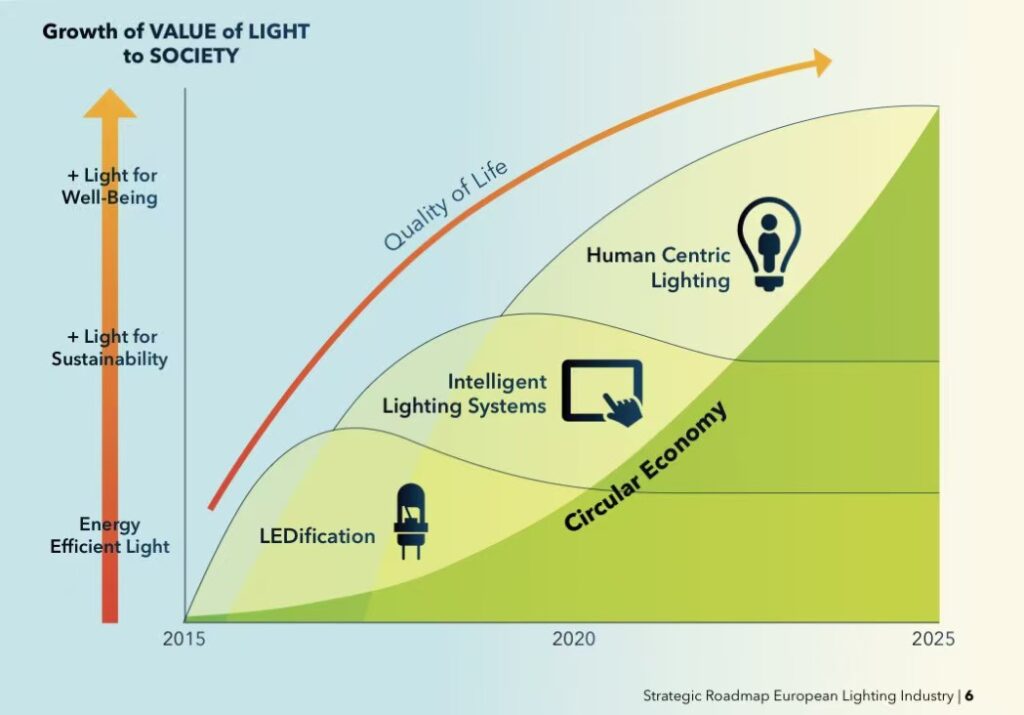
At this point, I believe it is worth returning to an industry direction that should never have been treated as secondary: the Human Centric Lighting roadmap.
LightingEurope’s own vision states it very clearly:
“The increased Value of Lighting will come from Intelligent Lighting Systems and Human Centric Lighting.”
That sentence deserves to be read carefully.
It does not say the future value of lighting will come from connectivity alone. It does not say it will come from controls alone. It does not say it will come from energy efficiency alone.
It says the increased value of lighting comes from two pillars together: Intelligent Lighting Systems and Human Centric Lighting.
That is a crucial distinction.
Because it reminds the entire industry that intelligence without human relevance is incomplete.
It is not enough for lighting to become smarter. It must also become more beneficial.
4. The broader GLA roadmap carries the same warning
The strategic roadmap associated with the global lighting industry reinforces the same point.
It explicitly calls on the industry to promote the fact that lighting does much more than enabling vision, and to make Human Centric Lighting part of the healthy building movement and building standards.
This is not just policy language.
It is a reminder of original intent.
The industry did not invest in better LEDs, optics, drivers, controls, measurement, connectivity, and software merely to create more layers of automation.
We did so because we believed lighting could become more valuable to life.
More supportive of health. More responsive to human rhythms. More meaningful in experience. More effective in work, education, hospitality, care, and recovery. More sustainable not only in energy terms, but in long-term value.
That is why I say this to the whole industry now:
Do not forget why we started.
We started because light matters to people.
5. Human Centric Lighting should not remain a niche
One of the industry’s persistent weaknesses is that HCL is still too often treated as a specialist topic, a premium concept, or a separate layer of innovation rather than a central direction for mainstream value creation.
That is no longer enough.
If intelligent systems are moving to the center of our market strategy, then human-centric purpose must move there too.
Not because every project needs a complicated theoretical framework.
But because the principle itself is simple: Technology should improve human outcomes.
This means the next phase of lighting should not only ask: Can it be connected? Can it be controlled? Can it be measured? Can it be monetized?
It must also ask: Does it support healthier rhythms? Does it improve comfort? Does it reduce stress? Does it support performance? Does it improve emotional quality? Does it make the space more humane? Does it increase long-term value rather than short-term novelty?
These are not soft questions.
They are strategic questions.
And if the lighting industry does not answer them clearly, others will answer them for us.
6. The next chapter of lighting must move from systems to outcomes, and from outcomes to value
In my view, the industry’s next evolution should be understood in three steps:
From products to systems. This transition is already happening.
From systems to outcomes. This is where many companies are now competing.
From outcomes to human value. This is where the next real differentiation will happen.
And that human value, in my view, should be framed around four interlinked priorities:
Sustainability. Health. Productivity. Emotional value.
Not one instead of the others.
Not one trend this year and another next year.
All four.
Because real people do not experience buildings in isolated technical categories.
They experience them as living conditions.
And light is one of the most powerful conditions of all.
7. ‘Do not forget the original aspiration’ is not a call backward — it is a call upward
To remind the industry of its human-centered purpose is not to reject innovation.
It is the opposite.
I am not arguing against electrification. Not against digitalisation. Not against AI. Not against integrated building systems.
All of these are necessary.
But they must be re-anchored in purpose.
The point is not to slow down technology.
The point is to elevate its meaning.
Because the next frontier is not simply smarter lighting.
It is more valuable lighting.
Valuable because it supports better sleep and better wakefulness. Valuable because it improves visual, biological, and emotional conditions. Valuable because it enhances comfort, performance, and human experience. Valuable because it fits into circular, adaptable, serviceable long-life systems. Valuable because it makes buildings not just intelligent, but worth inhabiting.
That is where HCL, intelligent lighting systems, measurement, controls, and sustainability can converge.
Not as separate agendas.
But as one larger industrial mission.
8. What Light + Building 2026 should remind us
Light + Building 2026 demonstrated that our sector remains innovative, capable, and globally relevant. Messe Frankfurt’s review makes that abundantly clear.
But beyond the scale and innovation, the fair also leaves us with a more important reminder:
An industry can become very advanced in its tools and still fall short in articulating its higher purpose.
That is why the HCL roadmap still matters.
That is why the GLA perspective still matters.
That is why the human value of light must not be treated as a side discussion.
And that is why this message matters now:
Do not let electrification become the ceiling of imagination. Do not let connectivity replace purpose. Do not let intelligence drift away from humanity. Do not forget why we started.
We started because light is not only technical. It is biological. It is emotional. It is spatial. It is cultural. It is human.
And for LRS, that remains the core belief:
Good light should not only be smarter. It should be more purposeful, more human, and more valuable to life.
Source note
Official Light + Building 2026 final report from Messe Frankfurt; official LightingEurope “Our Vision” page referencing the industry strategic roadmap; and the GLA strategic roadmap language on promoting lighting beyond vision and embedding human centric lighting within healthy buildings and standards.
LRS Editorial / Lawrence Lin
照明配方工作室
 English
  Chinese (Taiwan)
  Chinese (China)
  German