White Light Is More Than CCT: IES Is Bringing Spectrum Back to the Heart of Lighting — The Foundational Logic of Next-Generation Good Light from the IES Light for Life® Virtual Symposium 2026
When we talk about lighting, we often rely on a familiar set of terms:
- Illuminance.
- Correlated Color Temperature (CCT).
- Color Rendering Index (CRI).
- Luminous efficacy.
- Energy efficiency.
- Visual comfort.
These are, of course, all important.
But if we continue to understand light only through these metrics, they may no longer be sufficient.
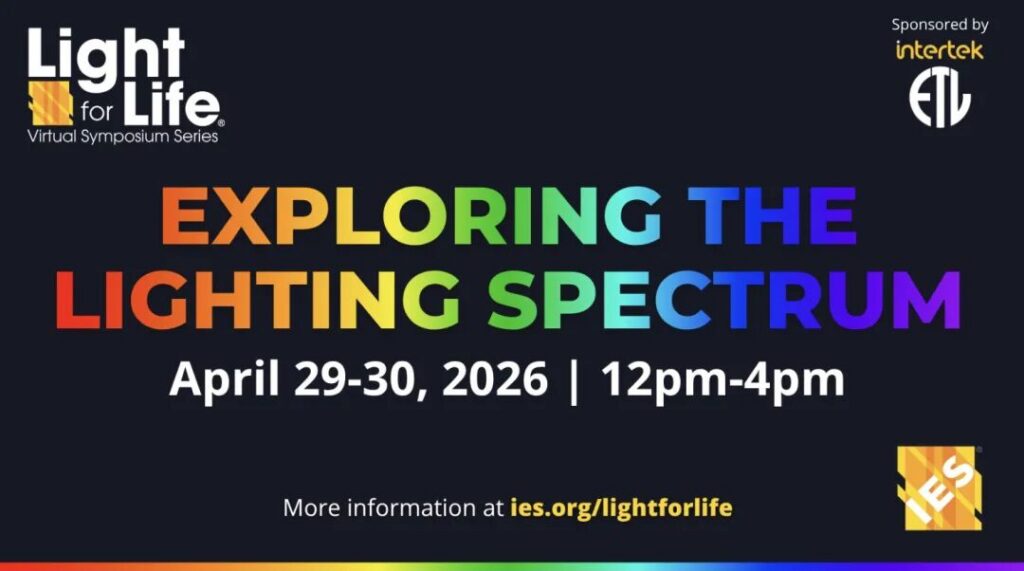
Recently, the IES Light for Life® Virtual Symposium 2026: Exploring the Lighting Spectrum dedicated two full days—more than eight hours of presentations—to a topic that has long been simplified, and in many cases underestimated, by the lighting industry: Spectrum.
The symposium explored topics ranging from ultraviolet radiation, visible light, the 380–440 nm spectral region, deep red light, and near-infrared radiation, to nighttime lighting, biological effects, museum conservation, sports lighting, spatial brightness, wearable light dosimeters, and color rendition. Together, these presentations reopened the conversation about the complexity behind what we simply call white light.
The message to the lighting industry was clear:
- White light is more than CCT.
- Lighting is more than lux.
- Healthy lighting is more than simply “cool white in the morning and warm white at night.”
What truly determines the value of a lighting environment is the complete spectral composition of light—and how that spectrum interacts with real spaces, real people, and real moments in time.
1. We’ve Been Thinking About “White Light” Too Simply
Over the past two decades, LEDs have transformed the lighting industry.
They have made lighting more energy-efficient, more compact, and more controllable. They have also enabled dimming, tunable white lighting, and intelligent control systems.
At the same time, however, LEDs have introduced an issue that is often overlooked.
In the pursuit of higher luminous efficacy, many electric light sources have been optimized to emit primarily the portions of the spectrum that contribute most effectively to human photopic vision—and therefore to lumens.
In other words, what we often obtain is white light that appears bright enough, but not necessarily white light with a complete spectral composition.
This was one of the key themes raised by Steve Paolini in his presentation, Revisiting Daylight: Spectral Gaps and Limitations in Electric Lighting.
Natural daylight is not simply a “5000 K white light curve.” It spans the full visible spectrum while extending into both the ultraviolet and near-infrared regions. Its spectral composition continuously changes with the time of day, geographic location, atmospheric conditions, cloud cover, and the seasons.
By comparison, the spectra of many electric light sources are noticeably narrower, more engineered, and optimized for specific performance objectives.
This raises a fundamental question:
When we say we are “replicating natural light,” what exactly are we trying to replicate?
Are we replicating a CCT value?
Or are we replicating the dynamic spectral composition of daylight?
Are we replicating the visual appearance of white light?
Or are we attempting to replicate the broader influence of natural daylight on vision, non-visual physiology, materials, architecture, and biological systems?
If all we do is tune a luminaire from 6500 K in the morning zu 2700 K in the evening, that may be only the most basic first step.
It does not mean that we truly understand daylight.
2. CCT Is Not Spectrum, and “Cool by Day, Warm by Night” Is Not the Whole Story of Healthy Lighting
Today, many so-called gesundes Licht oder circadian lighting solutions still rely on a relatively simple model:
- Cooler light in the morning.
- Brighter light during the day.
- Warmer light in the evening.
- Dimmer light before bedtime.
There is nothing inherently wrong with this approach.
But it is also easily reduced to a marketing message.
Because CCT is not the same as spectrum.
Two light sources with the same 4000 K CCT may have completely different spectral compositions—different amounts of blue, cyan, red, deep red, and melanopic content.
Likewise, two luminaires rated at 2700 K may produce very different biological effects, color rendition, perceived spatial brightness, material preservation characteristics, and levels of nighttime physiological stimulation.
This is precisely why the next generation of lighting cannot stop at CCT.
We need to return to what truly defines light: SPD (Spectral Power Distribution).
Because what determines how light affects people is not simply what color temperature it appears to have, but how energy is distributed across every wavelength—how those wavelengths enter the eye, interact with surfaces within a space, and change over time.
Only by understanding the full spectral power distribution can we begin to understand the true relationship between light, people, and the built environment.
3. 380–440 nm: Often Overlooked by Lux, Yet Potentially Far from Insignificant
One of the most thought-provoking presentations at the symposium was Katherine A. Gruner’s talk, The Narrow Band That Broadens Everything: 380–440 nm Across the Visible Spectrum.
Die 380–440 nm region lies at the boundary between violet light and near-ultraviolet radiation.
In conventional lighting practice, this portion of the spectrum has often been overlooked—and for a simple reason:
It contributes relatively little to lux.
Traditional illuminance measurements are based on the human photopic luminous efficiency function, V(λ), which is relatively insensitive to these shorter wavelengths. As a result, within an industry that has long prioritized luminous efficacy und lumen output, the 380–440 nm region has often been sacrificed in the pursuit of efficiency.
But the real question is this:
Human responses to light are not limited to photopic vision.
The human body possesses a far more sophisticated light-sensing system than cones and rods alone. In addition to the classical visual photoreceptors, we have melanopsin-containing intrinsically photosensitive retinal ganglion cells (ipRGCs) and other photobiological pathways involved in circadian regulation, metabolism, development, and physiological function.
This means that some wavelengths may contribute relatively little to lux, yet still carry significant biological relevance.
For the healthy lighting industry, this is an important reminder.
We should no longer ask only:
“Is this light bright enough?”
We must also ask:
“Is the spectrum complete?”
And perhaps even more importantly:
“When, at what intensity, and from what spatial direction does this spectrum reach the human eye?”
4. Lighting at Night: Not Something to Eliminate, but Something to Use with Greater Restraint
In his presentation, Light at Night and the Domino Effect: Why Spectrum Matters, Ron Gibbons shifted the discussion toward one of today’s most important lighting challenges: lighting at night.
Nighttime lighting is an essential part of modern society. Roads require safe illumination. Cities depend on visibility and wayfinding. People need to work, travel, and interact after dark. Transportation, industry, healthcare, security, and commerce all rely on nighttime lighting.
Yet light at night can also trigger a cascade of unintended consequences. It may disrupt human sleep and circadian rhythms. It may affect insects, birds, plants, and entire ecosystems. It can contribute to skyglow. And it can make our cities progressively brighter, while making the night progressively less natural.
The question, therefore, is not simply whether we should eliminate light at night.
The real questions are:
- When is light actually needed?
- Where is it needed?
- How much light is appropriate?
- What spectral composition should it have?
- Where should the light be directed?
- Is the light spilling beyond where it is needed?
- Does it really need to remain on throughout the entire night?
From this perspective, the future of nighttime lighting is not about technological spectacle—it is about restraint.
This is particularly true for urban landscape lighting, architectural façades, tourism lighting, roadways, commercial exteriors, and outdoor advertising.
The industry needs to move beyond the old mindset that brighter is better, bluer is more advanced, and more visually dramatic is inherently superior.
The lighting of the future should not be excessive. It should be purposeful, time-aware, spatially controlled, and spectrally managed.
Because truly good light is not light without limits. It is light designed with clear boundaries, the right timing, precise directionality, and thoughtful spectral control.
5. Spatial Brightness Is About More Than Illuminance
For lighting designers, one of the most valuable presentations came from Alp Durmuş, whose talk, Understanding Spectra-Driven Variability in Spatial Brightness, explored how spectral composition influences our perception of space.
His central message was both simple and profound:
Spatial brightness is not determined by illuminance alone. It is also influenced by the spectral power distribution (SPD) of light.
This insight is particularly important because what designers ultimately care about is rarely whether a desktop measures exactly 500 lux.
What truly matters is how a space feels to the people who experience it.
- Does it feel bright?
- Does it feel open and spacious?
- Does it feel fresh and uplifting?
- Or does it feel enclosed and gloomy?
- Does it promote alertness?
- Does it feel glaring?
- Or does it simply feel comfortable?
Traditional lighting design has long relied on horizontal illuminance calculations.
But that is not how people actually perceive a space.
The human visual system responds to the entire visual environment—walls, ceilings, vertical surfaces, reflected light, a wide field of view, and the way our eyes continuously adapt to changing luminance.
In other words, people experience spaces, not measurement grids.
This means the next generation of lighting design cannot rely solely on tables of horizontal illuminance.
We need to pay far greater attention to:
- Eye-level illuminance.
- Vertical illuminance.
- Spatial brightness.
- Spectral power distribution.
- Surface reflectance.
- Material characteristics.
- Visual adaptation.
- Melanopic-related metrics.
- And, ultimately, the real human experience within a space.
This is the direction in which healthy lighting is evolving.
It represents a shift from luminaire specifications to spatial models. And from illuminance calculations to human-centered models that better reflect how people actually perceive and respond to light.
6. Wearable Light Dosimeters: Healthy Lighting Is More Than a Beautiful Dashboard
In another presentation, Spectral Accuracy of Wearable Light Dosimeters, Alp Durmuş addressed one of the most practical challenges facing the implementation of healthy lighting.
Today, an increasing number of research projects and real-world applications are using wearable light dosimeters to measure an individual’s daily light exposure.
This is becoming increasingly important for studies of circadian rhythms, sleep, workplace wellbeing, healthcare environments, senior living, and educational facilities.
But there is a critical challenge.
Not all wearable light meters measure light in the same way.
Different devices can exhibit significantly different spectral responses.
Some perform reasonably well under broad-spectrum light but become inaccurate when measuring narrowband sources. Some are overly sensitive to certain wavelength regions. Some produce substantial errors under different lighting technologies.
Others may report metrics such as lux, CCT, melanopic EDI, or other circadian-related values, while the underlying spectral measurements are not sufficiently accurate.
This serves as a very practical reminder for the lighting industry.
Healthy lighting is not about building a beautiful app.
It is not about creating an attractive dashboard. And it is certainly not about displaying a handful of lighting metrics on a screen.
The real questions are:
- How accurate is the sensor?
- Has its spectral response been properly calibrated?
- Can it accurately measure narrowband light sources?
- How large are the measurement errors under different lighting conditions?
- Has it been evaluated using CIE spectral mismatch methodologies?
- Can it provide data that is reliable enough for scientific research, industry standards, WELL projects, and real-world validation?
If the measurement itself cannot be trusted, then every healthy lighting metric derived from it may be equally unreliable.
That is why the future of healthy lighting will not be defined by control systems alone. Its true competitive advantage will lie in measurement accuracy, scientific validation, and the ability to verify lighting performance with confidence.
7. Museum Lighting: One of the Most Demanding Applications of Spectral Control
In Scott Rosenfeld’s presentation, Selecting a Spectrum for Museum Applications… and What Matters More, the symposium highlighted one of the most rigorous real-world applications of spectral engineering: museum lighting.
Museum lighting presents a unique challenge.
Light must allow visitors to appreciate the beauty of an artifact. But the same light can also accelerate its deterioration.
Different wavelengths affect materials differently. Paper, textiles, pigments, photographs, wood, leather, and natural dyes all exhibit different levels of sensitivity to light exposure.
For this reason, museum lighting has never been simply about low illuminance and high CRI.
It requires balancing multiple considerations simultaneously:
- Color rendition.
- The visitor’s visual experience.
- Material degradation.
- Spectral risk.
- Illuminance levels.
- Exposure duration.
- Cumulative light dose.
- Scene control.
- The long-term preservation of the collection.
The advent of LED technology has, for the first time, given lighting professionals the ability to engineer spectral distributions with remarkable precision.
But the greater our ability to control the spectrum, the greater our responsibility to make informed decisions.
This illustrates an important point:
Spectrum is not merely an abstract scientific concept—it has direct consequences for real-world applications.
In museums, spectral design determines the balance between visual appreciation and long-term preservation.
The goal is not simply to reveal the artwork beautifully today, but to ensure that future generations will still be able to experience it tomorrow.
This is why museum lighting remains one of the most demanding—and most meaningful—applications of spectral control in the lighting profession.
8. Sports Lighting: Spectrum Also Shapes Performance
In his presentation, Sports and the Spectrum, Jim Sanfilippo demonstrated that spectral design is not only about health—it is also about performance.
In sports venues, lighting must do far more than illuminate the field.
It must help athletes quickly judge the speed, direction, depth, and position of a moving ball. It must provide spectators with a clear and engaging viewing experience. At the same time, it must meet the demanding requirements of television broadcasting, high-speed photography, slow-motion replay, and modern camera sensors.
Achieving this depends on much more than illuminance alone.
Key considerations include:
- Color rendition.
- Uniformity.
- Contrast.
- Flicker performance.
- Spectral power distribution.
- Correlated color temperature (CCT).
- The visual distinction between turf, uniforms, and equipment.
- Camera sensor response.
- High-speed image quality.
For fast-paced sports such as baseball, tennis, ice hockey, and football, lighting quality has a direct impact on athlete performance, spectator experience, and broadcast image quality.
The question, therefore, is no longer simply:
“Is the field bright enough?”
Instead, we should ask:
- Can athletes clearly perceive the action?
- Can cameras reproduce the scene accurately?
- Are slow-motion images stable and free from flicker?
- Are colors clearly distinguishable?
- Can moving objects be tracked easily by both the human eye and imaging systems?
Once again, the message is clear:
Spectrum is not only a health issue—it is a performance issue.
As lighting applications become increasingly human-centered and technology-driven, spectral engineering is becoming fundamental to how people see, perform, and experience the environments around them.
9. Will a Rose Be Red? It Depends on the Light You Give It
The title of Wendy Luedtke’s presentation, Will Roses Be Red? Spectral Considerations for the Look You Want, appears simple at first glance. In reality, it points to something fundamental about human vision and lighting design.
Why does a red rose appear red?
It is not because the rose independently “contains” red as an isolated property.
What we perceive as color is the result of a complex interaction between:
- The spectral power distribution of the light source.
- The spectral reflectance of the object.
- The human visual system.
- The surrounding environment.
- Visual adaptation processes.
The same rose can therefore appear vividly red under one light source, yet dull, brownish, or lifeless under another.
This has direct implications for a wide range of applications, including retail, hospitality, dining, residential environments, exhibition design, healthcare settings, photography, live streaming, fashion, and cosmetics.
Good lighting is not simply about making things brighter.
It is about enabling objects to reveal their true texture, color fidelity, and sense of vitality—as they are intended to be experienced.
In this sense, spectrum is not a technical detail in the background.
It is a defining factor in how we perceive reality itself.
10. The CCT Era Is Not Over, But the SPD Era Has Already Begun
The most important message emerging from the IES Light For Life® Virtual Symposium 2026 is a return to a fundamental truth:
Light is not a single value. Light is a complex spectral system.
For decades, the lighting industry has relied heavily on a small set of familiar metrics:
- CCT (Correlated Color Temperature)
- CRI (Color Rendering Index)
- Lux
- Luminous efficacy (lm/W)
These metrics remain useful. They are not obsolete.
But they are no longer sufficient.
The next generation of lighting requires a broader and more precise language—one that reflects the true physical and biological complexity of light:
- SPD (Spectral Power Distribution)
- m-EDI (melanopic Equivalent Daylight Illuminance)
- melanopic DER (Daylight Efficacy Ratio)
- α-opic metrics
- Spectral mismatch functions
- Spatial brightness models
- Material damage functions
- Biological action spectra
- Camera sensor response
- Personal light exposure measurement
- Field-based validation
- Time-integrated light dose models
Today, these terms may still sound specialized or technically dense.
But they are rapidly becoming the foundational vocabulary of:
- next-generation lighting design
- product engineering
- international standards development
- healthy building frameworks
- real-world environmental verification
In this sense, the industry is not abandoning its past metrics.
It is expanding beyond them.
CCT has not ended. But SPD has already begun to define what comes next.
11. Implications for the Chinese Lighting Industry
Die IES Light For Life® Virtual Symposium 2026 carries particularly practical implications for the Chinese lighting industry.
For many years, China’s lighting sector has excelled at manufacturing.
It has been able to:
- Drive down LED production costs.
- Accelerate fixture manufacturing cycles.
- Build highly integrated supply chains.
- Achieve world-leading delivery capability.
However, the next phase of competition will no longer be defined primarily by manufacturing efficiency.
It will increasingly be determined by deeper capabilities in:
- Understanding spectral science.
- Interpreting spatial lighting environments.
- Integrating human factors into design.
- Engaging with healthy building frameworks.
- Developing robust verification methods.
- Translating scientific knowledge into products and systems.
- Converting “good light” from a slogan into measurable, designable, deliverable, and verifiable solutions.
This shift has direct consequences for the entire value chain:
- Light source manufacturers can no longer compete on lm/W alone.
- Luminaire manufacturers cannot rely solely on parameter escalation.
- Control system providers cannot focus only on dimming and tuning.
- Sensor companies cannot depend on low-cost data acquisition alone.
- Design software platforms must move beyond lux-based simulations.
- Testing laboratories must expand beyond traditional photometric metrics.
- Lighting designers cannot rely solely on experience-based selection.
- Clients and building owners cannot evaluate solutions based only on cost and energy savings.
The future of meaningful lighting requires integration across five fundamental dimensions:
Light. People. Space. Time. Activity.
This integration marks the critical transition of healthy lighting:
From a product-centric concept
zu einer system-level value framework that can be measured, designed, validated, and delivered in real environments.
12. Good Light Must Be Verified
Looking back from the IES Light For Life® Virtual Symposium 2026, the direction aligns closely with what the Good Light Wake-up Call has been emphasizing:
Good light should not remain a descriptive phrase.
It should not function as a marketing label.
And it should certainly not be reduced to loosely defined claims such as “sun-like,” “eye-friendly,” or “circadian lighting” when these terms are used without rigorous definition.
Good light must return to science.
It must be:
- Describable
- Measurable
- Simulatable
- Designable
- Verifiable
- Continuously managed
This is why the industry shift being discussed is not incremental—it is structural.
From CCT to SPD.
From horizontal illuminance to eye-level light exposure.
From isolated products to system-level models combining space, people, time, and activity.
From experience-based judgment to data-driven validation.
Ultimately, lighting industry advancement is not just about adding smart controls or expanding color-tuning features.
It is about fundamentally reinterpreting what light does.
Light does not only illuminate space.
It also:
- Shapes perception
- Regulates biological rhythms
- Protects materials
- Supports health outcomes
- Enables imaging systems
- Influences ecosystems
- Defines spatial experience
- And ultimately reshapes the relationship between people and the built environment
To move forward, lighting must be treated not as an output, but as a verifiable environmental system.
Only then does “Good Light” become something more than an idea—it becomes something that can be proven.
Conclusion: Relearning Light
We may have become so familiar with the lighting industry that we have forgotten how to relearn “light” itself.
Die IES Light For Life® Virtual Symposium 2026 offers a clear reminder of exactly this.
When we talk about white light, we should not look only at CCT.
When we talk about brightness, we should not look only at lux.
When we talk about health, we should not reduce it to “cool in the morning, warm at night.”
When we talk about design, we should not focus only on luminaire layout.
When we talk about standards, we should not remain confined to traditional parameters.
Light is more complex than we have historically understood.
And it is more valuable than we have traditionally imagined.
The next generation of lighting competition is not about making luminaires brighter—it is about understanding light more deeply.
The CCT era is not over. But the SPD era has already begun.

 English
  Chinese (Taiwan)
  Chinese (China)
  German