From HP Opto and Philips to private equity and geopolitics:
Zusammenfassung
Lumileds is more than a company with a complicated ownership history. It is a lens through which to view the shifting center of power in the LED industry. Born from the HP Opto lineage, it helped define major eras in red LEDs, high-brightness performance, power packaging, and automotive applications, while also supporting Philips’ strategic transition into LED lighting. But as the industry matured, value migrated from core device technology toward scale, cost, systems, and ecosystems. Capital restructuring and geopolitics then further reshaped the company’s fate, turning Lumileds from a strategic engine into an asset repeatedly put up for sale. Its story raises a larger question for every technology-driven company: can core technical capability remain strategically owned, continuously upgraded, and continuously translated into market control — or will it eventually become just another asset on the transaction table?
A company that once helped define an era, only to become an asset for sale**
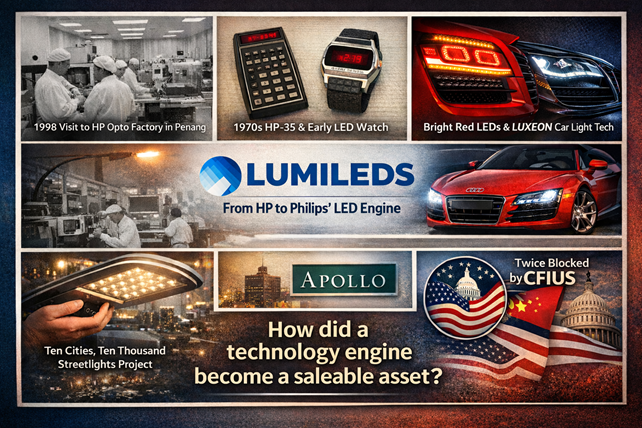
In 1998, I visited the HP Opto factory in Penang.
Even now, I still remember the feeling.
That was not the LED industry people know today — an industry reshaped by price competition, manufacturing scale, and supply-chain efficiency. Back then, LED still carried a very strong semiconductor-industrial character: clean, restrained, precise. Behind it stood real hard power — materials, process engineering, packaging, reliability — and also the quiet confidence of a technology era that still believed deep engineering could shape the future.
Later, when I was responsible for procurement at Everlight, Lumileds was one of our most important suppliers in Taiwan. Later still, in China’s “Ten Cities, Ten Thousand Street Lamps” (十城萬盞)street-lighting programs, I again encountered Lumileds products in real projects and real deployment decisions.
So in a sense, I did not come to know Lumileds only through headlines or corporate history. I encountered it repeatedly, in different historical positions, at different stages of the industry.
That is why, when I look back at Lumileds today, I find it difficult to see it as merely the story of one company’s ups and downs.
To me, it is more like a coordinate point in the industry’s collective memory.
If you follow its journey carefully, you can almost retrace the most important shifts in the LED business over the past three decades: from American optoelectronics labs to European strategic integration, from the golden age of high-brightness LEDs, power packaging, and automotive applications to the rise of Asian manufacturing, and then on to capital restructuring, private equity ownership, and the new reality of geopolitics and national security review.
Some companies grow inside an era. Lumileds, in my view, is one of the rare companies that lived through the turning of an entire era.
And what it leaves behind is not just a technical legacy. It leaves a question that every technology-driven company must eventually face:
How does a technology engine become a saleable asset?
1. Lumileds did not begin as a lighting company. It began in semiconductor optoelectronics.
Many younger people in the industry instinctively think of Lumileds as simply a Philips LED company. That is not wrong. But it is not enough.
The roots of Lumileds are not really in traditional lighting. They are in HP’s optoelectronics and semiconductor heritage.
This matters. Because it means Lumileds did not grow out of the conventional logic of lamps, fixtures, channels, and lighting engineering. It grew out of a different logic altogether: materials, epitaxy, chips, packaging, reliability, and productization.
Many lighting companies first understood “light” and then learned “LED.” The HP–Agilent–Lumileds line followed the reverse path: it first understood semiconductor light, and only then expanded into lighting, automotive, and broader real-world applications.
That difference in origin shaped everything. It shaped the kind of problems the company solved. It shaped the kind of talent it built. And it shaped the role it played in the early LED industry.
Lumileds was never just another supplier. At its core, it was a platform company born from deep technology. And that is exactly why its later fate became so symbolic.
2. HP Opto was not just a predecessor. It was one of the early talent nurseries of the LED industry.
If we describe HP Opto merely as the predecessor of Lumileds, we still underestimate its historical importance. To me, HP Opto was more like a practical academy for the early LED industry.
It trained not only engineers, but an entire generation of people who understood how to move from material science to manufacturing, from chip to package, from reliability to product, and from product to large-scale market adoption.
That kind of capability was rare. LED was never the kind of technology that could succeed simply because a laboratory proved it could work. It had to cross many thresholds: scientific feasibility, manufacturability, reliability, consistency, customer trust, application fit, and economic viability.
What made the HP Opto lineage special was not only that it produced technology. It produced people who knew how to industrialize technology.
Over time, talent from that lineage did not remain within one company. It spread outward — into Lumileds, Cree, Bridgelux, and many other LED and lighting businesses across Europe, the United States, and China.
That is why I do not see HP Opto merely as a historical ancestor. I see it as one of the early talent and management mother-bodies of the LED era.
If Lumileds later became an important technology engine for Philips’ transformation, then HP Opto was, in many ways, one of the industry’s earliest academies of execution.
It did not only produce products. It produced methods, discipline, industrial DNA, and a generation of professionals who would shape the next chapters of the LED business.
3. Lumileds did not merely lead. It helped define an era.
Younger professionals entering the industry today may find it difficult to imagine how strong Lumileds once was. It was not just another company making LEDs. For a significant period of time, it was one of the companies defining the path of the industry itself.
Its technologies influenced several key turning points: High-brightness red and amber LEDs helped LEDs take over applications such as mice, signal indication, automotive tail lamps, and brake lights. Power white LEDs and packaging breakthroughs helped LEDs move beyond indication and earn the right to be taken seriously for illumination. Automotive-grade reliability and integration helped turn LEDs from mere electronic components into part of automotive brand language and design identity.
If you lived through those years, you know these were not just product launches. They were moments when a handful of companies, through deep technical investment and long-term execution, carved out entirely new application paths.
Today, it seems obvious that LEDs belong in automotive lighting, in general illumination, in street lighting, in architectural lighting. But none of that was inevitable. Those roads were built. And Lumileds was one of the companies helping to build them.
4. Why was Philips able to turn so successfully toward LED? Lumileds was one of the crucial foundations.
When people think about Philips’ transition from a traditional lighting giant into the LED era, they often think first of brand strength, global channels, systems capability, and market reach.
All of that matters. But the story is incomplete without Lumileds. What Philips understood, earlier and more clearly than many others, was that if the future of lighting belonged to semiconductor light sources, then controlling fixtures, channels, and branding would not be enough. It also needed access to the underlying source technology platform.
This is what made Lumileds strategically important. Lumileds was not just a component supplier sitting somewhere inside the broader Philips structure. It was one of the technical foundations that allowed Philips Lighting to move from legacy light sources into the LED age with real credibility and momentum.
In other words, Philips’ LED transition was not only a commercial repositioning. It was also a reassembly of technical capability. And Lumileds was one of the key pieces in that reassembly.
5. The real turning point was not technical decline. It was a change in role.
A company’s fate is often determined not by how important it once was, but by whether it is still seen as part of the future. That, in my view, was the decisive turning point for Lumileds.
The problem was not that it forgot how to innovate. The problem was that its role changed.
When it was seen as a strategic engine, it carried strategic premium. When it became a separable asset, it began to be judged through a different lens: valuation, transaction structure, buyer suitability, and exit logic.
This is where many technology companies begin to lose control of their destiny. Not because the technology suddenly becomes weak. But because the company ceases to be treated as a strategic capability and starts being treated as a financial object.
From strategic asset to financial asset. From engine of transformation to asset available for disposal. That shift is subtle at first. But once it happens, it changes everything.

6. Why was Lumileds sold and resold? Because the center of value in the LED industry moved.
If we reduce the Lumileds story to “a great company with bad luck,” we miss the deeper point. Its fate changed because the center of value in the LED industry changed.
In the early phase of LED, value was concentrated in materials, epitaxy, chips, packaging, and reliability. Whoever mastered those layers had technical authority. Whoever had technical authority could occupy a commanding position in the value chain.
But as the industry matured, value began to migrate. It shifted from core technical breakthroughs to manufacturing scale. From manufacturing scale to cost structure and supply-chain efficiency. And then further still, toward modules, systems, controls, branding, scenarios, and integrated hardware-software ecosystems.
That shift is profound. It means that a company that was extraordinarily powerful in the “component age” may not remain equally central in the “systems age” or the “platform age.”
Lumileds did not stop innovating. That is not the point. The point is simpler, and harsher: Innovation can continue, while industry control quietly moves elsewhere.
This is one of the hardest truths for old technology leaders to accept. Sometimes you do not become weak. Sometimes the center of gravity simply moves.
7. From private equity to geopolitics: why Lumileds was blocked twice
One of the most revealing aspects of the Lumileds story is that attempts to sell it to buyers tied to Chinese capital were blocked twice by U.S. national security review. At that point, Lumileds was no longer just an LED company. It had become a sensitive optoelectronic asset.
Once a company touches U.S. technology, U.S. operations, U.S. customers, or strategically relevant semiconductor capabilities, the question is no longer just: who wants to buy it, and at what price?
The question becomes: how will it be interpreted inside a broader framework of national security, technology competition, and supply-chain control?
That is why Lumileds is so important as a case study. Its story cannot be understood only at the level of corporate management. It belongs to a larger narrative: from technology competition, to technology plus capital restructuring, to technology plus capital plus geopolitics.
And that same logic is now visible far beyond lighting.
8. Why does this company feel personal to me? Because I saw it in different positions across different eras.
When I write about Lumileds today, it is difficult for me to write as a detached observer. Because I saw it in different forms, at different moments.
I saw the Penang HP Opto factory in 1998, when LED still carried that distinctive semiconductor-industrial seriousness. I saw Lumileds again as a major supplier when I was in procurement at Everlight. And I saw it again in the phase when LED began moving rapidly into larger-scale urban lighting and infrastructure programs.
So for me, Lumileds is not just a company name in an article. I have seen it as a technology source. I have seen it as a supplier of consequence. I have seen it participate in the transition from high-end technical capability to large-scale real-world adoption.
That is why its story carries weight. It was not a latecomer riding a trend. It was there across nearly every important phase of the LED era: early technical formation, high-brightness breakthroughs, automotive penetration, general-lighting expansion, and finally mass-market commoditization.
A company like that ending up repeatedly traded, repeatedly reviewed, and never quite settled in ownership — that is bound to provoke reflection.
9. What should the industry learn from Lumileds?
If we revisit Lumileds today, the real takeaway is not merely that its story is unfortunate. It is that it offers several warnings to every technology-driven business.
First, core technology must continue to advance — but it must also continue to enter the market effectively. Technical leadership that does not translate into next-generation market relevance will eventually thin out.
Second, component leaders that fail to move upward toward systems, platforms, scenarios, standards, or ecosystem control are likely to be revalued as mature manufacturing assets.
Third, when a parent company begins to see a technical engine as a disposable asset, the short-term financial logic may be sound, but the long-term strategic cost may be much higher than it first appears.
Fourth, private equity can repair balance sheets, restructure portfolios, and improve financial flexibility — but that is not the same as restoring a company’s historical place in the industry.
Fifth, critical semiconductor and optoelectronic assets can no longer be understood through commercial logic alone. They are increasingly shaped by three forces at once: technology logic, capital logic, and national-security logic.
Ignore any one of them, and you may fundamentally misread where you stand.
Conclusion
What makes the Lumileds story so striking is this: It was not a company without technology. It was not a company without history. It was not a company without contribution.
Quite the opposite. It carried some of the strongest optoelectronic DNA of the HP era. It helped support Philips’ LED transformation. It helped define the eras of red LEDs, high-brightness performance, power packaging, and automotive LED adoption. And it also served as a talent and management mother-body whose influence spread far beyond one corporate boundary.
And yet, precisely because of all that, it eventually became a key asset that was repeatedly sold, repeatedly re-evaluated, and repeatedly difficult to place. So the real question Lumileds leaves behind is not: Why was its journey so turbulent?
The real question is: When a company becomes great because of core technology, can it continue upgrading that technology, continue shaping the market with it, and keep that capability in the hands of a strategic owner who truly understands its long-term value?
If not, then today’s technology engine may become tomorrow’s asset for sale.

 English
  Chinese (Taiwan)
  Chinese (China)
  German